
We read your photo as:
Discuss Mr. Tembo's potential losses and the five stages of grieving.
ScanSolve AI Answer
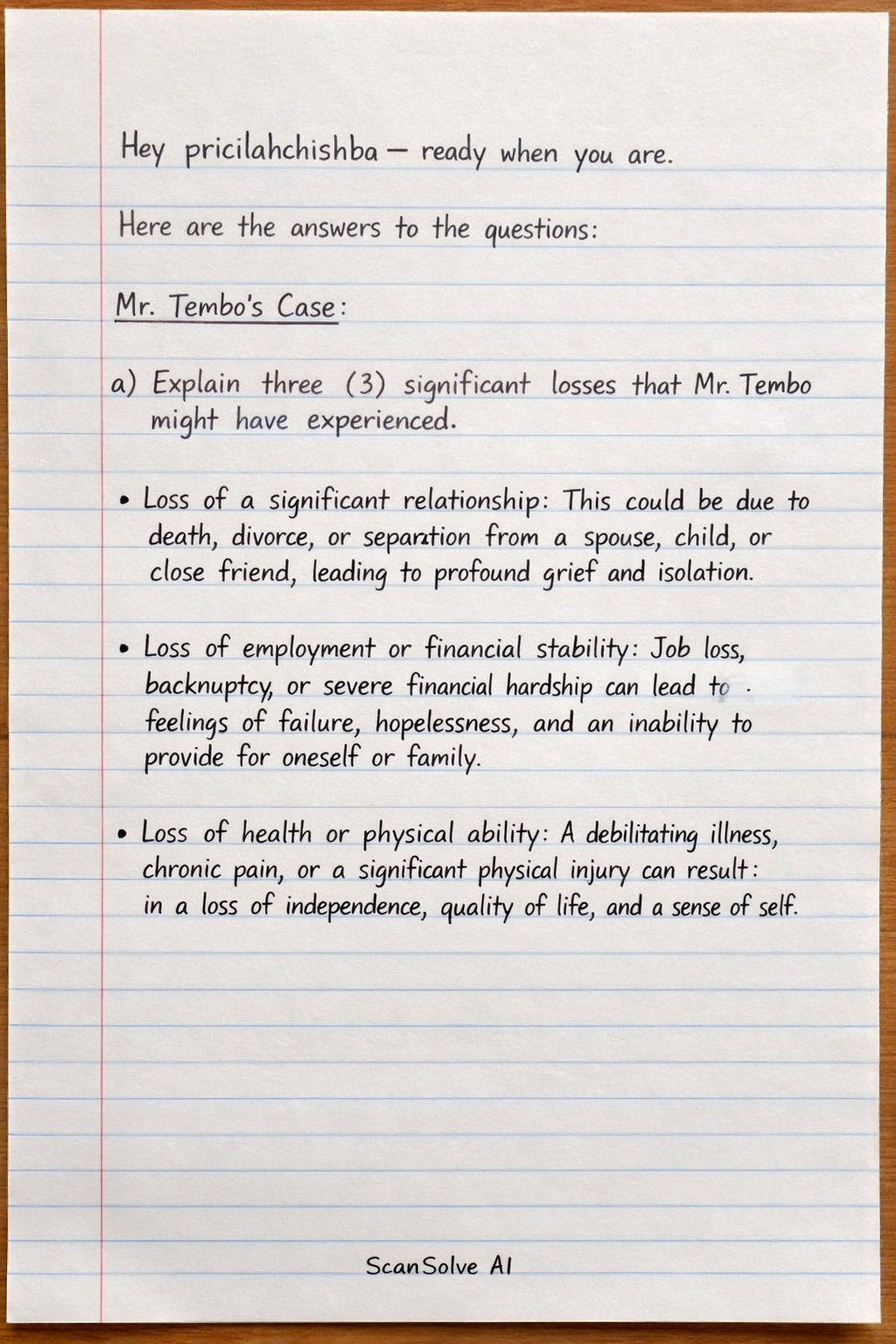
Here are the answers to the questions:
Mr. Tembo's Case:
a) Explain three (3) significant losses that Mr. Tembo might have experienced.
Mr. Tembo might have experienced significant losses that contributed to his suicidal attempts. Three such losses could be:
- Loss of a significant relationship: This could be due to death, divorce, or separation from a spouse, child, or close friend, leading to profound grief and isolation.
- Loss of employment or financial stability: Job loss, bankruptcy, or severe financial hardship can lead to feelings of failure, hopelessness, and an inability to provide for oneself or family.
- Loss of health or physical ability: A debilitating illness, chronic pain, or a significant physical injury can result in a loss of independence, quality of life, and a sense of self.
b) Outline five (5) stages of grieving.
The five stages of grieving, as described by Elisabeth Kübler-Ross, are:
- Denial: A temporary shock reaction where the individual refuses to believe the loss has occurred, often as a defense mechanism.
- Anger: Feelings of frustration, rage, and resentment directed at oneself, others, or even the deceased/situation, as the reality of the loss sets in.
- Bargaining: Attempts to negotiate or make deals, often with a higher power, to reverse or postpone the loss, typically accompanied by guilt.
- Depression: A period of intense sadness, despair, and withdrawal, where the individual fully comprehends the magnitude of the loss.
- Acceptance: Coming to terms with the reality of the loss, finding a way to move forward, and integrating the loss into one's life, not necessarily meaning happiness but a sense of peace.
c) Explain four (4) types of suicide.
Émile Durkheim identified four types of suicide based on the individual's integration into society and moral regulation:
- Egoistic suicide: Occurs when an individual feels isolated and detached from society, experiencing low social integration. They feel their life lacks meaning or purpose within the community.
- Altruistic suicide: Happens when an individual is excessively integrated into society, sacrificing their life for the group's benefit or honor, often seen in military contexts or cults.
- Anomic suicide: Results from a lack of social regulation, often during periods of rapid social change, economic crisis, or personal upheaval, leading to a sense of normlessness and despair.
- Fatalistic suicide: Arises from excessive regulation and oppression, where an individual feels their life is overly controlled, with no hope for change or freedom, such as in oppressive societies or prisons.
d) Discuss the management of Mr. Tembo.
The management of Mr. Tembo, given his history of suicidal attempts, would involve a multi-faceted approach focused on safety, treatment, and long-term support:
- Immediate safety and stabilization: Ensure a safe environment, remove any means of self-harm, and provide constant observation. This may involve hospitalization in a psychiatric unit.
- Comprehensive psychiatric assessment: Evaluate his mental state, assess suicide risk, identify any underlying mental health disorders (e.g., depression, bipolar disorder, substance abuse), and explore contributing factors.
- Pharmacological treatment: Administer appropriate medications, such as antidepressants, mood stabilizers, or anxiolytics, to manage symptoms of underlying conditions.
- Psychotherapy: Engage Mr. Tembo in therapies like Cognitive Behavioral Therapy (CBT) or Dialectical Behavior Therapy (DBT) to help him develop coping skills, challenge negative thoughts, and manage emotional distress.
- Social and family support: Involve family members in his care, educate them on warning signs, and facilitate family therapy to improve communication and support systems. Connect him with community support groups.
- Discharge planning and follow-up: Develop a safety plan, arrange for outpatient therapy and medication management, and ensure regular follow-up appointments to monitor his progress and prevent relapse.
Mr. Stephen Njovu's Case:
a) Define alcohol abuse.
Alcohol abuse is a pattern of drinking that leads to significant impairment or distress, characterized by recurrent alcohol use resulting in a failure to fulfill major role obligations, use in physically hazardous situations, recurrent alcohol-related legal problems, or continued use despite persistent social or interpersonal problems caused or exacerbated by alcohol. It differs from dependence in that it does not necessarily involve tolerance or withdrawal symptoms.
The definition of alcohol abuse is:
b) Explain five (5) social effects of alcohol abuse.
Alcohol abuse can have profound social effects, impacting an individual's relationships and societal functioning:
- Family and marital problems: Increased conflict, domestic violence, neglect of children, and eventual separation or divorce due to alcohol-related behaviors and financial strain.
- Occupational difficulties: Absenteeism (as mentioned in the case), decreased productivity, poor job performance, and ultimately job loss, leading to unemployment and financial instability.
- Legal problems: Arrests for driving under the influence (DUI), public intoxication, assault, or other alcohol-related offenses, resulting in fines, imprisonment, and a criminal record.
- Social isolation: Withdrawal from friends and social activities, loss of healthy relationships, and engagement in risky behaviors, leading to loneliness and a diminished social support network.
- Financial strain: Excessive spending on alcohol, inability to maintain employment, and legal fees can lead to severe debt, poverty, and an inability to meet basic needs.
c) Discuss five (5) ways of how alcohol abuse can be prevented.
Prevention of alcohol abuse involves strategies at individual, community, and policy levels:
- Public health education campaigns: Raising awareness about the risks and consequences of excessive alcohol consumption through media campaigns, school programs, and community outreach.
- Regulation of alcohol availability: Implementing policies such as minimum legal drinking age laws, restricting sales hours, limiting the number of alcohol outlets, and increasing alcohol taxes to reduce consumption.
- Early intervention programs: Identifying individuals at risk for alcohol abuse (e.g., adolescents, those with a family history) and providing counseling, support, and alternative activities before abuse escalates.
- Promoting healthy coping mechanisms: Educating individuals on stress management techniques, problem-solving skills, and alternative ways to relax and socialize that do not involve alcohol.
- Support for families and communities: Providing resources for families affected by alcohol abuse, fostering strong community bonds, and creating environments that discourage heavy drinking and promote responsible choices.
d) Describe in detail the management of Mr. Njovu.
The management of Mr. Njovu, diagnosed with alcohol abuse and experiencing tremors, requires a structured approach:
- Detoxification: This is the first critical step, especially given his tremors (a sign of withdrawal). It involves medically supervised withdrawal in a hospital setting to manage acute withdrawal symptoms safely. Benzodiazepines (e.g., lorazepam, diazepam) are typically administered to prevent seizures and delirium tremens. Thiamine supplementation is crucial to prevent Wernicke-Korsakoff syndrome.
- Pharmacological treatment: After detoxification, medications can be used to reduce cravings and prevent relapse. Examples include Naltrexone (reduces cravings and pleasure from alcohol), Acamprosate (reduces withdrawal symptoms and cravings), and Disulfiram (causes unpleasant reactions when alcohol is consumed).
- Psychotherapy and counseling: Individual therapy, such as Cognitive Behavioral Therapy (CBT), helps Mr. Njovu identify triggers, develop coping strategies, and address underlying psychological issues. Motivational Interviewing can enhance his commitment to change. Group therapy, like Alcoholics Anonymous (AA), provides peer support and a structured recovery program.
- Family involvement: Given his wife's concerns, family therapy is essential to address the impact of his alcohol abuse on the family, improve communication, and build a supportive home environment. The family can learn about enabling behaviors and how to support his recovery effectively.
- Addressing co-occurring disorders: Screen for and treat any co-existing mental health conditions (e.g., depression, anxiety) that may contribute to or be exacerbated by alcohol abuse. Integrated treatment for both conditions is most effective.
- Relapse prevention planning: Develop a comprehensive plan that includes identifying high-risk situations, developing alternative coping mechanisms, establishing a strong support network, and regular follow-up appointments with healthcare providers and support groups.
Still stuck on this one?
Ask a follow-up, and the answer starts from this question.
More Psychology Questions
Handwritten Step-by-Step Solution
Get this as a handwritten image on WhatsApp — like a tutor wrote it for you.
Try on WhatsApp