

This psychology problem is solved step by step below, with detailed explanations to help you understand the method and arrive at the correct answer.
ScanSolve AI Answer
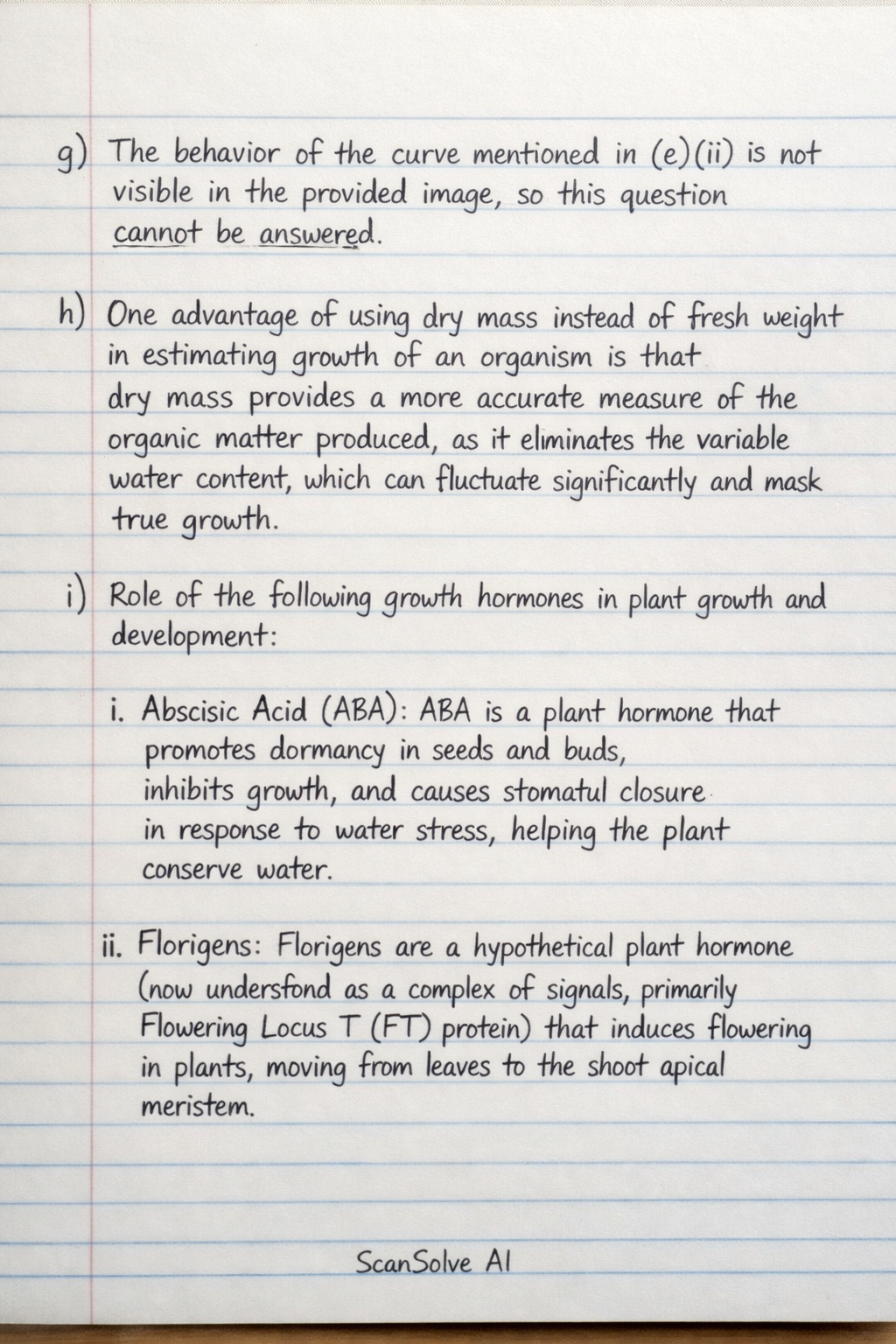
g) The behavior of the curve mentioned in (e) (ii) is not visible in the provided image, so this question cannot be answered. h) One advantage of using dry mass instead of fresh weight in estimating growth of an organism is that dry mass provides a more accurate measure of the organic matter produced, as it eliminates the variable water content, which can fluctuate significantly and mask true growth. i) Role of the following growth hormones in plant growth and development: i. Abscisic Acid (ABA): ABA is a plant hormone that promotes dormancy in seeds and buds, inhibits growth, and causes stomatal closure in response to water stress, helping the plant conserve water. ii. Florigens: Florigens are a hypothetical plant hormone (now understood as a complex of signals, primarily Flowering Locus T (FT) protein) that induces flowering in plants, moving from leaves to the shoot apical meristem. 7. a) Explain the role of the liver and pancreas in blood sugar regulation: • The pancreas contains islets of Langerhans, which produce hormones. Beta cells secrete insulin when blood glucose is high, promoting glucose uptake by cells and its conversion to glycogen in the liver and muscles, thus lowering blood sugar. Alpha cells secrete glucagon when blood glucose is low, stimulating the liver to break down stored glycogen into glucose (glycogenolysis) and synthesize new glucose (gluconeogenesis), thereby raising blood sugar. • The liver is a primary target organ for insulin and glucagon. It stores excess glucose as glycogen (glycogenesis) under the influence of insulin. When blood glucose levels drop, the liver breaks down stored glycogen (glycogenolysis) and produces glucose from non-carbohydrate sources (gluconeogenesis) under the influence of glucagon, releasing glucose into the bloodstream to maintain homeostasis. b) Describe the adaptations of halophytes to their habitats: Halophytes are plants adapted to grow in high-salt environments. Their adaptations include: • Salt exclusion: Some halophytes prevent salt from entering their roots or actively pump it out of root cells. • Salt excretion: Many possess salt glands on their leaves to excrete excess salt, which can then be washed away by rain or wind. • Salt accumulation/sequestration: They can accumulate salt in specific vacuoles within their cells or in older leaves, which are then shed to remove the excess salt from the plant. • Succulence: Some halophytes develop fleshy, succulent leaves or stems to dilute the internal salt concentration. • Osmotic adjustment: They produce compatible solutes (osmolytes) like proline or glycine betaine to maintain a lower water potential inside their cells than the surrounding soil, allowing water uptake while protecting cellular machinery from high salt levels. Send me the next one 📸