
We read your photo as:
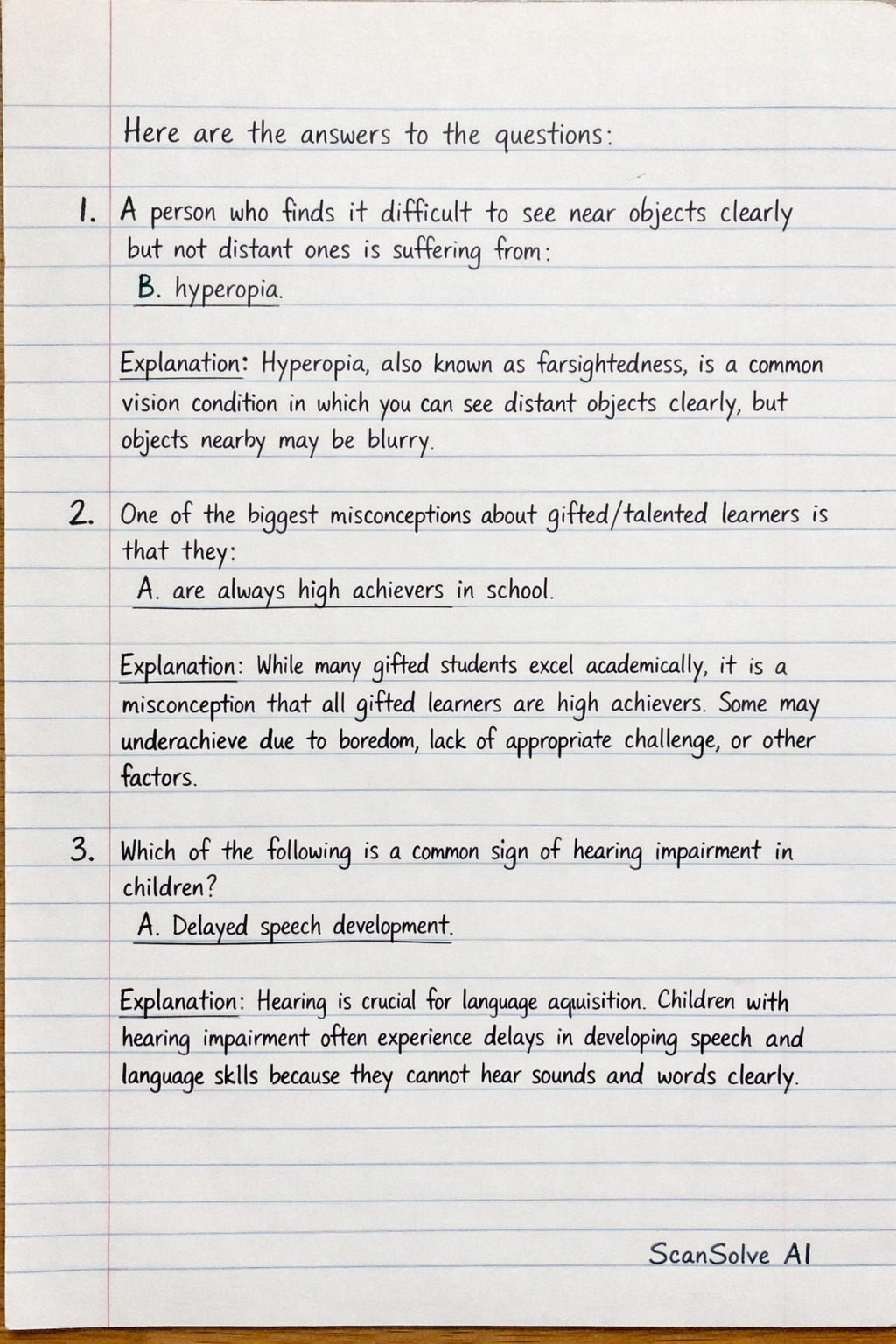
Here are the answers to the questions: A person who finds it difficult to see near objects clearly but not distant ones is suffering from: B. hyperopia Explanation: Hyperopia, also known as farsighted
ScanSolve AI Answer
Here are the answers to the questions:
-
A person who finds it difficult to see near objects clearly but not distant ones is suffering from:
- B. hyperopia
- Explanation: Hyperopia, also known as farsightedness, is a common vision condition in which you can see distant objects clearly, but objects nearby may be blurry.
-
One of the biggest misconceptions about gifted/talented learners is that they:
- A. are always high achievers in school
- Explanation: While many gifted students excel academically, it is a misconception that all gifted learners are high achievers. Some may underachieve due to boredom, lack of appropriate challenge, or other factors.
-
Which of the following is a common sign of hearing impairment in children?
- A. Delayed speech development
- Explanation: Hearing is crucial for language acquisition. Children with hearing impairment often experience delays in developing speech and language skills because they cannot hear sounds and words clearly.
-
What does an Individualized Education Programme (IEP) provide for students with disabilities?
- C. Personalized educational plans
- Explanation: An Individualized Education Program (IEP) is a written document that outlines the special education and related services a student with a disability will receive. It is tailored to meet the unique needs of each student.
-
Which of the following devices is commonly used to assess visual acuity?
- C. Snellen chart
- Explanation: The Snellen chart is the most common tool used by eye care professionals to measure visual acuity, which is the sharpness of vision.
-
The primary difference between a learning disability (LD) and an intellectual disability (ID) is that...
- Option A is incorrect.
- Explanation: The statement "LD affects overall intelligence while ID affects only specific academic skills" is the opposite of the truth.
- Learning Disabilities (LD) affect specific academic skills (e.g., reading, writing, math) in individuals who generally have average or above-average overall intelligence.
- Intellectual Disabilities (ID) involve significant limitations in both intellectual functioning (overall intelligence) and adaptive behavior.
Still stuck on this one?
Ask a follow-up, and the answer starts from this question.
More Psychology Questions
Handwritten Step-by-Step Solution
Get this as a handwritten image on WhatsApp — like a tutor wrote it for you.
Try on WhatsApp