
In severe hyperthyroidism, the increased utilization of oxygen is due to ………….. a. Rapid rate of absorption b. Rapid rate of metabolism c. Decrease rate of utilization of carbon dioxide d. Severe break down of blood cells. . 2. In a client with a diabetic coma, the nurse must observe patient for………………… a. The presence of sugar content in the urine b. abnormal increase in blood glucose c. Polydypsia d. Polyphagia 3. In teaching a patient and family to administer insulin at home, the nurse ….. a. Demonstrate the action of insulin to only the patient b. Demonstrate how to take other prescribed drugs c. Demonstrate the ability to prepare a syringe with insulin solution d. Demonstrate the action of oral drugs . 4. To control diabetes mellitus, the nurse should advice the patient to take the following foods in moderation except a. cabbage bread fruit milk 5. In providing nursing care for a client diagnosed of diabetes mellitus, the patient said he enjoys eating pastries. The nurse’s response should be …. a. “take pastries in moderation” “you should eat pastries freely” “you must avoid eating pastries” “consult your counselor before your take pastries” ……. 6. In diabetes mellitus, the priority of the nurse is to correct ………………….. a. fluid balance b. knowledge deficit c. altered nutrition d. ineffective family coping 7. In acute phase of Diabetic Ketoacidosis the priority nursing action is to …………….. a. administer intravenous Regular insulin b. administer intravenous 5% Dextrose c. correct alkalosis d. apply an ECG monitor 8. A client diagnosed with NIDDM has blood glucose of 600mg/dl, the client was experiencing polyuria, polydipsia, weight loss and weakness. The nurse expects which of the following diagnoses? a. diabetic ketoacidosis b. hypoglycaemia c. hyperglycaemia hyperosmolar nonketotic syndrome d. pheochromocytoma 9. A nurse has collected data on a client with diabetes mellitus. The FBS IS 130 mg?dl, temperature 38ºC, respiration is 22 breathes per minute, and blood pressure 140/80mmHg. Which of the Following is the most concern to the nurse? a. pulse rate b. blood pressure c. blood glucose d. temperature 10. The Non-Insulin Dependent Diabetes Mellitus affects about................. of all cases. a. 50-60% b. 70-80% c. 80-85% d. 90-95%. 11. The thyroid gland produces the following hormones except: a. calcitonin b. cortisol c. thyroxine d. triiodothyronine. 12. The immediate diagnostic test a nurse can conduct on a patient suffering from diabetes later in a day is.................................. a. urea and creatinine b. fasting blood sugar c. blood nitrogen level. d. random blood sugar. 13. The common causes of hypoglycemia in diabetes mellitus are present if the patient.............. a. takes in more food than necessary b. does not tolerate the prescribed drugs c. takes overdose of antidiabetic drugs d. takes more fruit drinks. 14. In caring for a diabetic patient, the nurse must change the infusion of normal saline to dextrose when the blood glucose level is........................... a. 13mmol/L or less b. 13mmol/L or more c. 15mmol/L or more d. 15mmol/L or less 15. The type II diabetes mellitus commonly affects........................................... a. newly born children b. persons less than 30 years c. persons over 30 years d. person with hypertension and kidney failure. 16. Rapid-acting insulin drugs often works within.......................... a. 20 hours b. 15 hours c. 3 hours d. 1 hour 17. Management of diabetes mellitus is directed toward....................................... a. reducing metabolic activities b. establishing and maintaining metabolic control c. treatment of complications to avoid death d. increasing the body’s insulin resistance 18. Which of the following findings by the nurse would indicate that the client is having an insulin reaction? a. air hunger and acetone breathe b. vomiting and flushed skin c. nausea and headache d. confusion and diaphoresis 19. The cardinal signs and symptoms of diabetic ketoacidosis include the following except................... a. air hunger and acetone breathe b. vomiting and flushed skin c. nausea and headache d. confusion alone 20. Diabetic ketoacidosis is common in............................................................................... a. Type I b. Type II c. both Type I and II d. none of them The components of management of diabetes mellitus include Diet Exercise Fasting Medication I, II and III I, II and IV II, III and IV I, II, III and IV Symptoms that occur prior to diabetic coma include the following EXCEPT Dry skin Hunger Rapid pulse Thirst 23 .A typical sign that a patient with diabetic ketoacidosis is likely to exhibit on admission is A slow pulse rate Deep rapid respiration Dilated pupils Excessive perspiration Which of the following substances account for the sweet, fruity odour that a nurse notes in the breath of a patient with hyperglycaemic coma Amino acid Glycogen Ketone bodies Urea The nurse encourages strict diabetic control in the patient prone to diabetic nephropathy knowing that the renal tissue changes that may occur in this condition include Uric acid calculi and nephrolithiasis Renal sugar – crystal calculi and cyst Lipid deposits in the glomeruli and nephrons Thickening of the glomerular basement membrane and glomerulosclerosis Diabetic coma results from an excess accumulation in the blood of Glucose from rapid CHO metabolism causing drowsiness Ketones from rapid fat breakdown, causing acidosis Nitrogen from protein catabolism causing ammonia intoxication Sodium bicarbonate causing alkalosis A patient with diabetes mellitus says “I cannot eat big meals. I prefer eating snacks throughout the day”. The nurse should explain that Large meals can bring about weight problems Regulated food intake is basic to diabetic control Salt and sugar restriction is the main concern Small frequent meals are better for easy digestion When assessing a patient with hyperthyroidism, the nurse should expect the patient to exhibit Increased appetite, slow pulse and dry skin Loss of weight, constipation and restlessness Nervousness, weight loss and increased appetite Protruding eyeballs, slow pulse and sluggishness Diabetic coma results from an excess accumulation in the blood of Glucose from rapid carbohydrate metabolism Ketones from rapid fat metabolism causing acidosis Nitrogen from protein catabolism causing ammonia intoxication Sodium bicarbonate causing alkalosis The most common cause of diabetic ketoacidosis is Emotional stress Inadequate food intake Increased insulin dose Presence of infection A diabetic patient on admission has developed insulin coma. The signs that the nurse is expected to observe include Anorexia, glycosuria Excessive thirst, dry hot skin Fruity odour of breath, acetonuria Pallor, sweating, tremors Symptoms of hyperthyroidism include Increased appetite, slow pulse, dry skin Loss of weight, constipation, restlessness Nervousness, weight loss, increased appetite Protruding eyeballs, slow pulse, sluggishness Complications of hyperparathyroidism include Bone destruction Graves’ disease Seizures Tetany During the first 24 hours of starvation, the order in which the body obtains substrate for energy is Glycogen, skeletal protein Visceral protein, fat stores, glycogen Fat stores, skeletal protein, visceral protein Liver protein, muscle protein, visceral protein Complications of diabetes mellitus include Decreased resistance to infections Delayed wound healing Peripheral numbness and pain Sodium retention I and II I, II and III II, III and IV I, II, III and IV A severe form of hyperthyroidism which is usually abrupt in onset and often fatal is known as Exophthalmus Throiditis Thyrotoxicosis Thyroid storm Acromegaly is produced by oversecretion of Testosterone Growth hormone Thyroid hormone Adrenocorticotropin The nurse understands that the cause of Cushing’s Syndrome is most commonly Pituitary hypoplasia Insufficient ACTH production Hyperplasia of the adrenal cortex Deprivation of adrenocortical hormone Glucocorticoids and Mineralocorticoids are secreted by the Gonads Pancreas Adrenal gland Anterior pituitary gland In Cushing’s syndrome, excessive amounts of glucocorticoids and mineralocorticoids will increase the client’s Urine output Glucose levels Serum potassium Immune response Thyroid crisis (storm) is caused by Increased iodine in the blood Removal of the parathyroid gland High levels of the hormone triiodothyronine A rebound increase in metabolism following anaesthesia Aldosterone reabsorption of sodium occurs after stimulation with A C T H Insulin A D H Pitocin Hyperthyroidism is characterised by Increased bone resorption Elevated serum phosphate Increased neuromuscular activity A and C Adrenal insufficiency is the same as Myxoedema Cushing’s syndrome Phaechromocytoma Addison’s disease Simple goitre can be prevented through dietary intake of Fresh water fish Cabbage Iodised salt Antithyroid agents In planning a diet for a patient with diabetes mellitus, the percentage of fat required is 12 – 20% Less than 30% 50 – 60% More than 60% The following are all complications of diabetes mellitus except Retinopathy Nephropathy Diabetic ketoacidosis Myxoedema coma In diabetes insipidus, polyuria is as a result of Deficiency in vasopressin secretion Excessive antidiuretic hormone Excessive fluid intake Increased appetite The nurse assists the patient with dietary management of diabetes mellitus with the knowledge that diabetic diet is designed To be used only for type 1 diabetes For use
ScanSolve AI Answer
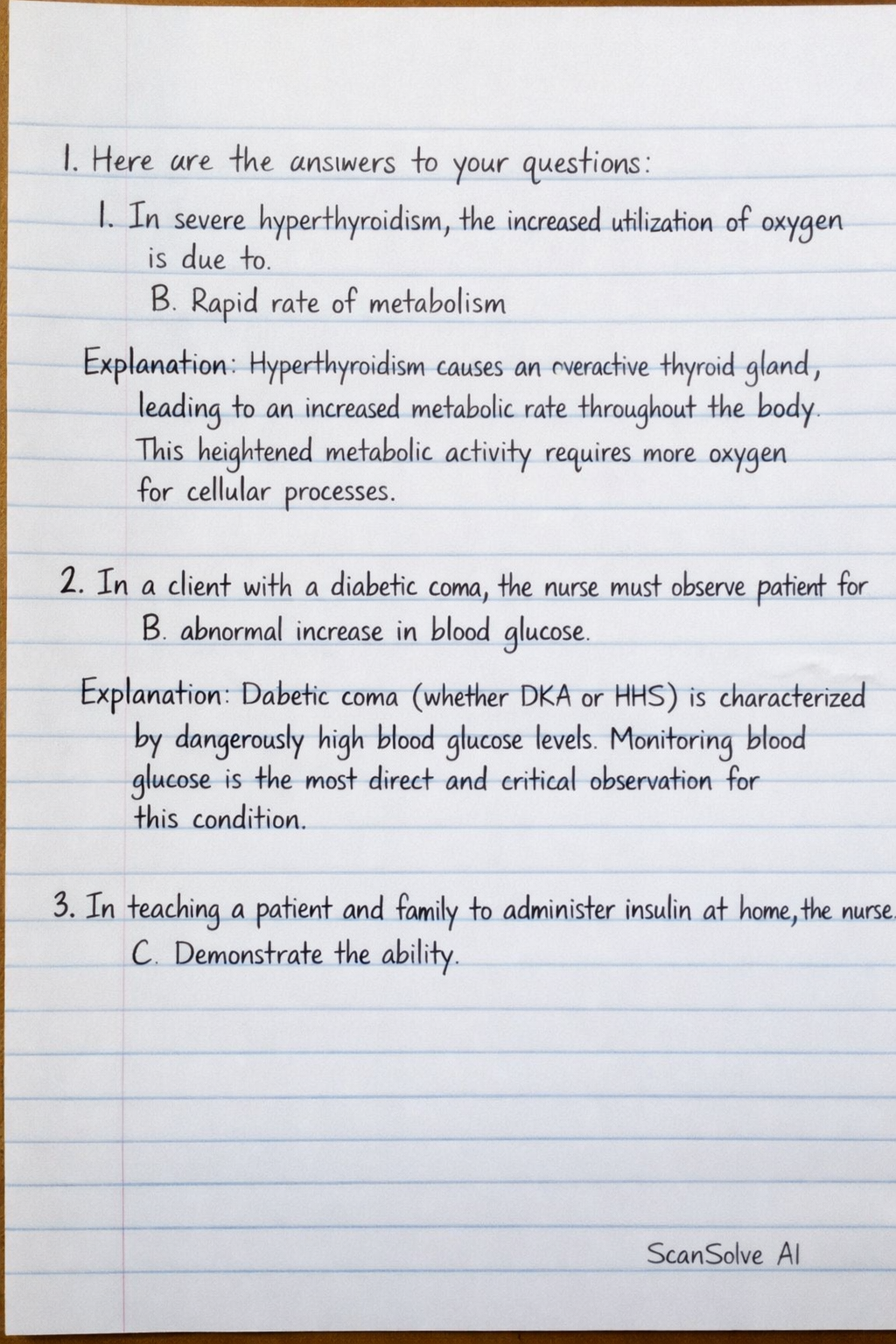
Here are the answers to your questions:
1. In severe hyperthyroidism, the increased utilization of oxygen is due to …………..
B. Rapid rate of metabolism
Explanation: Hyperthyroidism causes an overactive thyroid gland, leading to an increased metabolic rate throughout the body. This heightened metabolic activity requires more oxygen for cellular processes.
2. In a client with a diabetic coma, the nurse must observe patient for…………………
B. abnormal increase in blood glucose
Explanation: Diabetic coma (whether DKA or HHS) is characterized by dangerously high blood glucose levels. Monitoring blood glucose is the most direct and critical observation for this condition.
3. In teaching a patient and family to administer insulin at home, the nurse …..
*C. Demonstrate the ability
Still stuck on this one?
Ask a follow-up, and the answer starts from this question.
More Psychology Questions
Handwritten Step-by-Step Solution
Get this as a handwritten image on WhatsApp — like a tutor wrote it for you.
Try on WhatsApp