
We read your photo as:
Indicate whether each of the statements about disabilities and special education is TRUE or FALSE.
ScanSolve AI Answer
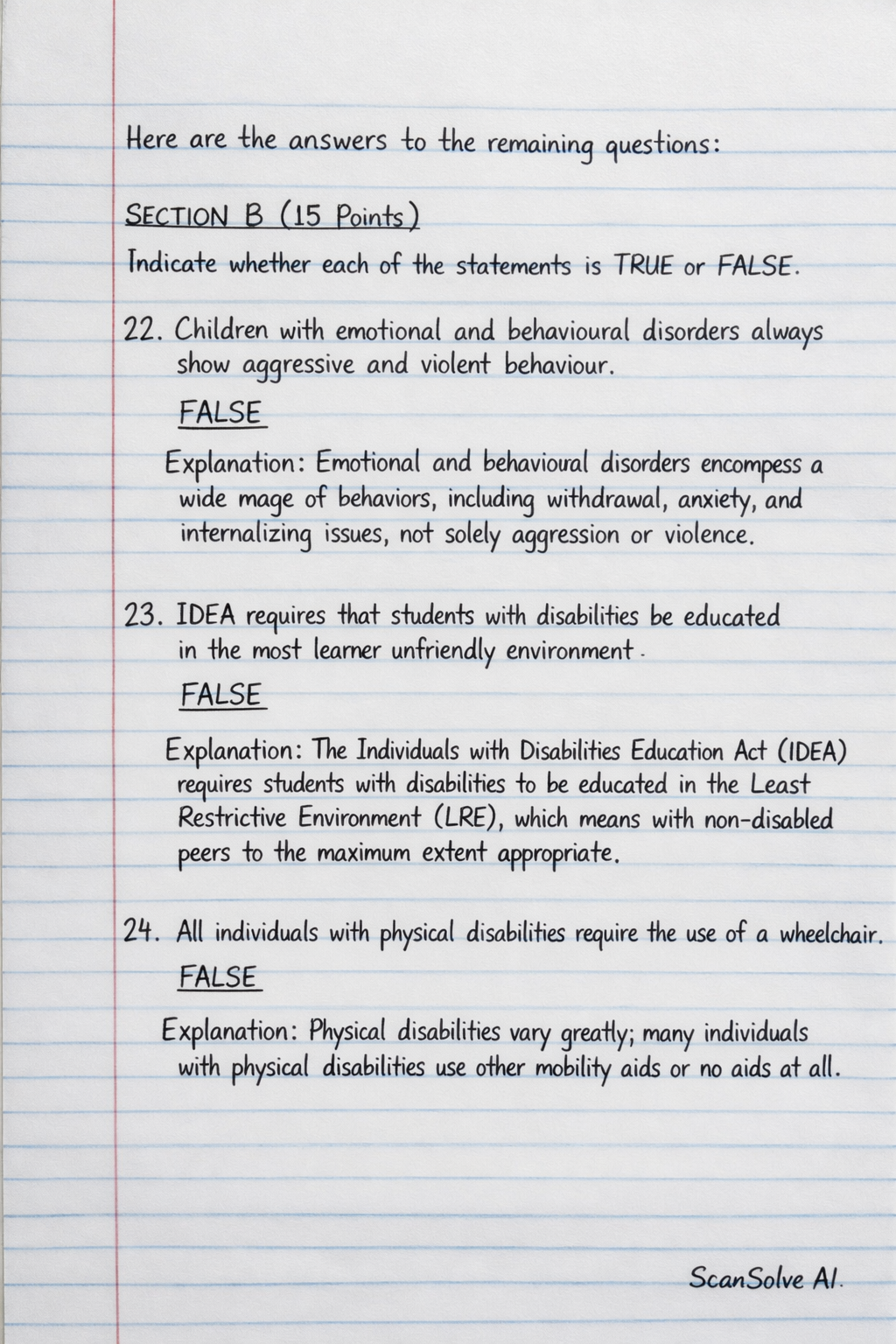
Here are the answers to the remaining questions:
SECTION B (15 Points)
Indicate whether each of the statements is TRUE or FALSE.
-
Children with emotional and behavioural disorders always show aggressive and violent behaviour.
- FALSE
- Explanation: Emotional and behavioral disorders encompass a wide range of behaviors, including withdrawal, anxiety, and internalizing issues, not solely aggression or violence.
-
IDEA requires that students with disabilities be educated in the most learner unfriendly environment.
- FALSE
- Explanation: The Individuals with Disabilities Education Act (IDEA) requires students with disabilities to be educated in the Least Restrictive Environment (LRE), which means with non-disabled peers to the maximum extent appropriate.
-
All individuals with physical disabilities require the use of a wheelchair.
- FALSE
- Explanation: Physical disabilities vary greatly; many individuals with physical disabilities use other mobility aids or no aids at all.
-
Disabilities can be temporary, permanent, or progressive.
- TRUE
- Explanation: Disabilities can manifest in various forms and durations, from temporary conditions to lifelong or worsening conditions.
-
A background noise affects an individual with profound hearing impairment.
- FALSE
- Explanation: Individuals with profound hearing impairment have very little or no residual hearing, so background noise would likely have minimal to no impact on their perception of sound.
-
Inclusive education is only about placing students with disabilities in regular classrooms.
- FALSE
- Explanation: Inclusive education is a comprehensive approach that involves providing appropriate support, accommodations, and modifications to ensure all students can learn and participate meaningfully, not just physical placement.
-
Handicap is determined by social and environmental barriers.
- TRUE
- Explanation: A handicap refers to the disadvantage or barrier an individual experiences due to an impairment or disability, often imposed by societal or environmental factors.
-
Physical and health disabilities do not affect a student's ability to learn.
- FALSE
- Explanation: Physical and health disabilities can significantly impact a student's ability to learn, affecting attendance, concentration, energy levels, and access to educational materials.
-
Inclusive education only benefits students with disabilities.
- FALSE
- Explanation: Inclusive education benefits all students by fostering empathy, understanding, and diverse perspectives, and by promoting a more equitable learning environment.
-
Isolation from peers' strategies mostly help manage students with emotional and behaviour disorders.
- FALSE
- Explanation: Isolation from peers is generally not an effective strategy and can worsen emotional and behavioral issues. Positive behavioral interventions and social skills training are usually more beneficial.
-
Schools are legally required to provide support services to students with physical or health disabilities.
- TRUE
- Explanation: Laws like IDEA and Section 504 mandate that schools provide necessary support services and accommodations to students with disabilities to ensure access to education.
-
Impairment, disability, and handicap are unrelated concepts.
- FALSE
- Explanation: These terms are related in a sequence: an impairment can lead to a disability, which can then result in a handicap due to environmental or social barriers.
-
Asthma is considered a health impairment under Individual with Disability Education Act (IDEA).
- TRUE
- Explanation: If asthma significantly impacts a child's educational performance, it can be classified as an "Other Health Impairment" (OHI) under IDEA.
-
All individuals with hearing impairment use sign language to communicate.
- FALSE
- Explanation: Many individuals with hearing impairment use spoken language, lip-reading, hearing aids, cochlear implants, or a combination of communication methods; not all use sign language.
SECTION C (10 Points)
Match each of the following emotional and behaviour disorders in Column A with its symptoms in Column B.
-
36. Conduct Disorder
- F. Displays rule-breaking behaviours, aggression, and disregard for social norms.
-
37. Anxiety Disorder
- E. Shows conditions like phobias and social nervousness.
-
38. Oppositional Defiant Disorder
- A. Manifested by persistent defiance, anger, and hostility towards authority figures.
-
39. Bipolar Disorder
- B. Marked by extreme mood swings between highs and lows.
-
40. Depression
- G. Characterised by persistent sadness, lack of interest, and loss of energy.
Still stuck on this one?
Ask a follow-up, and the answer starts from this question.
More Psychology Questions
Handwritten Step-by-Step Solution
Get this as a handwritten image on WhatsApp — like a tutor wrote it for you.
Try on WhatsApp