
We read your photo as:
Which of the following is a form of body language that is always present and often unconscious, providing a rich source of information?
Psychology
ScanSolve AI Answer
Answer
C
Body language refers to non-verbal cues communicated through physical behaviors. The statement highlights that body language is "always present" and "unconscious," providing a "rich source of information."
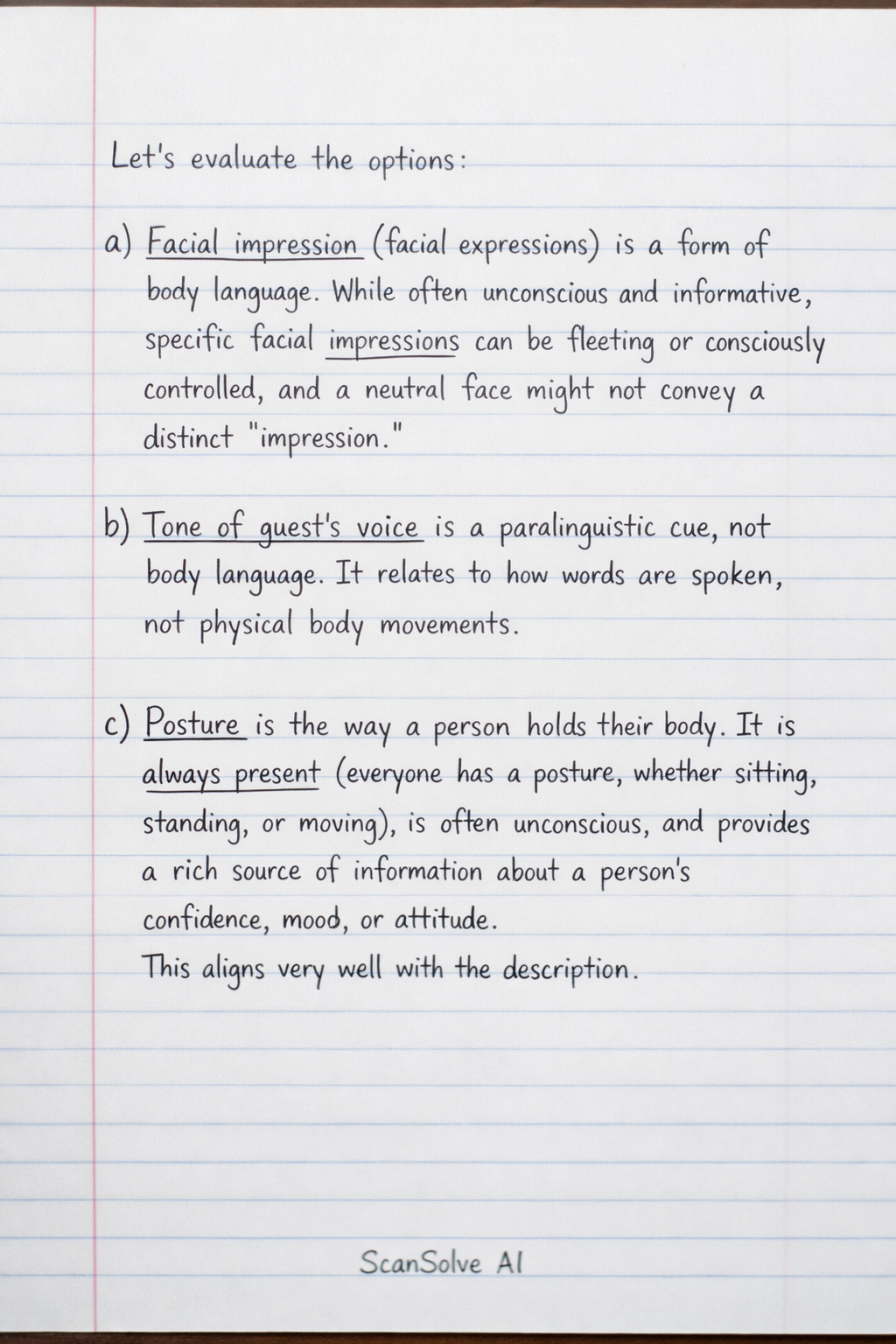
Let's evaluate the options:
- a) Facial impression (facial expressions) is a form of body language. While often unconscious and informative, specific facial impressions can be fleeting or consciously controlled, and a neutral face might not convey a distinct "impression."
- b) Tone of guest's voice is a paralinguistic cue, not body language. It relates to how words are spoken, not physical body movements.
- c) Posture is the way a person holds their body. It is always present (everyone has a posture, whether sitting, standing, or moving), is often unconscious, and provides a rich source of information about a person's confidence, mood, or attitude. This aligns very well with the description.
- d) Nervous moments describe a state or a period of time, not a specific form of body language itself. While nervousness can manifest through body language (like fidgeting or changes in posture), "nervous moments" is not the direct referent of body language.
Considering the emphasis on being "always present" and "unconscious," posture is the most fitting answer as it is a continuous and often involuntary aspect of non-verbal communication.
The correct option is c.
The answer is:
c. Posture
Was this helpful?
Try one yourself
A new problem that tests the same skill.
Still stuck on this one?
Ask a follow-up, and the answer starts from this question.
Got a different question?Ask your own question
More Psychology Questions
QWhat are examples of poor body language in communication and what do they signal?QWhat do you understand these body movements to mean?QA) Facial expressions are critical in sign language communication because they convey grammatical…QWhich of the following is the most important assertive skill for communication and problem-solving?…QWhat principle supports maintaining engagement and trust during non-verbal interactions?
Handwritten Step-by-Step Solution
Get this as a handwritten image on WhatsApp — like a tutor wrote it for you.
Try on WhatsApp