
We read your photo as:
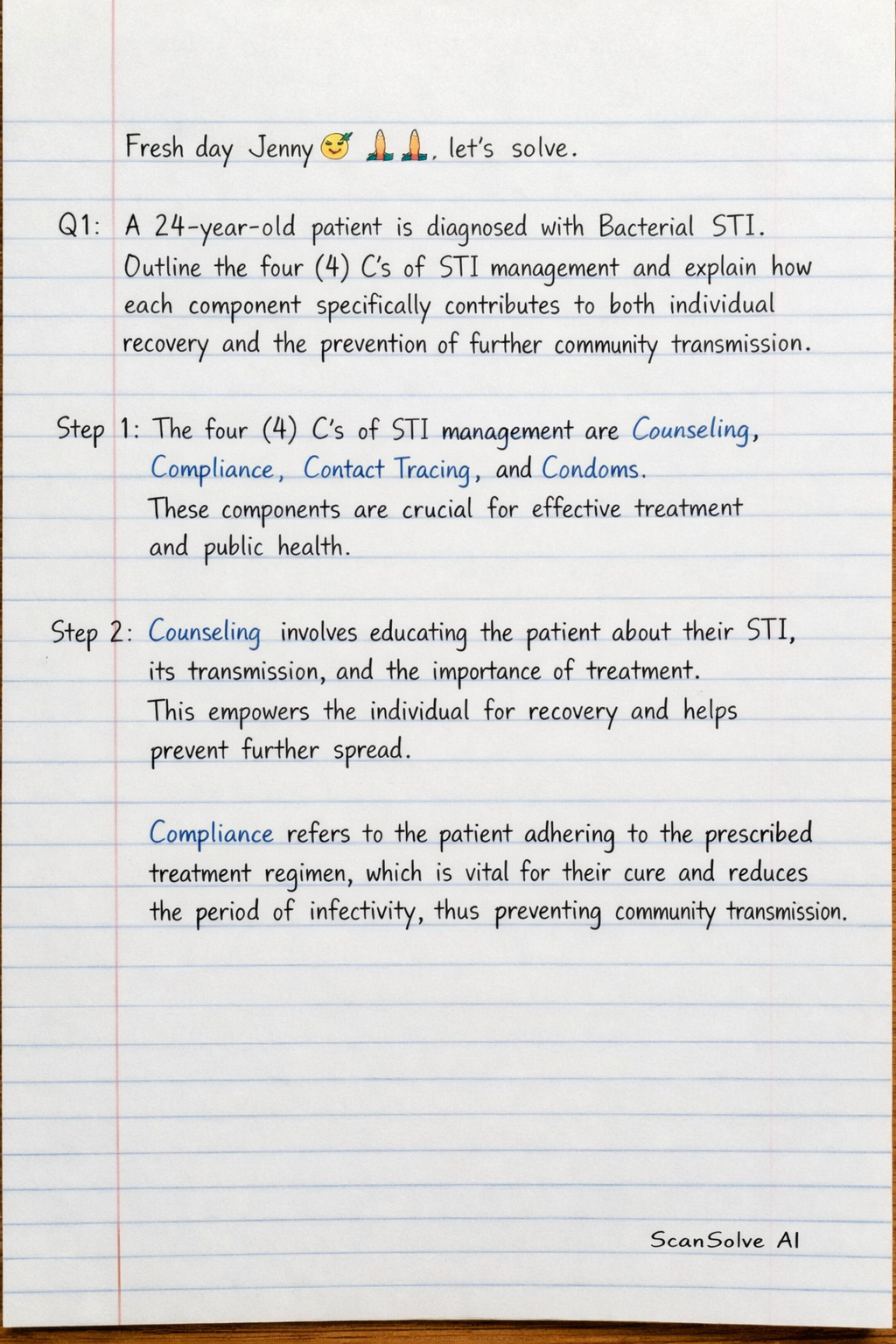
The four (4) C's of STI management are Counseling, Compliance, Contact Tracing, and Condoms. These components are crucial for effective treatment and public health.
ScanSolve AI Answer
Step-by-step solution
8 stepsQ1: A 24-year-old patient is diagnosed with Bacterial STI. Outline the four (4) C's of STI management and explain how each component specifically contributes to both individual recovery and the prevention of further community transmission.
The four (4) C's of STI management are Counseling, Compliance, Contact Tracing, and Condoms.
These components are crucial for effective treatment and public health.
Counseling* involves educating the patient about their STI, its transmission, and the importance of treatment.
This empowers the individual for recovery and helps prevent further spread. Compliance refers to the patient adhering to the prescribed treatment regimen, which is vital for their cure and reduces the period of infectivity, thus preventing community transmission.
Contact Tracing* involves identifying and notifying sexual partners of the infected individual.
This allows partners to be tested and treated, preventing reinfection of the primary patient and interrupting the chain of transmission within the community.
Condoms* are a barrier method that, when used correctly and consistently, prevent the transmission of STIs.
This protects the individual from acquiring new infections or transmitting existing ones, significantly reducing community spread.
Q2: A patient presents with painful fluctuant lymphadenopathy in the groin area commonly referred to as an inguinal bubo. Outline 2 bacterial (primary) causes of this syndrome and describe the clinical features that distinguish it from a simple genital ulcer.
Two primary bacterial causes of an inguinal bubo are Chancroid (caused by Haemophilus ducreyi) and Lymphogranuloma Venereum (LGV) (caused by specific serovars of Chlamydia trachomatis).
An inguinal bubo is characterized by painful, swollen, and often fluctuant (fluid-filled) lymph nodes in the groin.
It typically develops after the initial genital lesion has healed or is less prominent. In the case of chancroid, the bubo is usually unilateral and can rupture to form a draining ulcer. In LGV, buboes are often bilateral and can form a "groove sign" (inguinal and femoral lymphadenopathy separated by the inguinal ligament).
A simple genital ulcer is a primary lesion on the genitals, often caused by STIs like herpes, syphilis, or chancroid itself.
These ulcers are typically open sores, which can be painful or painless, single or multiple, and may or may not be associated with significant regional lymphadenopathy.
The key distinguishing features are that an inguinal bubo is primarily a manifestation of lymphadenopathy (swollen lymph nodes) that becomes fluctuant and painful, often occurring after the initial genital ulcer has appeared or resolved.
A simple genital ulcer, however, is the initial lesion on the genital skin or mucosa. While some ulcers (like chancroid) can lead to buboes, the bubo itself is a distinct, later stage of lymphatic involvement, characterized by its fluctuant, pus-filled nature, whereas a simple ulcer is a surface lesion.
Still stuck on this one?
Ask a follow-up, and the answer starts from this question.
More Psychology Questions
Handwritten Step-by-Step Solution
Get this as a handwritten image on WhatsApp — like a tutor wrote it for you.
Try on WhatsApp