
We read your photo as:
What are the negative effects of poor family communication and how can empathy be shown to a child experiencing parental conflict?
Psychology
ScanSolve AI Answer
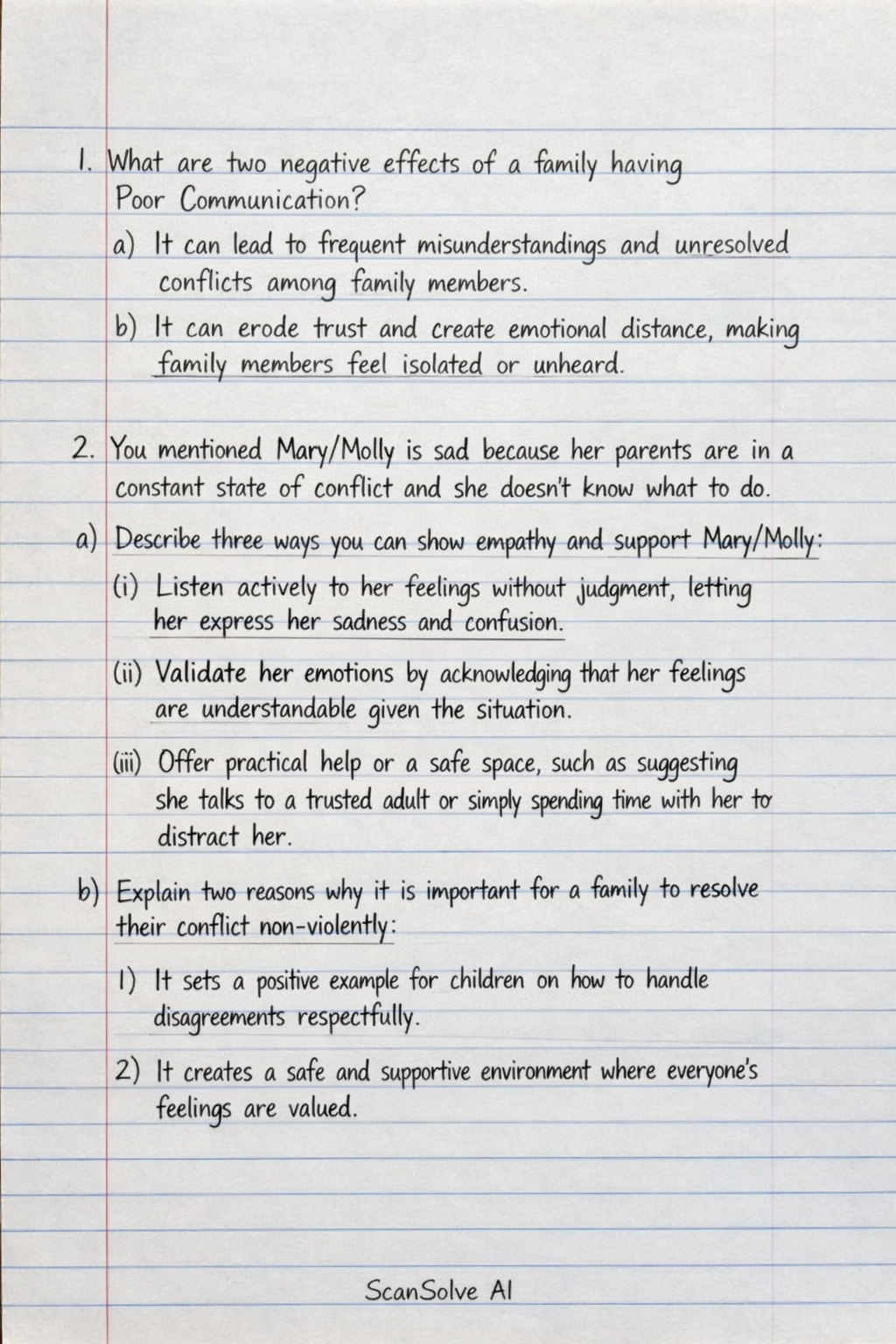
1. What are two negative effects of a family having Poor Communication?
- a) It can lead to frequent misunderstandings and unresolved conflicts among family members.
- b) It can erode trust and create emotional distance, making family members feel isolated or unheard.
2. You mentioned Mary/Molly is sad because her parents are in a constant state of conflict and she doesn't know what to do.
- a) Describe three ways you can show empathy and support Mary/Molly:
- (i) Listen actively to her feelings without judgment, letting her express her sadness and confusion.
- (ii) Validate her emotions by acknowledging that her feelings are understandable given the situation.
- (iii) Offer practical help or a safe space, such as suggesting she talks to a trusted adult or simply spending time with her to distract her.
- b) Explain two reasons why it is important for a family to resolve their conflict non-violently:
- (i) Non-violent conflict resolution protects the emotional and physical well-being of all family members, especially children, preventing trauma and fear.
- (ii) It teaches healthy communication and problem-solving skills, fostering a positive family environment where members feel safe and respected.
4. A family is having a disagreement about how to spend their limited money. The mother wants to save for school fees, the father wants to buy a new farming tool, and the children want a new TV.
- a) Explain three steps they can take to negotiate and find a solution that works for the whole family:
- (i) Open Communication: Each family member should clearly express their needs and reasons for their desired spending, ensuring everyone feels heard and understood.
- (ii) Prioritization and Compromise: The family should collectively list all needs and wants, then prioritize them based on urgency and long-term benefit. They should be willing to compromise, perhaps by allocating a portion of the money to the most critical needs first and saving for others later.
- (iii) Joint Decision-Making: After discussing priorities and potential compromises, the family should make a decision together, ensuring the chosen solution is fair and considers the well-being of all members.
Was this helpful?
Still stuck on this one?
Ask a follow-up, and the answer starts from this question.
Got a different question?Ask your own question
More Psychology Questions
QExplain how to enhance effective communication in resolving conflict with family, referencing…QState the possible outcomes of poor family and community relationshipQWhat are some ways to improve family relationships during a misunderstanding?QDiscuss the negative impacts of physical and psychological/emotional abuse.QExplain three benefits of using mediation to resolve conflict in a family.
Handwritten Step-by-Step Solution
Get this as a handwritten image on WhatsApp — like a tutor wrote it for you.
Try on WhatsApp