
Types of mental illness Organic matter disorder Substances use disorder Delusional disorder Personalities disorder Sexual disorder Mood disorder Substances disorder Differentiate between psychology and health Health psychology What causes the health Who is responsible for illness How should illness be treated Who is responsible for treatment The role of psychology in health and illness Type it in paper
ScanSolve AI Answer
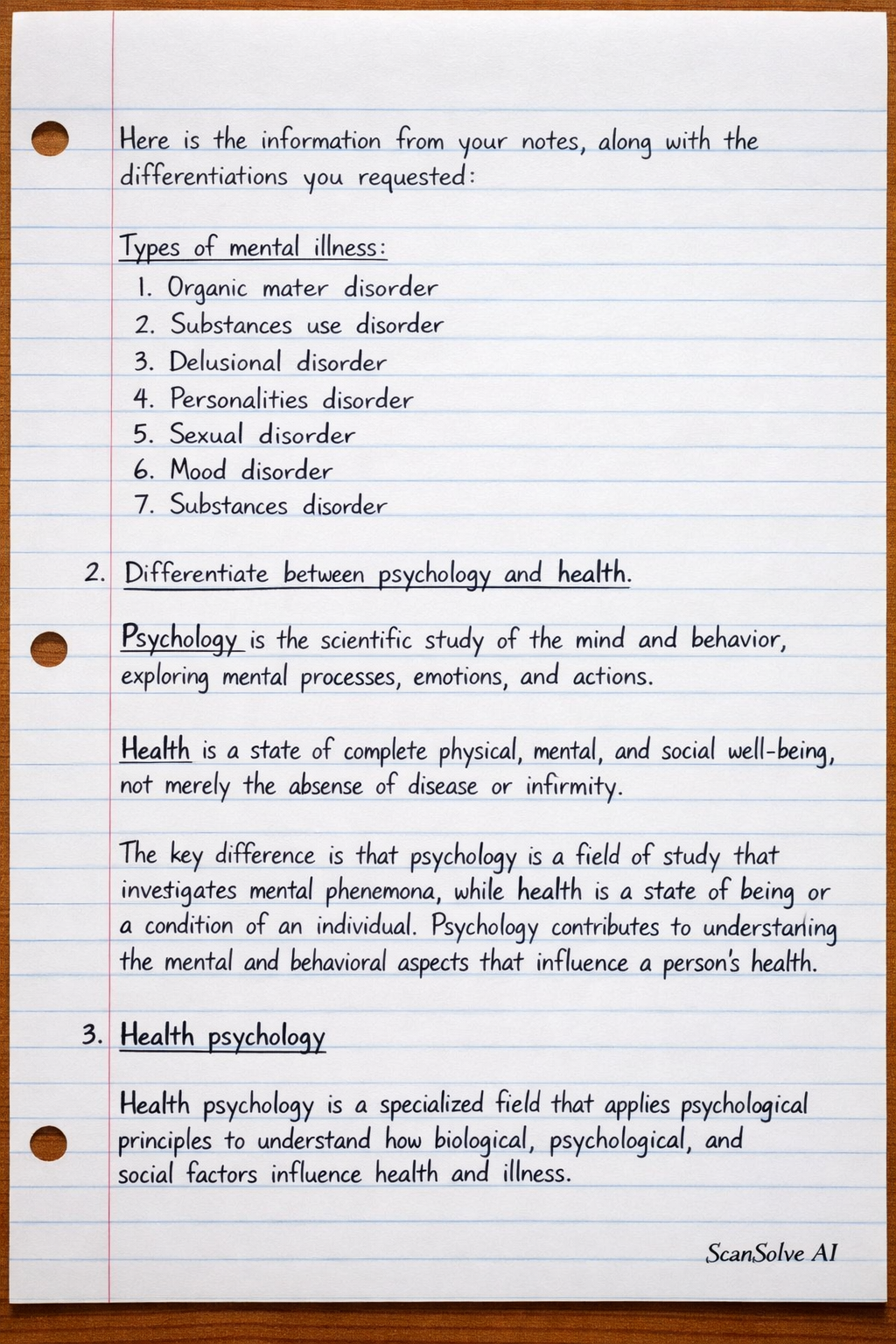
Here is the information from your notes, along with the differentiations you requested:
Types of mental illness
- Organic matter disorder
- Substances use disorder
- Delusional disorder
- Personalities disorder
- Sexual disorder
- Mood disorder
- Substances disorder
2. Differentiate between psychology and health
- Psychology is the scientific study of the mind and behavior, exploring mental processes, emotions, and actions.
- Health is a state of complete physical, mental, and social well-being, not merely the absence of disease or infirmity.
The key difference is that psychology is a field of study that investigates mental phenomena, while health is a state of being or a condition of an individual. Psychology contributes to understanding the mental and behavioral aspects that influence a person's health.
3. Health psychology
Health psychology is a specialized field that applies psychological principles to understand how biological, psychological, and social factors influence health and illness.
- What causes health? Health psychology examines how a combination of biological predispositions, psychological factors (like thoughts, emotions, and behaviors), and social influences (such as support systems and cultural norms) contribute to an individual's health status.
- Who is responsible for illness? It emphasizes that responsibility for illness is multifaceted, involving individual lifestyle choices and behaviors, genetic vulnerabilities, and environmental or social stressors.
- How should illness be treated? Treatment in health psychology involves a holistic approach, integrating psychological interventions (e.g., stress management, behavioral modification) with medical treatments to address the whole person.
- Who is responsible for treatment? Responsibility for treatment is shared among the individual (through adherence and self-management), healthcare providers, and the broader healthcare system.
- The role of psychology in health and illness: Psychology plays a crucial role in understanding health behaviors, coping with stress, managing chronic conditions, promoting disease prevention, and improving patient-provider communication.
Still stuck on this one?
Ask a follow-up, and the answer starts from this question.
More Psychology Questions
Handwritten Step-by-Step Solution
Get this as a handwritten image on WhatsApp — like a tutor wrote it for you.
Try on WhatsApp