
This mathematics problem involves applying core mathematical principles and formulas. Below you will find a complete step-by-step solution with detailed explanations for each step, helping you understand not just the answer but the method behind it.
ScanSolve AI Answer
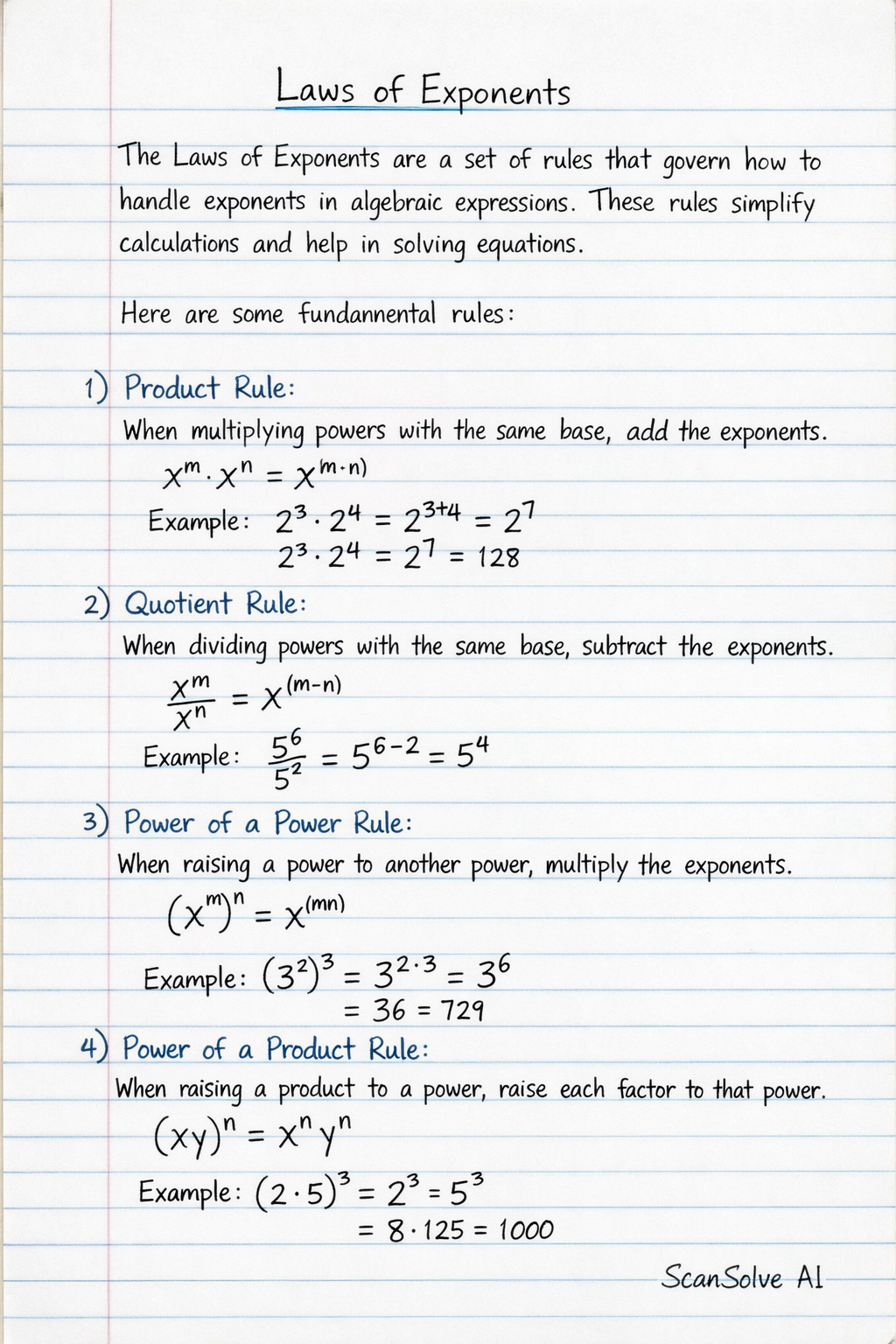
Here are the Laws of Exponents explained in English: The Laws of Exponents are a set of rules that govern how to handle exponents in algebraic expressions. These rules simplify calculations and help in solving equations. Here are some fundamental rules: Product Rule: When multiplying powers with the same base, add the exponents. x^m · x^n = x^m+n Example: 2^3 · 2^4 = 2^3+4 = 2^7 Quotient Rule: When dividing powers with the same base, subtract the exponents. (x^m)/(x^n) = x^m-n Example: (5^6)/(5^2) = 5^6-2 = 5^4 Power of a Power Rule: When raising a power to another power, multiply the exponents. (x^m)^n = x^mn Example: (3^2)^3 = 3^2 · 3 = 3^6 Power of a Product Rule: When raising a product to a power, raise each factor to that power. (xy)^n = x^n y^n Example: (2 · 5)^3 = 2^3 · 5^3 Power of a Quotient Rule: When raising a quotient to a power, raise both the numerator and the denominator to that power. ((x)/(y))^n = (x^n)/(y^n) Example: ((4)/(7))^2 = (4^2)/(7^2) Zero Exponent Rule: Any non-zero number raised to the power of zero is 1. x^0 = 1 (where x ≠ 0) Example: 10^0 = 1 Negative Exponent Rule: A negative exponent means the reciprocal of the base raised to the positive exponent. x^-n = (1)/(x^n) Example: 4^-2 = (1)/(4^2) = (1)/(16) Fractional Exponent Rule: Fractional exponents represent roots. x^1/n = [n]x x^m/n = [n]x^m = ([n]x)^m Example: 9^1/2 = sqrt(9) = 3 Example: 8^2/3 = [3]8^2 = [3]64 = 4 What's next?