Describe the first aid procedure for a drowning victim. Explain five roles of a first aider. Describe the process of performing CPR in children. Describe the first aid procedure for cuts and grazes. Explain the difference between Anaphylaxis and Asthma. State five injuries common from electrical accidents. Highlight five symptoms of shock. Describe various ways through which poison can enter the body.
This biology question covers important biological concepts and processes. The step-by-step explanation below helps you understand the underlying mechanisms and reasoning.
ScanSolve AI Answer
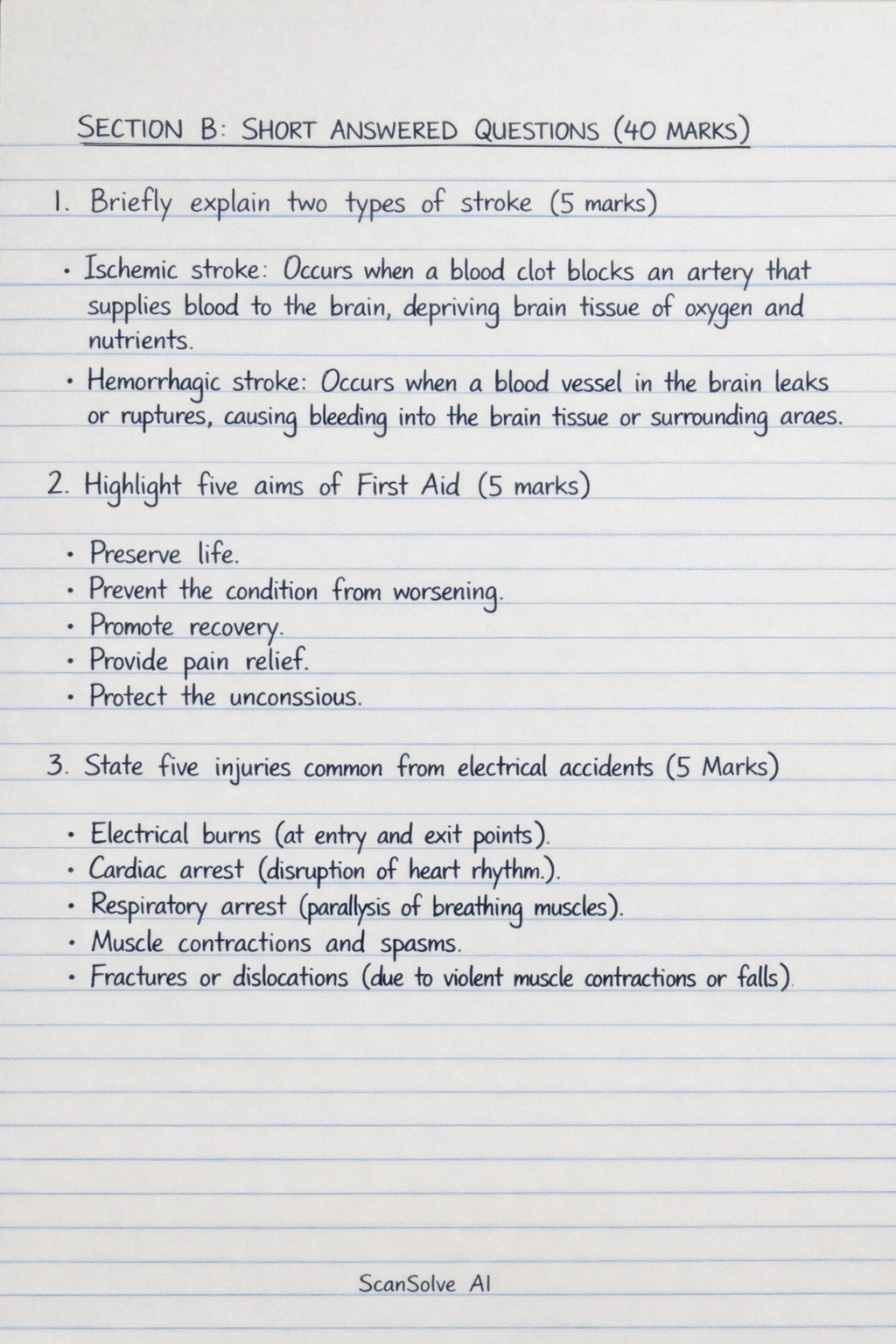
SECTION B: SHORT ANSWERED QUESTIONS (40 MARKS)
1. Briefly explain two types of stroke (5 marks)
Ischemic stroke: Occurs when a blood clot blocks an artery that supplies blood to the brain, depriving brain tissue of oxygen and nutrients.
Hemorrhagic stroke: Occurs when a blood vessel in the brain leaks or ruptures, causing bleeding into the brain tissue or surrounding areas.
2. Highlight five aims of First Aid (5 marks)
Preserve life.
Prevent the condition from worsening.
Promote recovery.
Provide pain relief.
Protect the unconscious.
3. State five injuries common from electrical accidents (5 Marks)
Electrical burns (at entry and exit points).
Cardiac arrest (disruption of heart rhythm).
Respiratory arrest (paralysis of breathing muscles).
Muscle contractions and spasms.
Fractures or dislocations (due to violent muscle contractions or falls).
4. Describe the first aid procedure for nose bleeding (5 Marks)
Step 1: Sit the person upright and lean them slightly forward to prevent blood from flowing down the throat.
Step 2: Pinch the soft part of the nose, just above the nostrils, firmly for 10-15 minutes.
Step 3: Encourage the person to breathe through their mouth.
Step 4: Apply a cold compress or ice pack to the bridge of the nose.
Step 5: Advise the person to avoid blowing their nose, picking it, or strenuous activity for several hours after the bleeding stops.
5. Explain the difference between Anaphylaxis and Asthma (5 Marks)
Anaphylaxis is a severe, life-threatening allergic reaction that affects multiple body systems rapidly. It can cause widespread hives, swelling, difficulty breathing, a sudden drop in blood pressure, and can lead to shock.
Asthma is a chronic respiratory condition characterized by inflammation and narrowing of the airways, leading to symptoms like wheezing, coughing, chest tightness, and shortness of breath. While an asthma attack can be severe, it is generally not as rapid or systemic as anaphylaxis.
6. Highlight five symptoms of shock (5 Marks)
Pale, cold, and clammy skin.
Rapid, weak pulse.
Rapid, shallow breathing.
Nausea or vomiting.
Weakness, dizziness, or confusion.
7. Describe the first aid procedure for cuts and grazes (5 marks)
Step 1: Wash your hands thoroughly with soap and water or use hand sanitizer.
Step 2: Clean the wound gently with mild soap and water to remove dirt and debris.
Step 3: Apply gentle, direct pressure with a clean cloth or sterile gauze to stop any bleeding.
Step 4: Apply an antiseptic solution or cream if available.
Step 5: Cover the wound with a sterile adhesive bandage or dressing to protect it from infection.
8. Describe various ways through which poison can enter the body (5 Marks)
Ingestion: Swallowing poisonous substances, such as medications, cleaning products, or contaminated food.
Inhalation: Breathing in toxic fumes, gases, or vapors, like carbon monoxide or chemical fumes.
Absorption: Through contact with the skin or mucous membranes, such as poisonous plants or pesticides.
Injection: Via bites or stings from venomous animals (e.g., snakes, spiders) or through intentional injection (e.g., drug overdose).
---
SECTION C: LONG ANSWERED QUESTIONS (40 MARKS)
1. a) Explain five roles of a first aider (10 marks)
Assess the situation: A first aider must quickly and safely evaluate the scene for any dangers to themselves, the casualty, or bystanders, and determine the nature of the injury or illness.
Protect the casualty: This involves moving the casualty to safety if necessary, preventing further injury, and maintaining their dignity and privacy.
Provide immediate care: Administering appropriate first aid based on the casualty's condition, following established protocols for injuries or medical emergencies.
Call for professional help: Contacting emergency medical services (e.g., ambulance) promptly when the situation warrants it, providing clear and concise information about the incident.
Reassure and comfort: Keeping the casualty calm and comfortable, explaining what is happening, and offering emotional support to reduce anxiety.
1. b) Describe the process of performing CPR in children (10 marks)
Step 1: Ensure safety: Check the scene for any dangers before approaching the child.
Step 2: Check for response: Gently tap the child's shoulder and shout to see if they respond.
Step 3: Shout for help: Call for assistance from anyone nearby.
Step 4: Open the airway: Gently tilt the child's head back and lift their chin to open the airway.
Step 5: Check for breathing: Look, listen, and feel for normal breathing for no more than 10 seconds. Gasping or irregular breaths are not normal.
Step 6: Give 5 initial rescue breaths: If the child is not breathing normally, pinch their nose, seal your mouth over theirs, and give 5 slow, gentle rescue breaths, watching for chest rise.
Step 7: Start chest compressions:
Place the heel of one hand (or two hands for a larger child) in the center of the child's chest, just below the nipple line.
Compress the chest by about one-third of its depth (approximately 5 cm or 2 inches) at a rate of 100-120 compressions per minute.
Perform 30 compressions.
Step 8: Continue with rescue breaths: After 30 compressions, give 2 rescue breaths.
Step 9: Repeat cycle: Continue cycles of 30 compressions and 2 breaths.
Step 10: Call emergency services: If you are alone, perform CPR for 1 minute before calling emergency services. If someone else is present, have them call immediately while you start CPR. Continue until the child recovers, emergency services arrive, or you are too exhausted to continue.
2. a) Whilst feeding your child, he starts to gag and appear unable to breathe. He seems close to losing consciousness, his lips are turning a definite shade of blue. What is the first aid procedure you'll conduct to such a child (10 Marks)
This describes a severe choking incident in a child.
Step 1: Assess severity: The child is unable to breathe, lips are blue, and losing consciousness, indicating a severe airway obstruction.
Step 2: Give 5 back blows:
Support the child across your lap or arm, face down, with their head lower than their chest.
Deliver up to 5 sharp back blows between the shoulder blades with the heel of your hand.
Step 3: Give 5 chest/abdominal thrusts (if back blows fail):
If back blows do not clear the obstruction, turn the child onto their back.
For an infant (under 1 year): Give up to 5 chest thrusts. Place two fingers on the breastbone, just below the nipple line, and give sharp, downward thrusts.
For a child (over 1 year): Perform up to 5 abdominal thrusts (Heimlich maneuver). Stand behind the child, wrap your arms around their waist, make a fist with one hand, place it just above the navel, grasp your fist with the other hand, and deliver sharp upward thrusts.
Step 4: Repeat cycle: Continue alternating 5 back blows and