ScanSolve logoScanSolve
Toggle sidebar
  • Homework
  • Tutor
  • Humanizer
  • AI Detector
  • Questions
  • Blog
  • History
  • Mobile App

  • Homework
  • Tutor
  • Humanizer
  • AI Detector

  • Questions
  • Math homework helpMath
    Physics homework helpPhysics
    Chemistry homework helpChemistry
    Biology homework helpBiology
    Computer Science homework helpComputer Science
    History homework helpHistory
    More homework helpMore
  • Blog
  • History

  • Mobile App
ScanSolvePLUS
  • Unlimited answers
  • ScanSolve AI Pro
Start Free Trial →
Try on WhatsApp

Scan it, Solve it

support@getscansolve.com

© 2026 ScanSolve. All rights reserved.

Company

About UsCareersContact Us

Resources

Questions HubAI HumanizerAI Detector

Support

FAQTerms of ServicePrivacy PolicyDo Not Sell My Data

Download App

Download ScanSolve on App StoreGet ScanSolve on Google PlayChat on WhatsApp
Home > Biology Homework Help > Solution

Describe the following disorders of the female reproductive organ and explain its causes, signs and symptoms and its management: Vaginitis, Vaginal dryness, Vaginal cyst, Bartholin gland cyst.

Asked on March 26, 2026|Biology

This biology question covers important biological concepts and processes. The step-by-step explanation below helps you understand the underlying mechanisms and reasoning.

ScanSolve AI AnswerAnswered on March 26, 2026
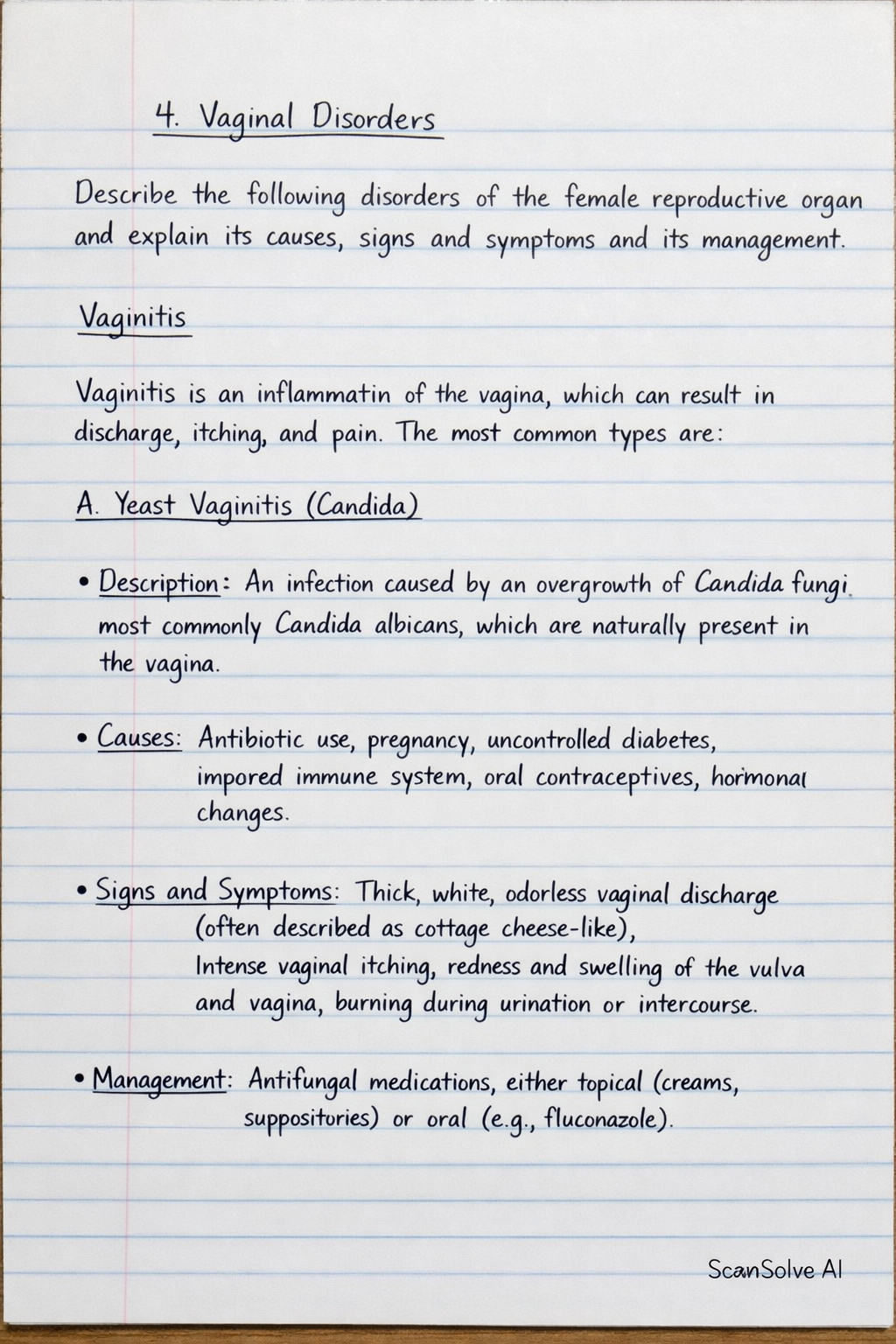
Here are the descriptions of the vaginal disorders: 4. Vaginal Disorders Describe the following disorders of the female reproductive organ and explain its causes, signs and symptoms and its management. Vaginitis Vaginitis is an inflammation of the vagina, which can result in discharge, itching, and pain. The most common types are: A. Yeast Vaginitis (Candida) Description: An infection caused by an overgrowth of Candida fungi, most commonly Candida albicans*, which are naturally present in the vagina. Causes: Antibiotic use, pregnancy, uncontrolled diabetes, impaired immune system, oral contraceptives, or hormonal changes. Signs and Symptoms: Thick, white, odorless vaginal discharge (often described as cottage cheese-like), intense vaginal itching, redness and swelling of the vulva and vagina, burning during urination or intercourse. Management: Antifungal medications, either topical (creams, suppositories) or oral (e.g., fluconazole). B. Trichomonas Vaginitis (Trichomoniasis) Description: A sexually transmitted infection (STI) caused by the single-celled parasite Trichomonas vaginalis*. Causes: Sexual contact with an infected partner. Signs and Symptoms: Foul-smelling, greenish-yellow, frothy vaginal discharge, severe vaginal itching and irritation, redness and swelling of the vulva, painful urination, discomfort during intercourse. Many infected individuals are asymptomatic. Management: Oral antibiotics, typically metronidazole or tinidazole, for both the infected individual and their sexual partners to prevent re-infection. C. Bacterial Vaginosis (BV) Description: A common vaginal infection resulting from an imbalance of the naturally occurring bacteria in the vagina, with an overgrowth of certain anaerobic bacteria and a decrease in beneficial Lactobacillus* bacteria. Causes: While not an STI, it is associated with sexual activity. Other risk factors include douching, new or multiple sexual partners, and lack of Lactobacillus* bacteria. Signs and Symptoms: Thin, white or gray vaginal discharge with a strong, fishy odor (especially after intercourse), vaginal itching, burning during urination. Many women with BV have no symptoms. Management: Oral or topical antibiotics (e.g., metronidazole, clindamycin). Vaginal dryness Description: A condition where the vagina lacks sufficient lubrication, leading to discomfort, itching, and pain. Causes: Primarily caused by a decrease in estrogen levels, which can occur during menopause, breastfeeding, certain medications (e.g., antihistamines, antidepressants, some birth control pills), cancer treatments (chemotherapy, radiation), surgical removal of ovaries, or certain autoimmune conditions. Signs and Symptoms: Itching, burning, soreness, pain or discomfort during sexual intercourse (dyspareunia), light bleeding after intercourse, urinary urgency or frequency. Management: Vaginal moisturizers for regular use, vaginal lubricants for sexual activity, low-dose vaginal estrogen therapy (creams, rings, tablets) for menopausal women, or systemic hormone therapy. Vaginal cyst Description: A fluid-filled sac or lump that forms on or under the lining of the vagina. They are usually benign and often asymptomatic. Causes: Can arise from various sources, including: Inclusion cysts:* Most common, often form after trauma or surgery (e.g., episiotomy) when vaginal tissue gets trapped. Gartner's duct cysts:* Remnants of embryonic structures that don't fully regress. Bartholin's gland cysts:* Form when the opening of a Bartholin's gland becomes blocked (discussed separately below). Endometriosis:* Endometrial tissue growing in the vagina. Signs and Symptoms: Often asymptomatic. If large, they may cause a noticeable lump, discomfort during intercourse, difficulty inserting tampons, or a feeling of pressure. If infected, they can become painful and tender. Management: Small, asymptomatic cysts usually require no treatment. Larger or symptomatic cysts may be surgically removed or drained. Infected cysts may require antibiotics and drainage. Bartholin gland cyst Description: The Bartholin glands are two small glands located on each side of the vaginal opening that produce lubricating fluid. A Bartholin gland cyst forms when the opening of one of these glands becomes blocked, causing fluid to back up and form a painless swelling. Causes: Blockage of the Bartholin gland duct, often due to infection (bacterial, including STIs), inflammation, or trauma. Signs and Symptoms: A small, painless lump near the vaginal opening. If the cyst grows large, it can cause discomfort when walking, sitting, or during intercourse. If it becomes infected, it forms a painful abscess, characterized by redness, swelling, tenderness, and sometimes fever. Management: Small, asymptomatic cysts may resolve on their own with warm sitz baths. Larger or symptomatic cysts may require drainage (marsupialization, needle aspiration) or, in cases of recurrent infection, surgical removal of the gland. Antibiotics are used if an abscess forms.

Related Biology Questions

  • What is photosynthesis
  • Construct and simplify equation whose root are -3,1
  • Which hormone regulates blood glucose
  • A hormone is carried to it's target organ mainly by
  • Write short not on photosynthesis
  • 1. I eat a fruit.
See all Biology questions

This step-by-step solution was generated by ScanSolve AI. Need help with more biology problems? Browse Biology solutions or ask your own question.

Home›Biology Homework Help›Describe the following disorders of the female reproductive…
Q

Describe the following disorders of the female reproductive organ and explain its causes, signs and symptoms and its management: Vaginitis, Vaginal dryness, Vaginal cyst, Bartholin gland cyst.

March 26, 2026|Biology
Describe the following disorders of the female reproductive organ and explain its causes, signs and symptoms and its management: Vaginitis, Vaginal dryness, Vaginal cyst, Bartholin gland cyst.

Describe the following disorders of the female reproductive organ and explain its causes, signs and symptoms and its management: Vaginitis, Vaginal dryness, Vaginal cyst, Bartholin gland cyst.

ScanSolve AI

ScanSolve AI Answer

Answered on March 26, 2026

Here are the descriptions of the vaginal disorders:

4. Vaginal Disorders

Describe the following disorders of the female reproductive organ and explain its causes, signs and symptoms and its management.

  • Vaginitis Vaginitis is an inflammation of the vagina, which can result in discharge, itching, and pain. The most common types are:

    • A. Yeast Vaginitis (Candida)

      • Description: An infection caused by an overgrowth of Candida fungi, most commonly Candida albicans, which are naturally present in the vagina.
      • Causes: Antibiotic use, pregnancy, uncontrolled diabetes, impaired immune system, oral contraceptives, or hormonal changes.
      • Signs and Symptoms: Thick, white, odorless vaginal discharge (often described as cottage cheese-like), intense vaginal itching, redness and swelling of the vulva and vagina, burning during urination or intercourse.
      • Management: Antifungal medications, either topical (creams, suppositories) or oral (e.g., fluconazole).
    • B. Trichomonas Vaginitis (Trichomoniasis)

      • Description: A sexually transmitted infection (STI) caused by the single-celled parasite Trichomonas vaginalis.
      • Causes: Sexual contact with an infected partner.
      • Signs and Symptoms: Foul-smelling, greenish-yellow, frothy vaginal discharge, severe vaginal itching and irritation, redness and swelling of the vulva, painful urination, discomfort during intercourse. Many infected individuals are asymptomatic.
      • Management: Oral antibiotics, typically metronidazole or tinidazole, for both the infected individual and their sexual partners to prevent re-infection.
    • C. Bacterial Vaginosis (BV)

      • Description: A common vaginal infection resulting from an imbalance of the naturally occurring bacteria in the vagina, with an overgrowth of certain anaerobic bacteria and a decrease in beneficial Lactobacillus bacteria.
      • Causes: While not an STI, it is associated with sexual activity. Other risk factors include douching, new or multiple sexual partners, and lack of Lactobacillus bacteria.
      • Signs and Symptoms: Thin, white or gray vaginal discharge with a strong, fishy odor (especially after intercourse), vaginal itching, burning during urination. Many women with BV have no symptoms.
      • Management: Oral or topical antibiotics (e.g., metronidazole, clindamycin).
  • Vaginal dryness

    • Description: A condition where the vagina lacks sufficient lubrication, leading to discomfort, itching, and pain.
    • Causes: Primarily caused by a decrease in estrogen levels, which can occur during menopause, breastfeeding, certain medications (e.g., antihistamines, antidepressants, some birth control pills), cancer treatments (chemotherapy, radiation), surgical removal of ovaries, or certain autoimmune conditions.
    • Signs and Symptoms: Itching, burning, soreness, pain or discomfort during sexual intercourse (dyspareunia), light bleeding after intercourse, urinary urgency or frequency.
    • Management: Vaginal moisturizers for regular use, vaginal lubricants for sexual activity, low-dose vaginal estrogen therapy (creams, rings, tablets) for menopausal women, or systemic hormone therapy.
  • Vaginal cyst

    • Description: A fluid-filled sac or lump that forms on or under the lining of the vagina. They are usually benign and often asymptomatic.
    • Causes: Can arise from various sources, including:
      • Inclusion cysts: Most common, often form after trauma or surgery (e.g., episiotomy) when vaginal tissue gets trapped.
      • Gartner's duct cysts: Remnants of embryonic structures that don't fully regress.
      • Bartholin's gland cysts: Form when the opening of a Bartholin's gland becomes blocked (discussed separately below).
      • Endometriosis: Endometrial tissue growing in the vagina.
    • Signs and Symptoms: Often asymptomatic. If large, they may cause a noticeable lump, discomfort during intercourse, difficulty inserting tampons, or a feeling of pressure. If infected, they can become painful and tender.
    • Management: Small, asymptomatic cysts usually require no treatment. Larger or symptomatic cysts may be surgically removed or drained. Infected cysts may require antibiotics and drainage.
  • Bartholin gland cyst

    • Description: The Bartholin glands are two small glands located on each side of the vaginal opening that produce lubricating fluid. A Bartholin gland cyst forms when the opening of one of these glands becomes blocked, causing fluid to back up and form a painless swelling.
    • Causes: Blockage of the Bartholin gland duct, often due to infection (bacterial, including STIs), inflammation, or trauma.
    • Signs and Symptoms: A small, painless lump near the vaginal opening. If the cyst grows large, it can cause discomfort when walking, sitting, or during intercourse. If it becomes infected, it forms a painful abscess, characterized by redness, swelling, tenderness, and sometimes fever.
    • Management: Small, asymptomatic cysts may resolve on their own with warm sitz baths. Larger or symptomatic cysts may require drainage (marsupialization, needle aspiration) or, in cases of recurrent infection, surgical removal of the gland. Antibiotics are used if an abscess forms.

Need help with your own homework?

Get instant step-by-step solutions to any question. Free to start.

Ask Your Question
Handwritten step-by-step solution

Handwritten Step-by-Step Solution

Get this solution as a handwritten image on WhatsApp — just like a tutor wrote it for you.

Try on WhatsApp

More Biology Questions

What is photosynthesisConstruct and simplify equation whose root are -3,1Which hormone regulates blood glucoseA hormone is carried to it's target organ mainly byWrite short not on photosynthesis1. I eat a fruit.
See all Biologyquestions →
Biology: Describe the following disorders of the female reproductive organ and explain it... — Step-by-Step Solution | ScanSolve