

This accounting problem is solved step by step below, with detailed explanations to help you understand the method and arrive at the correct answer.
ScanSolve AI Answer
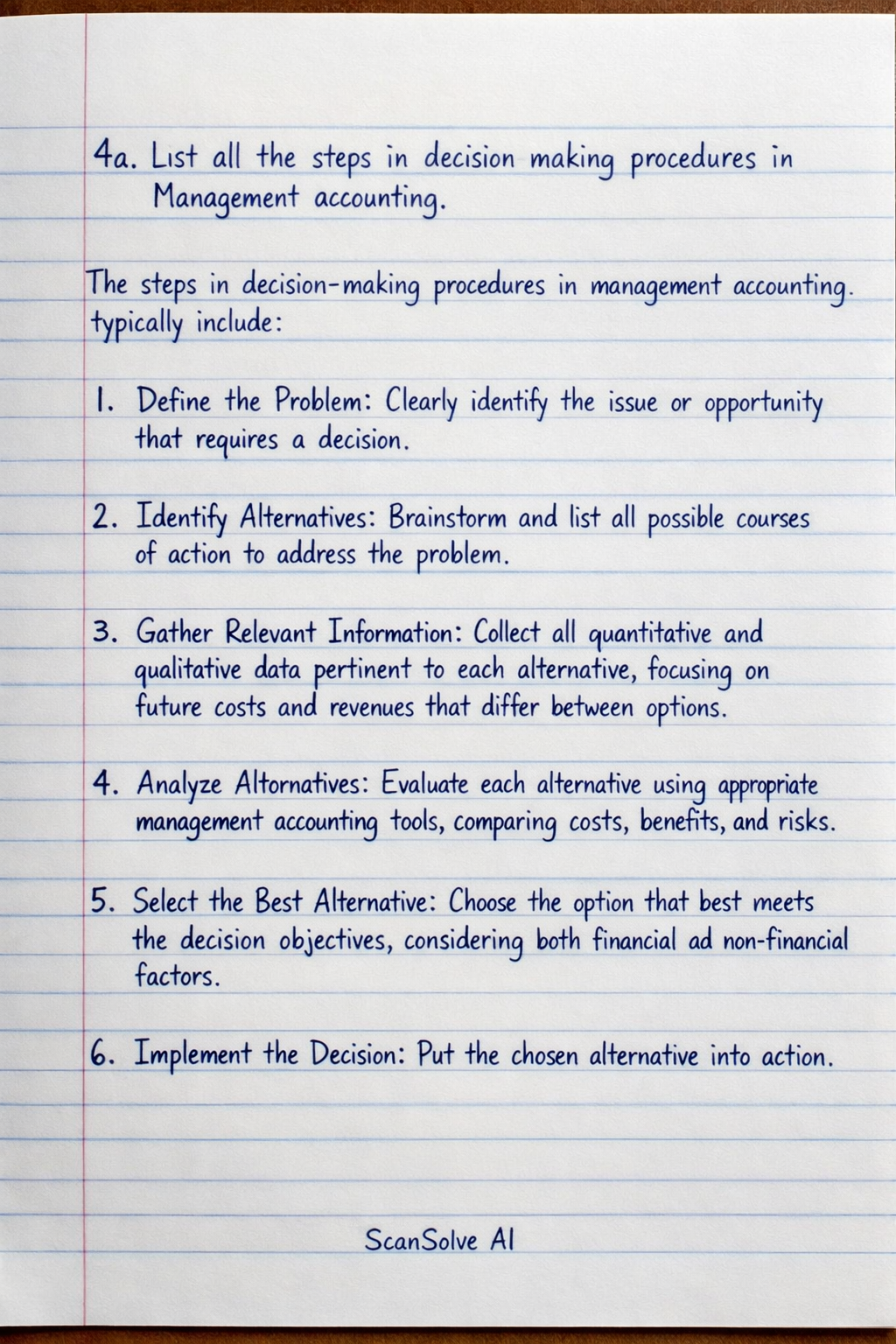
here are the answers for Question Four: 4a. List all the steps in decision making procedures in Management accounting. The steps in decision-making procedures in management accounting typically include: 1. Define the Problem: Clearly identify the issue or opportunity that requires a decision. 2. Identify Alternatives: Brainstorm and list all possible courses of action to address the problem. 3. Gather Relevant Information: Collect all quantitative and qualitative data pertinent to each alternative, focusing on future costs and revenues that differ between options. 4. Analyze Alternatives: Evaluate each alternative using appropriate management accounting tools, comparing costs, benefits, and risks. 5. Select the Best Alternative: Choose the option that best meets the decision objectives, considering both financial and non-financial factors. 6. Implement the Decision: Put the chosen alternative into action. 7. Review and Evaluate: Monitor the outcomes of the decision and compare them against expectations, making adjustments as necessary. 4b. List and explain the tools and Techniques used in management accounting for making decision. Management accounting uses various tools and techniques to aid decision-making: • Cost-Volume-Profit (CVP) Analysis: This technique examines the relationships between costs, sales volume, and profit. It helps in determining break-even points, target profits, and the impact of changes in costs or sales volume on profitability. • Relevant Costing: This involves identifying and analyzing only those costs and revenues that will change as a direct result of a decision. It helps in making short-term operational decisions like make-or-buy, special orders, or dropping a product line. • Budgeting: The process of creating detailed financial plans for future periods. Budgets serve as a roadmap for operations, resource allocation, and performance evaluation, guiding decisions on spending and revenue generation. • Variance Analysis: This technique compares actual financial results with budgeted or standard amounts to identify and explain differences (variances). It helps management understand why performance deviated from plans and take corrective actions. • Capital Budgeting Techniques: Methods like Net Present Value (NPV), Internal Rate of Return (IRR), and Payback Period are used to evaluate long-term investment projects. They help in deciding which projects to undertake based on their potential returns and risks. 4c. How can transfer pricing help a company in making their pricing decision in a turbulent economy environment. In a turbulent economic environment, transfer pricing can help a company make pricing decisions by: • Decentralized Decision-Making: It allows individual divisions to operate as profit centers, giving them autonomy to make pricing decisions that respond quickly to local market conditions and economic shifts, without constant head office intervention. • Performance Evaluation: By setting appropriate transfer prices, the profitability of each division can be accurately measured, even when they trade internally. This helps management identify which divisions are performing well or struggling in the turbulent environment, guiding resource allocation and strategic adjustments. • Optimizing Resource Allocation: Transfer prices can be set to encourage efficient internal resource allocation. For example, if an external market exists, market-based transfer prices can motivate divisions to buy or sell internally only if it's more efficient than external options, ensuring optimal use of company resources during uncertainty. • Tax and Regulatory Compliance: In a turbulent global economy, transfer pricing helps companies manage their tax liabilities across different jurisdictions by ensuring inter-company transactions are priced at arm's length, reducing the risk of penalties and optimizing overall tax efficiency. Drop the next question.