
We read your photo as:
Prepare a cash budget for January, February, and March. List and explain five (5) importance of a cash-budget. You are required: to Calculate Donald Corporation Current ratio, Quick ratio, and Cash ratio
ScanSolve AI Answer
Step-by-step solution
7 stepsHere's the solution to the questions from the image:
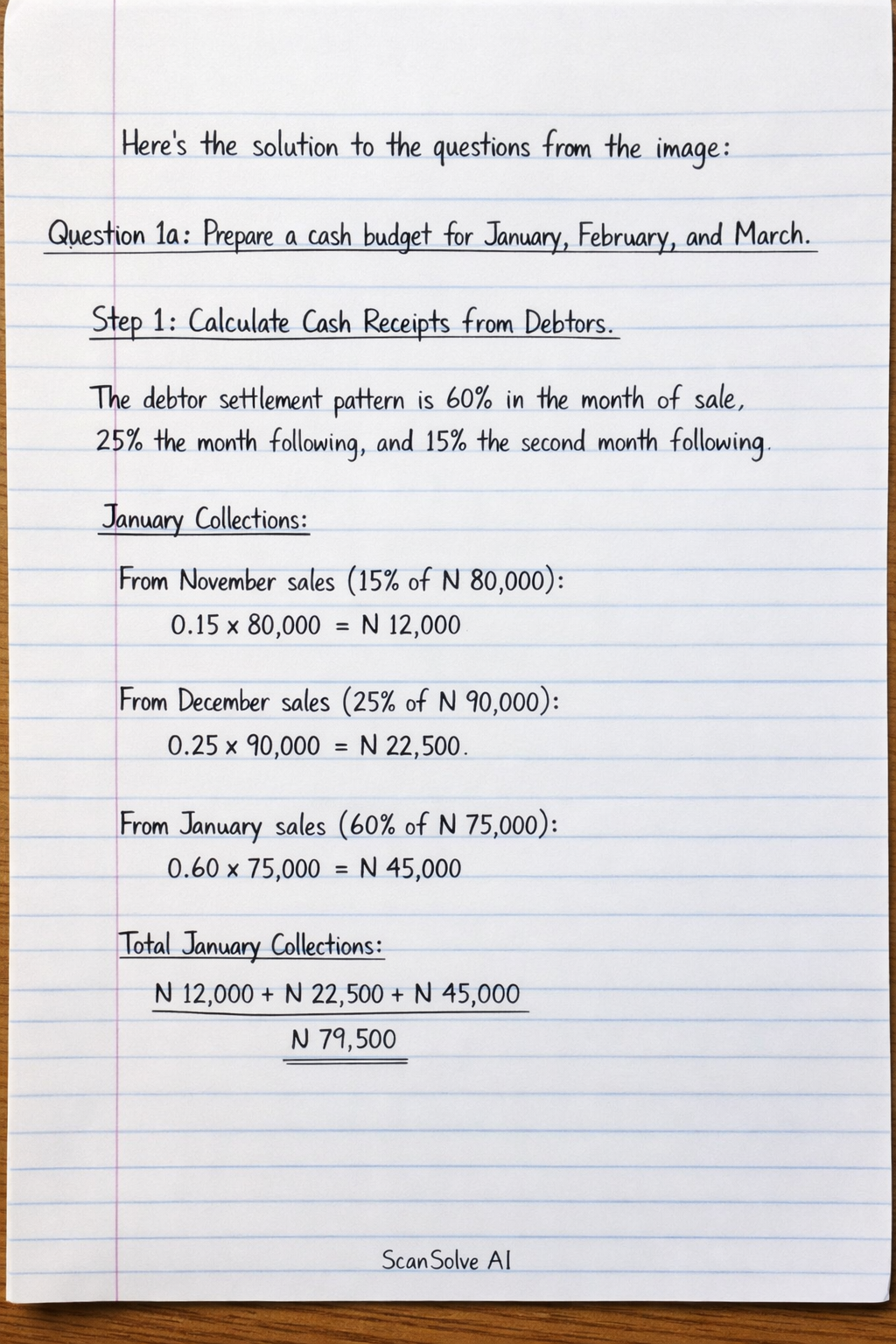
Question 1a: Prepare a cash budget for January, February, and March.
Calculate Cash Receipts from Debtors.
The debtor settlement pattern is 60% in the month of sale, 25% the month following, and 15% the second month following.
-
January Collections:
- From November sales ( of N 80,000):
- From December sales ( of N 90,000):
- From January sales ( of N 75,000):
- Total January Collections:
-
February Collections:
- From December sales ( of N 90,000):
- From January sales ( of N 75,000):
- From February sales ( of N 75,000):
- Total February Collections:
-
March Collections:
- From January sales ( of N 75,000):
- From February sales ( of N 75,000):
- From March sales ( of N 80,000):
- Total March Collections:
-
Calculate Cash Payments for Purchases.
The purchase settlement pattern is 90% in the month of purchase and 10% the month after.
-
January Payments for Purchases:
- From December purchases ( of N 60,000):
- From January purchases ( of N 55,000):
- Total January Payments:
-
February Payments for Purchases:
- From January purchases ( of N 55,000):
- From February purchases ( of N 45,000):
- Total February Payments:
-
March Payments for Purchases:
- From February purchases ( of N 45,000):
- From March purchases ( of N 55,000):
- Total March Payments:
-
Prepare the Cash Budget.
Note: Overheads are N 20,000 per month, including N 5,000 depreciation. Cash overheads are N 15,000 (20,000 - 5,000).
Question 1b: List and explain five (5) importance of a cash budget.
- Liquidity Management: A cash budget helps in forecasting cash surpluses or deficits, allowing management to plan for short-term borrowing to cover deficits or invest excess cash.
- Financial Planning: It provides a clear picture of future cash flows, which is crucial for overall financial planning and making informed decisions about capital expenditures or dividend policies.
- Performance Evaluation: The budget serves as a benchmark against which actual cash flows can be compared, enabling management to identify variances and take corrective actions.
- Coordination: It integrates various functional budgets (e.g., sales, production, purchases) into a single financial plan, ensuring better coordination and alignment across different departments.
- Control over Cash: A cash budget helps in monitoring and controlling cash inflows and outflows, preventing unnecessary expenditures and ensuring the efficient utilization of cash resources.
Question 2a: Calculate Donald Corporation Current ratio, Quick ratio, and Cash ratio.
Given Information:
- Cash and marketable securities = N 400,000
- Accounts receivable = N 1,200,000
- Inventory = N 2,100,000
- Accrued wages and taxes = N 500,000
- Accounts payable = N 800,000
- Notes payable = N 600,000
Calculate Total Current Assets and Total Current Liabilities.
Current Assets = Cash and marketable securities + Accounts receivable + Inventory
Current Liabilities = Accrued wages and taxes + Accounts payable + Notes payable
Calculate the Current Ratio.
Calculate the Quick Ratio (Acid-Test Ratio).
Calculate the Cash Ratio.
Still stuck on this one?
Ask a follow-up, and the answer starts from this question.
More Accounting Questions
Handwritten Step-by-Step Solution
Get this as a handwritten image on WhatsApp — like a tutor wrote it for you.
Try on WhatsApp