
We read your photo as:
ACCOUNTING 2ND TERM 2026 1. Auditing requires A. Preparing budget B. Procedure of recording transactions C. Counting inventory D. Auditing records
ScanSolve AI Answer
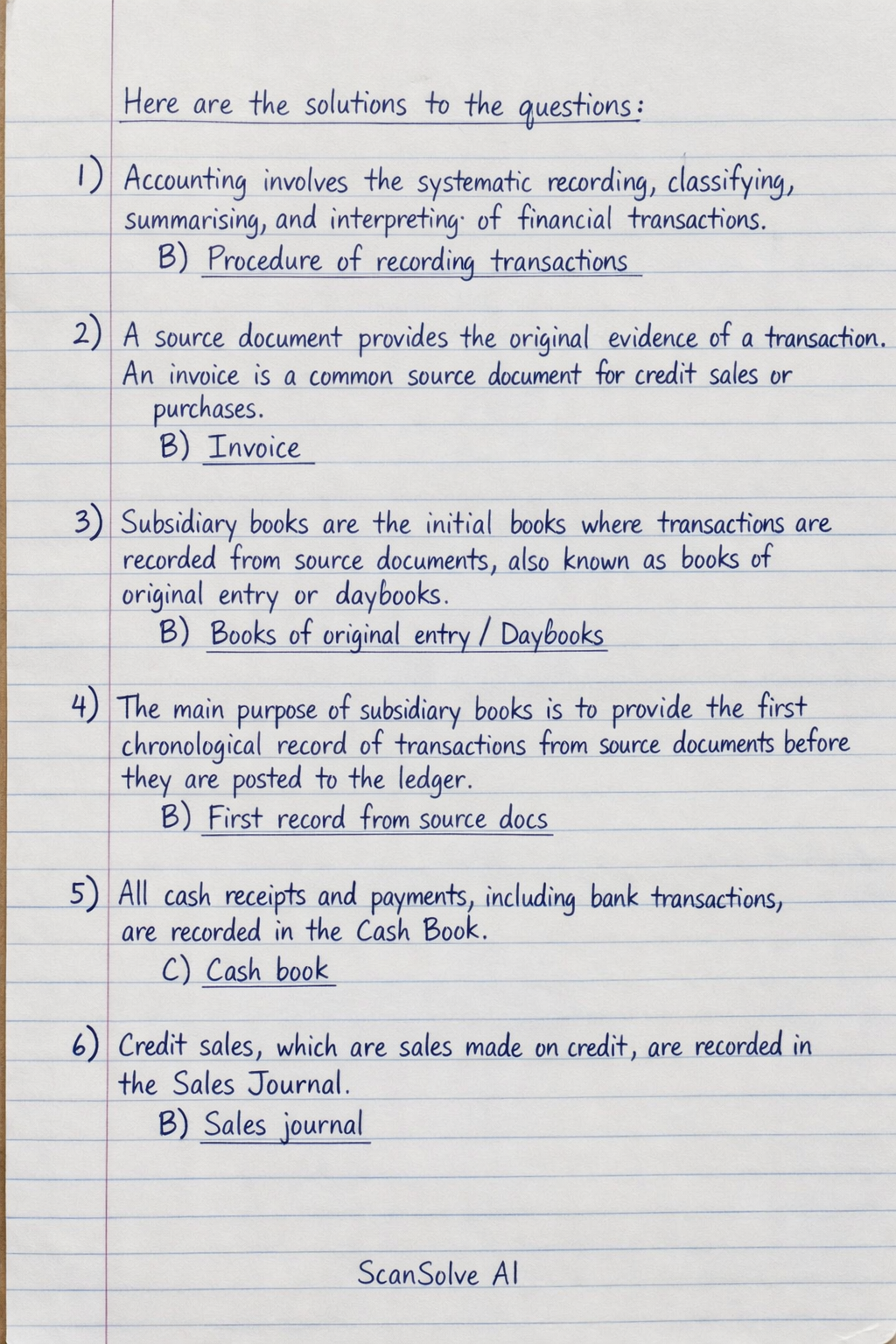
Here are the solutions to the questions:
1) Accounting involves the systematic recording, classifying, summarizing, and interpreting of financial transactions. * B) Procedure of recording transactions
2) A source document provides the original evidence of a transaction. An invoice is a common source document for credit sales or purchases. * B) Invoice
3) Subsidiary books are the initial books where transactions are recorded from source documents, also known as books of original entry or daybooks. * B) Books of original entry/Daybooks
4) The main purpose of subsidiary books is to provide the first chronological record of transactions from source documents before they are posted to the ledger. * B) First record from source docs
5) All cash receipts and payments, including bank transactions, are recorded in the Cash Book. * C) Cash book
6) Credit sales, which are sales made on credit, are recorded in the Sales Journal. * B) Sales journal
7) Credit purchases, which are purchases made on credit, are recorded in the Purchases Journal. * B) Purchases journal
8) Credit notes issued to customers indicate that goods have been returned by customers, which are sales returns. These are recorded in the Sales Returns Journal. * A) Sales returns
9) Credit notes received from suppliers indicate that goods have been returned to suppliers, which are purchases returns. These are recorded in the Purchases Returns Journal. * B) Purchases returns
10) A petty cash book is used to record small, day-to-day cash expenses. * C) Small expenses
11) The General Journal is used to record transactions that do not fit into any other specialized journal (like the cash book, sales journal, or purchases journal). * C) Transactions not in other day books
12) After transactions are initially recorded in the subsidiary books (journals), they are then transferred or posted to the respective Ledger accounts. * B) Ledger accounts
13) A ledger is typically divided into main sections such as the General Ledger, Sales Ledger (for debtors), and Purchases Ledger (for creditors). * B) 3
14) The Purchases Ledger (also known as the Creditors Ledger) contains individual accounts for each credit supplier. * B) Credit suppliers
15) The Sales Ledger (also known as the Debtors Ledger) contains individual accounts for each credit customer. * B) Credit customers
16) The Cash Book serves as both a book of original entry (journal) for cash and bank transactions and also as a ledger account for cash and bank, making it a subsidiary ledger for these accounts. * C) Subsidiary ledger cash/bank
17) The General Ledger contains all accounts that are not maintained in the Sales Ledger or Purchases Ledger, as well as summary control accounts for debtors and creditors. * C) All other accounts + summaries
18) The Purchases Ledger records transactions related to credit suppliers. * B) Credit suppliers
19) The Sales Ledger records transactions related to credit customers. * C) Credit customers
20) A trial balance is a list of all the debit and credit balances extracted from the ledger accounts after they have been balanced, prepared to check the arithmetic accuracy of the ledger. * B) List of balances after balancing
21) Credit sales are first recorded in the Sales Journal. * B) Sales journal
22) Credit purchases are first recorded in the Purchases Journal. * C) Purchases journal
23) The General Journal is used to record transactions that do not fit into any other specialized journal. * C) Transactions not in other day books
Still stuck on this one?
Ask a follow-up, and the answer starts from this question.
More Accounting Questions
Handwritten Step-by-Step Solution
Get this as a handwritten image on WhatsApp — like a tutor wrote it for you.
Try on WhatsApp