
We read your photo as:
What are accounting concepts and conventions, and provide examples for each?
ScanSolve AI Answer
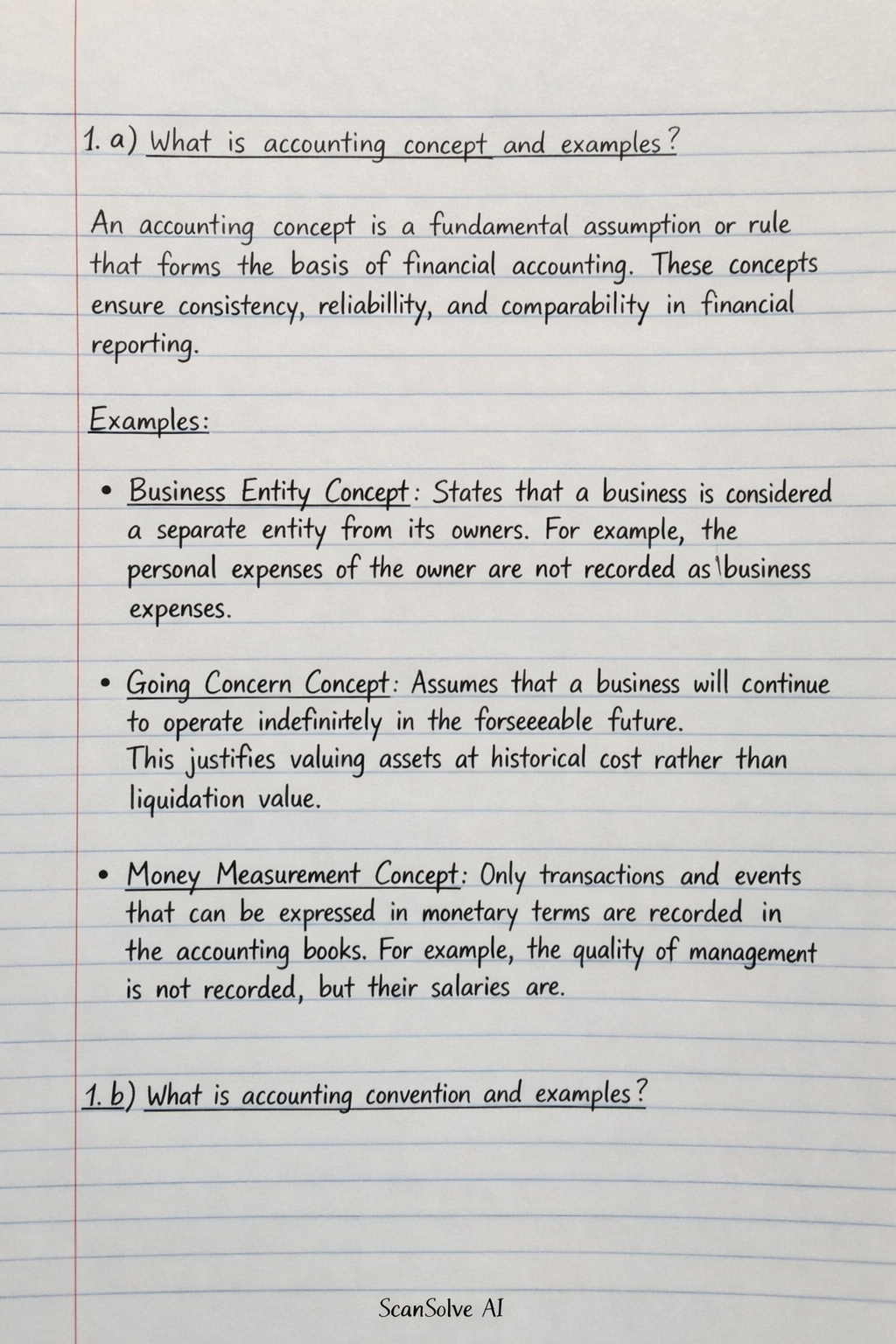
a) What is accounting concept and examples?
An accounting concept is a fundamental assumption or rule that forms the basis of financial accounting. These concepts ensure consistency, reliability, and comparability in financial reporting.
Examples:
- Business Entity Concept: States that a business is considered a separate entity from its owners. For example, the personal expenses of the owner are not recorded as business expenses.
- Going Concern Concept: Assumes that a business will continue to operate indefinitely in the foreseeable future. This justifies valuing assets at historical cost rather than liquidation value.
- Money Measurement Concept: Only transactions and events that can be expressed in monetary terms are recorded in the accounting books. For example, the quality of management is not recorded, but their salaries are.
b) What is accounting convention and examples?
An accounting convention is a guideline or practice that has evolved over time through general acceptance, used to address situations where specific accounting concepts or principles do not provide clear guidance. They help in applying accounting principles consistently.
Examples:
- Convention of Consistency: Requires that accounting methods and practices should be applied uniformly from one accounting period to another to ensure comparability of financial statements. For example, if a company uses the straight-line method for depreciation, it should continue to use it unless there's a valid reason to change.
- Convention of Conservatism (Prudence): Dictates that when there are two equally acceptable accounting treatments, the one that results in lower assets and revenues or higher liabilities and expenses should be chosen. It means "anticipate no profits, but provide for all possible losses." For example, valuing inventory at cost or market price, whichever is lower.
- Convention of Materiality: States that only items that are significant enough to influence the decisions of users of financial statements need to be disclosed. Immaterial items can be treated in a simpler manner. For example, a small stapler might be expensed immediately rather than capitalized as an asset.
c) What are sources of accounting?
The sources of accounting refer to the origins of the rules, principles, and standards that govern how financial transactions are recorded and reported.
Sources include:
- Generally Accepted Accounting Principles (GAAP): A common set of accounting principles, standards, and procedures that companies use to compile their financial statements.
- International Financial Reporting Standards (IFRS): A set of global accounting standards developed by the International Accounting Standards Board (IASB).
- Legislation and Laws: Government acts and regulations (e.g., Company Acts, tax laws) that mandate certain accounting practices.
- Professional Accounting Bodies: Organizations like the Financial Accounting Standards Board (FASB) in the US or the Institute of Chartered Accountants in various countries, which issue accounting standards and guidance.
- Business Practices and Customs: Long-standing traditions and practices within specific industries or businesses that have become generally accepted.
Still stuck on this one?
Ask a follow-up, and the answer starts from this question.
More Accounting Questions
Handwritten Step-by-Step Solution
Get this as a handwritten image on WhatsApp — like a tutor wrote it for you.
Try on WhatsApp