

This accounting problem is solved step by step below, with detailed explanations to help you understand the method and arrive at the correct answer.
ScanSolve AI Answer
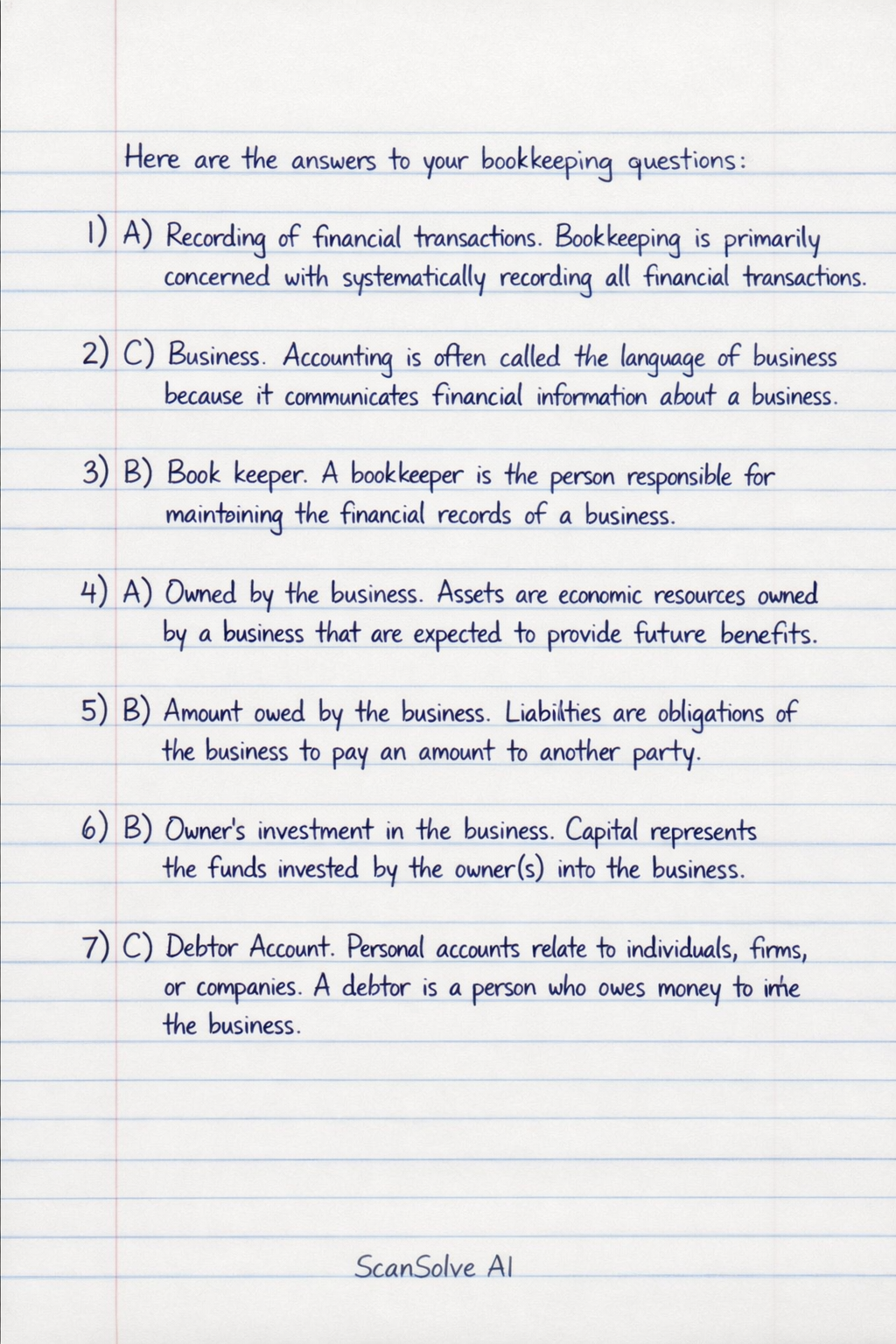
Here are the answers to your bookkeeping questions: 1. A) Recording of financial transactions. Bookkeeping is primarily concerned with systematically recording all financial transactions. 2. C) Business. Accounting is often called the language of business because it communicates financial information about a business. 3. B) Book keeper. A bookkeeper is the person responsible for maintaining the financial records of a business. 4. A) Owned by the business. Assets are economic resources owned by a business that are expected to provide future benefits. 5. B) Amount owed by the business. Liabilities are obligations of the business to pay an amount to another party. 6. B) Owner's investment in the business. Capital represents the funds invested by the owner(s) into the business. 7. C) Debtor Account. Personal accounts relate to individuals, firms, or companies. A debtor is a person who owes money to the business. 8. A) Debit note. When a buyer returns goods to a supplier (goods returned outward), they typically issue a debit note to indicate a reduction in the amount owed. 9. C) Cash Book. The Cash Book is a special journal used to record all cash receipts and cash payments. 10. A) Detect all accounting errors. A Trial Balance is prepared to check the arithmetical accuracy of the ledger accounts, though it does not detect all types of errors. 11. C) Furniture. Furniture is a tangible asset owned by the business. Creditors, Loan, and Bank overdraft are liabilities. 12. B) One transaction affects two accounts. The double-entry principle states that every transaction has two effects, a debit and a credit, on at least two accounts. 13. A) Goods returned to supplier. The Purchases Returns Book (or Returns Outward Book) records goods that the business has purchased and subsequently returned to its suppliers. 14. C) Business Entity Concept. This concept states that the business is treated as a separate entity from its owner(s) for accounting purposes. 15. B) Debit side of cash book. When a cash discount is allowed by the business, it is an expense and is recorded on the debit side of the cash book (in the discount column). 16. C) Rent Account. Nominal accounts relate to expenses, incomes, gains, and losses. Rent is an expense. 17. B) Personal accounts. The rule "Debit the receiver and credit the giver" is applied to personal accounts. 18. C) Ledger. The Ledger is the principal book where accounts are maintained, not a subsidiary book (which are books of original entry). 19. C) Profit. When income exceeds expenditure, the result is a profit. 20. B) Cash Account. When cash is received, the Cash Account (an asset) increases, and assets increase with a debit. That's 2 down. 3 left today — send the next one.