
We read your photo as:
FINANCIAL ACCOUNTING ASSIGNMENT WRITE SHORT NOTE ON THE FOLLOWING: 1: ACCOUNT TYPES OF ACCOUNT 1: PERSONAL 2: IMPERSONAL 3: NOMINAL 4: REAL LEDGER TYPES OF LEDGER 1: NOMINAL LEDGER 2: GENERAL 3: SALES 4: PURCHASES SUBSIDIARY BOOKS 1: PURCHASES BOOK 2: SALES RETURNS 3: PURCHASES JOURNAL
ScanSolve AI Answer
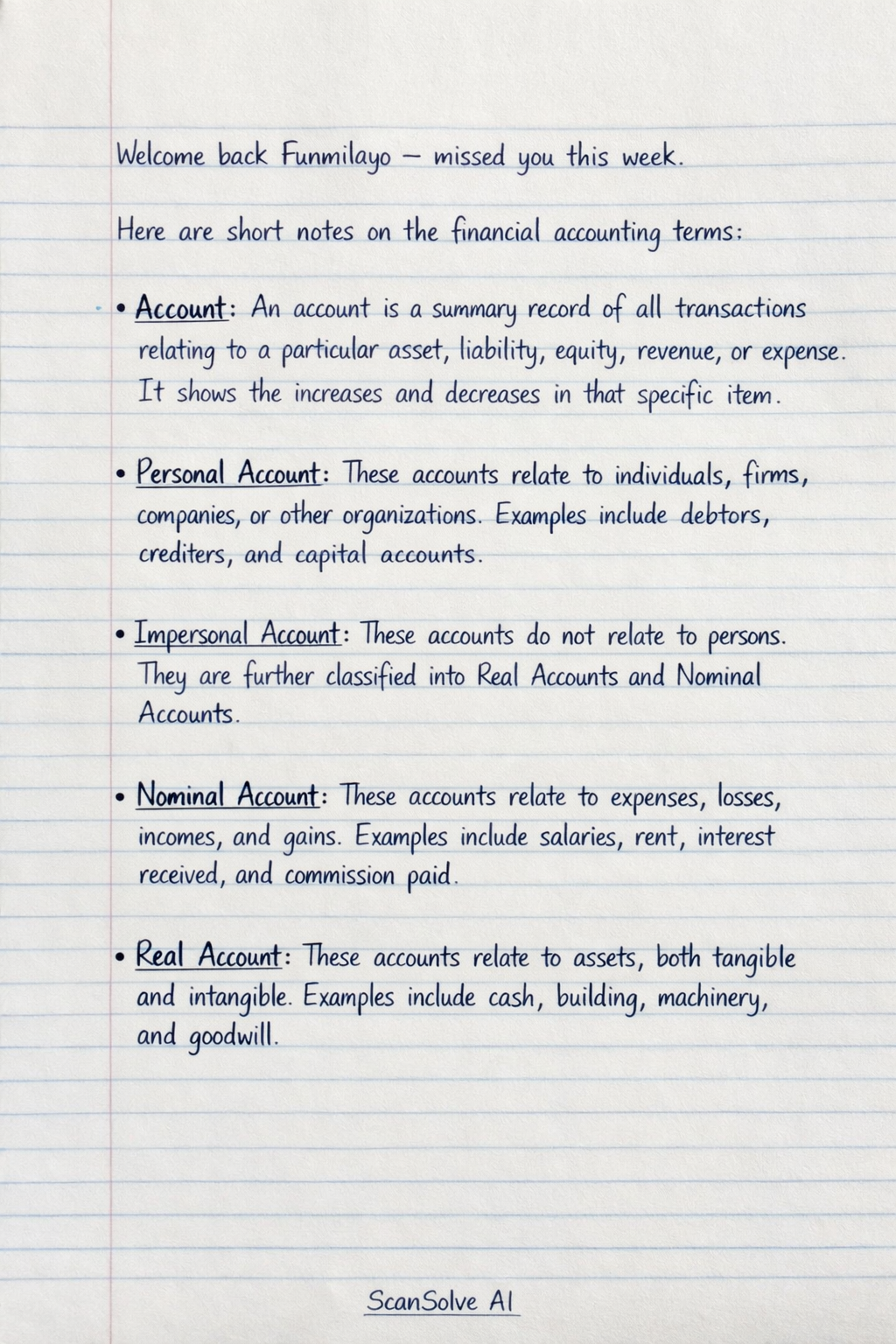
Here are short notes on the financial accounting terms:
-
Account: An account is a summary record of all transactions relating to a particular asset, liability, equity, revenue, or expense. It shows the increases and decreases in that specific item.
- Personal Account: These accounts relate to individuals, firms, companies, or other organizations. Examples include debtors, creditors, and capital accounts.
- Impersonal Account: These accounts do not relate to persons. They are further classified into Real Accounts and Nominal Accounts.
- Nominal Account: These accounts relate to expenses, losses, incomes, and gains. Examples include salaries, rent, interest received, and commission paid.
- Real Account: These accounts relate to assets, both tangible and intangible. Examples include cash, building, machinery, and goodwill.
-
Ledger: A ledger is the principal book of accounts where all transactions from the journal are posted, categorized into individual accounts. It provides a complete record of all financial transactions for each account.
- Nominal Ledger: This ledger contains all nominal accounts, such as expenses, revenues, gains, and losses. It is used to prepare the income statement.
- General Ledger: This is the main ledger that contains all the accounts necessary to prepare financial statements, including assets, liabilities, equity, revenues, and expenses. It summarizes all transactions from subsidiary ledgers and journals.
- Sales Ledger: Also known as the debtors' ledger, it contains individual accounts for each customer who buys goods on credit. It tracks amounts owed by customers.
- Purchases Ledger: Also known as the creditors' ledger, it contains individual accounts for each supplier from whom goods are purchased on credit. It tracks amounts owed to suppliers.
-
Subsidiary Books: These are primary books of entry used to record specific types of transactions of a similar nature. They simplify the recording process by reducing the number of entries in the general journal.
- Purchases Book: This book records all credit purchases of goods meant for resale. Cash purchases are not recorded here.
- Sales Returns: This refers to goods returned by customers to the business. The Sales Returns Book (or Returns Inward Book) is used to record these returns.
- Purchases Journal: This is another name for the Purchases Book, used to record all credit purchases of goods.
Still stuck on this one?
Ask a follow-up, and the answer starts from this question.
More Accounting Questions
Handwritten Step-by-Step Solution
Get this as a handwritten image on WhatsApp — like a tutor wrote it for you.
Try on WhatsApp