We read your photo as:

Calculate the break-even point in units, sales revenue, profit, margin of safety, and selling price needed to achieve a specific profit.

Accounting

ScanSolve AI Answer

Step-by-step solution

7 steps

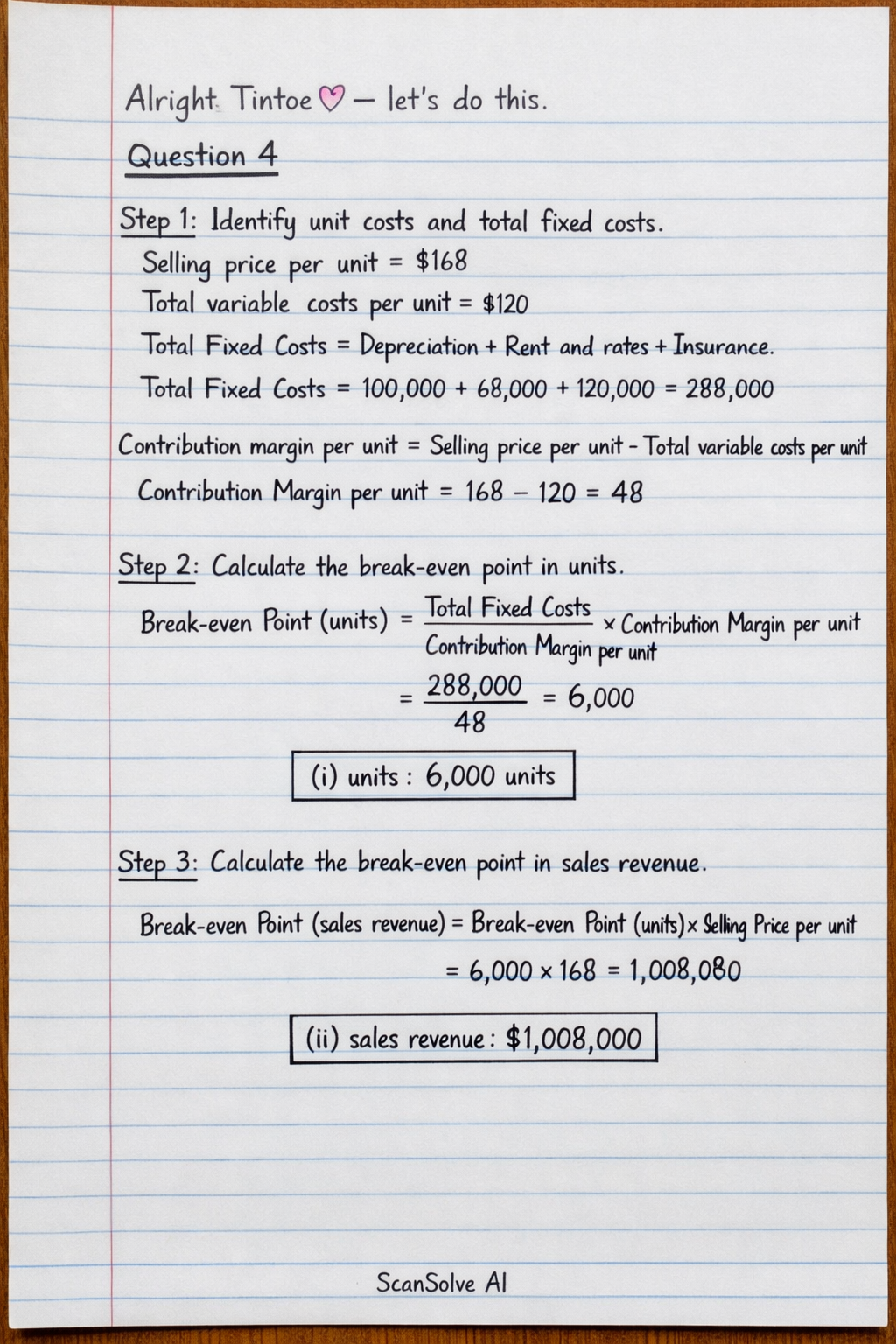
Question 4

a) Calculate the break-even point in

  1. Identify unit costs and total fixed costs.

    Selling price per unit = 168Totalvariablecostsperunit=168 Total variable costs per unit = 120 Total Fixed Costs = Depreciation + Rent and rates + Insurance

    Total Fixed Costs=100,000+68,000+120,000=288,000\text{Total Fixed Costs} = 100,000 + 68,000 + 120,000 = 288,000

    Contribution margin per unit = Selling price per unit - Total variable costs per unit

    Contribution Margin per unit=168−120=48\text{Contribution Margin per unit} = 168 - 120 = 48

    a) (i) units,

  2. Calculate the break-even point in units.

    Break-even Point (units)=Total Fixed CostsContribution Margin per unit\text{Break-even Point (units)} = \frac{\text{Total Fixed Costs}}{\text{Contribution Margin per unit}} Break-even Point (units)=288,00048=6,000\text{Break-even Point (units)} = \frac{288,000}{48} = 6,000

    a) (i) units: 6,000 units\boxed{\text{6,000 units}}

    a) (ii) sales revenue.

  3. Calculate the break-even point in sales revenue.

    Break-even Point (sales revenue)=Break-even Point (units)×Selling Price per unit\text{Break-even Point (sales revenue)} = \text{Break-even Point (units)} \times \text{Selling Price per unit} Break-even Point (sales revenue)=6,000×168=1,008,000\text{Break-even Point (sales revenue)} = 6,000 \times 168 = 1,008,000

    a) (ii) sales revenue: \boxed{\1,008,000}$

    b) If the firm decides to start by making and selling 13 000 units per annum, calculate at this level of activity,

    b) (i) profit,

  4. Calculate profit at 13,000 units.

    Total Sales Revenue = 13,000 units ×\times 168/unit=168/unit = 2,184,000
    Total Variable Costs = 13,000 units ×\times 120/unit=120/unit = 1,560,000
    Total Contribution = Total Sales Revenue - Total Variable Costs

    Total Contribution=2,184,000−1,560,000=624,000\text{Total Contribution} = 2,184,000 - 1,560,000 = 624,000

    Profit = Total Contribution - Total Fixed Costs

    Profit=624,000−288,000=336,000\text{Profit} = 624,000 - 288,000 = 336,000

    b) (i) profit: \boxed{\336,000}$

    b) (ii) margin of safety as a percentage,

  5. Calculate margin of safety as a percentage.

    Margin of Safety (units) = Actual Sales Units - Break-even Sales Units

    Margin of Safety (units)=13,000−6,000=7,000 units\text{Margin of Safety (units)} = 13,000 - 6,000 = 7,000 \text{ units}

    Margin of Safety as a percentage = Margin of Safety (units)Actual Sales Units×100%\frac{\text{Margin of Safety (units)}}{\text{Actual Sales Units}} \times 100\%

    Margin of Safety as a percentage=7,00013,000×100%≈53.85%\text{Margin of Safety as a percentage} = \frac{7,000}{13,000} \times 100\% \approx 53.85\%

    b) (ii) margin of safety as a percentage: 53.85%\boxed{53.85\%}

    b) (iii) the selling price needed to achieve a profit of $1 402 000,

  6. Calculate the new selling price for a target profit.

    Target Profit = $1,402,000 Required Total Contribution = Target Profit + Total Fixed Costs

    Required Total Contribution=1,402,000+288,000=1,690,000\text{Required Total Contribution} = 1,402,000 + 288,000 = 1,690,000

    Required Contribution per unit = Required Total ContributionSales Units\frac{\text{Required Total Contribution}}{\text{Sales Units}}

    Required Contribution per unit=1,690,00013,000=130\text{Required Contribution per unit} = \frac{1,690,000}{13,000} = 130

    New Selling Price per unit = Required Contribution per unit + Variable Cost per unit

    New Selling Price per unit=130+120=250\text{New Selling Price per unit} = 130 + 120 = 250

    *b) (iii) the selling price needed to achieve a profit of 1402000:∗1 402 000:* \boxed{$250}$

    b) (iv) the percentage change in selling price to achieve the result identified in (iii) above.

  7. Calculate the percentage change in selling price.

    Percentage Change = New Selling Price−Original Selling PriceOriginal Selling Price×100%\frac{\text{New Selling Price} - \text{Original Selling Price}}{\text{Original Selling Price}} \times 100\%

    Percentage Change=250−168168×100%=82168×100%≈48.81%\text{Percentage Change} = \frac{250 - 168}{168} \times 100\% = \frac{82}{168} \times 100\% \approx 48.81\%

    b) (iv) the percentage change in selling price: 48.81%\boxed{48.81\%}

    c) State five assumptions underlying cost-volume-profit (break-even) analysis.

    c) Assumptions:

    • All costs can be clearly classified as either fixed or variable.
    • The selling price per unit remains constant regardless of the volume sold.
    • Variable costs per unit remain constant regardless of the volume produced.
    • Fixed costs remain constant within the relevant range of activity.
    • The sales mix remains constant for multi-product companies.
    • Production equals sales, meaning there is no change in inventory levels.
Was this helpful?

Still stuck on this one?

Ask a follow-up, and the answer starts from this question.

Got a different question?Ask your own question
Handwritten step-by-step solution preview

Handwritten Step-by-Step Solution

Get this as a handwritten image on WhatsApp — like a tutor wrote it for you.

Try on WhatsApp