
We read your photo as:
What is the Break-Even Point (BEP) in sales and Margin of Safety given these financial figures?
ScanSolve AI Answer
Answer
Step-by-step solution
17 stepsHere are the solutions to questions 71, 72, 73, 74, 75, 76, and 77:
71. Sales ₹ 5,00,000; Variable Cost ₹ 3,00,000; Profit ₹ 1,00,000 then B.E.P. will be:
Calculate Contribution.
Calculate Fixed Cost.
Calculate P/V Ratio.
Calculate Break-even Point (in Sales).
The B.E.P. will be: (a)
72. Fixed Cost ₹ 1,20,000, Loss ₹ 20,000, Sales ₹ 4,00,000 then Margin of Safety will be:
Calculate Contribution.
Calculate P/V Ratio.
Calculate Break-even Point (in Sales).
Calculate Margin of Safety.
The Margin of Safety will be: (a)
73. Fixed Cost ₹ 20,000; Sales ₹ 1,00,000; Variable Cost ₹ 60,000; Desired Profit ₹ 10,000 then required sales will be:
Calculate Contribution from given Sales and Variable Cost.
Calculate P/V Ratio.
Calculate Required Sales for Desired Profit.
The required sales will be: (a)
74. Sales ₹ 4,00,000, P/V Ratio 30%, Fixed Cost ₹ 40,000 then amount of profit will be:
Calculate Contribution.
Calculate Profit.
The amount of profit will be: (a)
75. When B.E.P. is 500 units and contribution per units is ₹ 2, then fixed cost would be:
Use the formula for Break-even Point in units.
Rearrange to find Fixed Cost.
The fixed cost would be: (b)
76. If Sales ₹ 60,000 and P/V Ratio is 30% then variable cost will be:
Calculate Contribution.
Calculate Variable Cost.
The variable cost will be: (a)
77. Variable Cost per unit remains... with changes in level of activity.
Variable cost per unit is a cost that remains constant per unit of output, regardless of the level of production. Total variable cost changes with the level of activity, but the cost per unit does not.
The correct answer is: (a)
Try one yourself
A new problem that tests the same skill.
Still stuck on this one?
Ask a follow-up, and the answer starts from this question.
More Accounting Questions
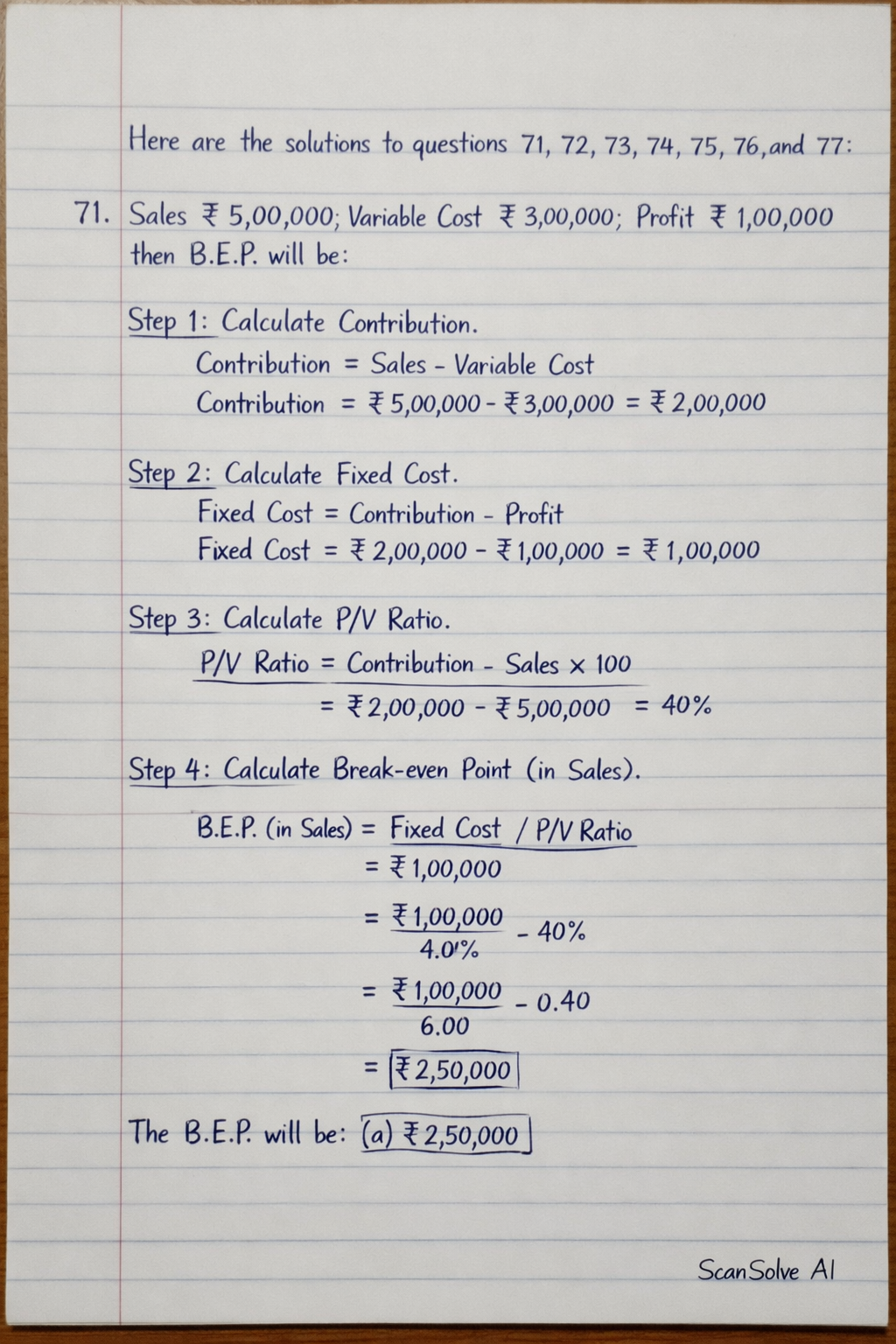
Handwritten Step-by-Step Solution
Get this as a handwritten image on WhatsApp — like a tutor wrote it for you.
Try on WhatsApp