
We read your photo as:
Explain the difference between redeemable and irredeemable preference shares and calculate the value of the preference share under different scenarios.
ScanSolve AI Answer
This answer stops before the end.
It was cut off when it was first written. Ask ScanSolve this question again for the full working.
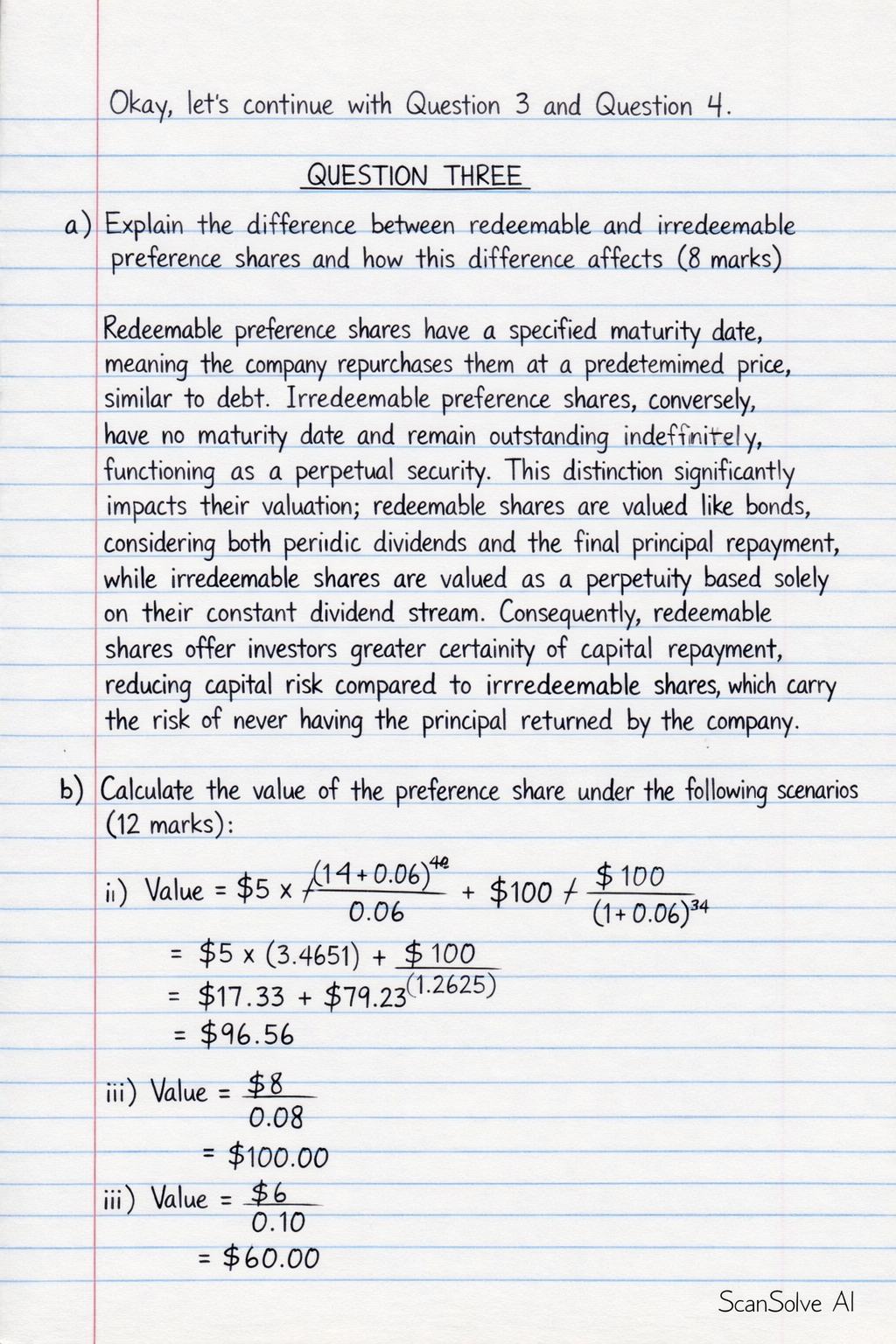
Okay, let's continue with Question 3 and Question 4.
QUESTION THREE
a) Explain the difference between redeemable and irredeemable preference shares and how this difference affects (8 marks)
Redeemable preference shares have a specified maturity date, meaning the company repurchases them at a predetermined price, similar to debt. Irredeemable preference shares, conversely, have no maturity date and remain outstanding indefinitely, functioning as a perpetual security. This distinction significantly impacts their valuation; redeemable shares are valued like bonds, considering both periodic dividends and the final principal repayment, while irredeemable shares are valued as a perpetuity based solely on their constant dividend stream. Consequently, redeemable shares offer investors greater certainty of capital repayment, reducing capital risk compared to irredeemable shares, which carry the risk of never having the principal returned by the company.
b) Calculate the value of the preference share under the following scenarios (12 marks)
Given:
Face Value (FV) = GH¢100
Dividend rate = 10%
Required rate of return () = 11%
First, calculate the annual preference dividend ():
i) If the share has a maturity period of 6 years
Step 1: Identify the given values for a redeemable preference share.
years
Step 2: Calculate the present value of the annual dividends.
Step 3: Calculate the present value of the face value (redemption amount).
Step 4: Sum the present values to find the intrinsic value ().
ii) If the share has no maturity date
Step 1: Identify the given values for an irredeemable preference share.
Step 2: Calculate the intrinsic value () using the perpetuity formula.
Still stuck on this one?
Ask a follow-up, and the answer starts from this question.
More Accounting Questions
Handwritten Step-by-Step Solution
Get this as a handwritten image on WhatsApp — like a tutor wrote it for you.
Try on WhatsApp