
We read your photo as:
Mention five advantages of control accounts. b. State five accounting procedure in joint venture accounts? b. State four methods of apportionment of expenses b. State five Accounting requirements.
Accounting
ScanSolve AI Answer
Step-by-step solution
13 stepshere are the answers to the questions from the image:
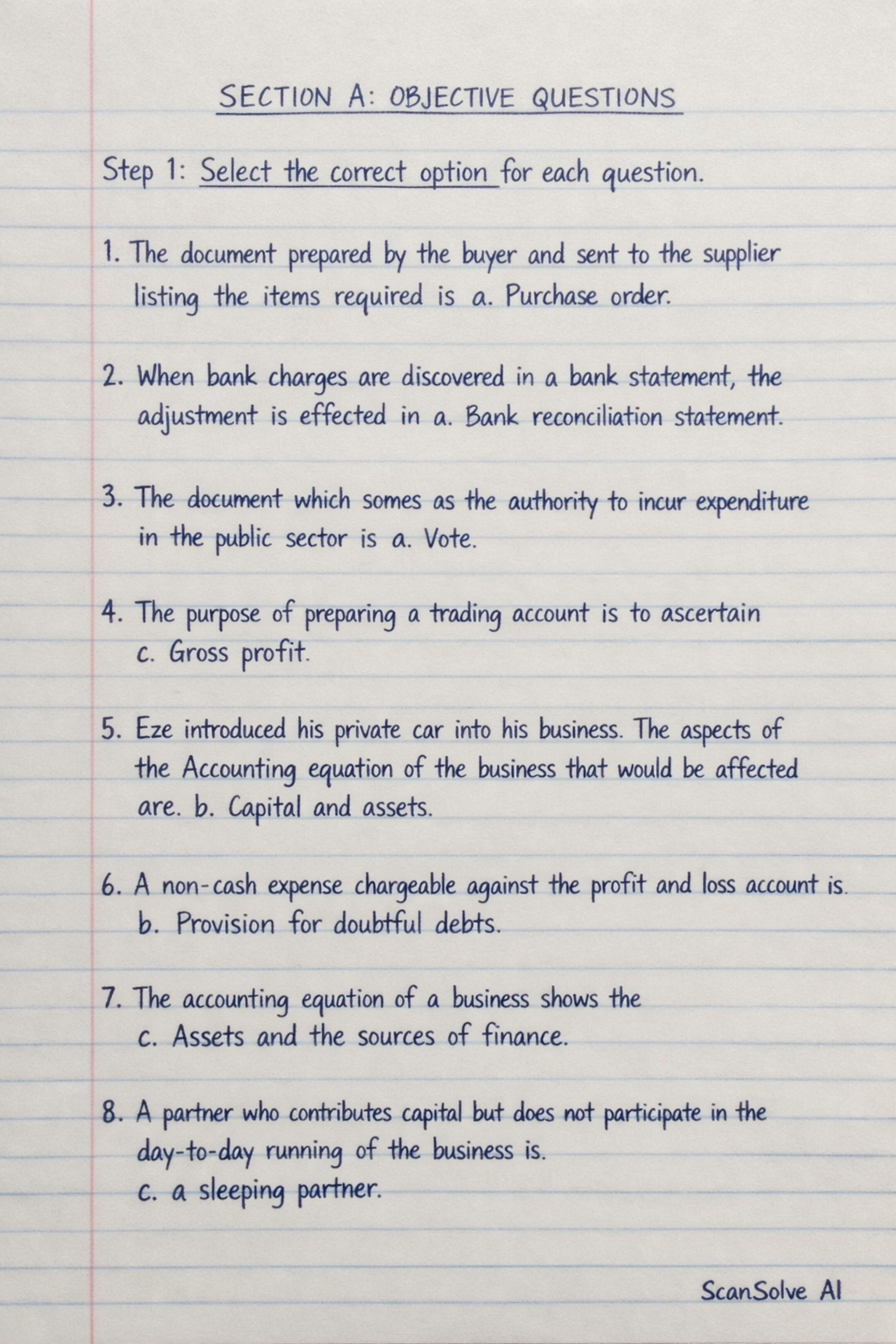
SECTION A: OBJECTIVE QUESTIONS
Select the correct option for each question.
- The document prepared by the buyer and sent to the supplier listing the items required is a. Purchase order.
- When bank charges are discovered in a bank statement, the adjustment is effected in the a. Bank reconciliation statement.
- The document which serves as the authority to incur expenditure in the public sector is a. Vote.
- The purpose of preparing a trading account is to ascertain c. Gross profit.
- Eze introduced his private car into his business. The aspects of the Accounting equation of the business that would be affected are b. Capital and assets.
- A non-cash expense chargeable against the profit and loss account is b. Provision for doubtful debts.
- The accounting equation of a business shows the c. Assets and the sources of finance.
- A partner who contributes capital but does not participate in the day-to-day running of the business is c. a sleeping partner.
- The internal users of accounting information are b. investors.
Use the provided information to answer questions 10-12.
- Net profit for the year = N40,500
- Interest on capital = 5% per annum
- Partners share profits and losses in proportion to their capital contribution.
Calculate interest on capital for each partner:
- Ata:
- Bubu:
- Chikum: Total interest on capital =
Calculate remaining profit for sharing:
Remaining profit = Net profit - Total interest on capital
Remaining profit =Calculate capital ratios:
Ata : Bubu : Chikum =
Total ratio parts =Calculate each partner's share of remaining profit:
- Ata's share =
- Bubu's share =
- Chikum's share =
Calculate total profit share for each partner (Interest on Capital + Share of Remaining Profit):
- Ata's total profit share =
- Bubu's total profit share =
- Chikum's total profit share =
- The profit available for sharing by the partner is c. N36,000.
- The balance of Chikum current account is c. N9,000.
- Bubu's share of profit is c. N12,000.
Answer questions 13-15.
- Income received in advance is treated in the balance sheet as c. current liabilities.
- The excess of net asset acquired over purchase consideration is c. Capital reserve.
- A disadvantage of cash basis of government accounting is that it c. makes no allowance for depreciation.
SECTION B: ESSAY QUESTIONS
Answer question 1a.
- 1a. What is a Bank Reconciliation statement? A Bank Reconciliation Statement is a document that compares the cash balance in a company's general ledger (cash book) with the corresponding balance on the bank statement. Its purpose is to identify and explain any differences between the two balances, ensuring that both records are accurate and up-to-date.
Answer question 1b.
- 1b. State five reasons for disagreement between the cash book and Bank Statement.
- Unpresented Cheques: Cheques issued by the company but not yet presented to the bank for payment.
- Uncredited Lodgements (Deposits in Transit): Cash or cheques deposited by the company but not yet credited by the bank.
- Bank Charges: Fees charged by the bank that the company has not yet recorded in its cash book.
- Direct Debits/Standing Orders: Payments made directly from the bank account by the bank's instruction (e.g., utility bills) that the company may not have recorded.
- Dishonoured Cheques: Cheques deposited by the company but returned unpaid by the bank (e.g., due to insufficient funds) which the company may not have removed from its cash book.
- 1b. State five reasons for disagreement between the cash book and Bank Statement.
Answer question 2a.
- 2a. What is a control Account? A Control Account is a summary account in the general ledger that represents the total of a group of individual subsidiary ledger accounts. For example, a Debtors Control Account summarizes all individual customer accounts in the Sales Ledger, and a Creditors Control Account summarizes all individual supplier accounts in the Purchases Ledger.
Answer question 2b.
- 2b. Mention five advantages of control Account.
- Error Detection: Helps to locate errors by comparing the balance of the control account with the total of the subsidiary ledger.
- Fraud Prevention: Reduces the chances of fraud as it provides an independent check on the accuracy of individual ledger accounts.
- Time Saving: Reduces the work of the general ledger clerk as only the total figures from the subsidiary ledgers are posted to the control account.
- Internal Check: Acts as an internal check system, as one person can maintain the control account while another maintains the subsidiary ledger.
- Trial Balance Preparation: Facilitates the preparation of the trial balance quickly, as only the control account balances are needed.
- 2b. Mention five advantages of control Account.
Answer question 3a.
- 3a. What is a Joint ventures Accounts? A Joint Ventures Account is a temporary account used to record all transactions related to a specific joint venture project undertaken by two or more parties. It tracks all revenues, expenses, and contributions associated with the venture to determine its profit or loss, which is then shared among the co-venturers.
Answer question 3b.
- 3b. State five accounting procedure in joint ventures.
- Separate Books of Accounts: A separate set of books may be maintained for the joint venture, or each co-venturer may record their transactions in their own books.
- Memorandum Joint Venture Account: A memorandum joint venture account is often prepared to calculate the profit or loss of the venture, without being part of the double-entry system.
- Co-venturers' Accounts: Each co-venturer maintains an account for the other co-venturers to record their contributions, expenses, and share of profit/loss.
- Valuation of Unsold Stock: Any unsold stock at the end of the venture is valued and taken over by one or more co-venturers, or sold, with the proceeds recorded.
- Settlement of Accounts: Upon completion of the venture, the profit or loss is distributed among the co-venturers, and their accounts are settled, usually by cash payment.
- 3b. State five accounting procedure in joint ventures.
Answer question 4a.
- 4a. What is a Department Account? A Department Account is an accounting record maintained for each separate department within a business. Its purpose is to track the revenues, expenses, and profits or losses generated by each department independently, allowing management to assess the performance and profitability of individual segments of the business.
Answer question 4b.
- 4b. State four methods of apportionment of expenses.
- Direct Allocation: Expenses directly attributable to a specific department (e.g., departmental salaries) are charged directly to that department.
- Sales Basis: Expenses that vary with sales volume (e.g., selling commissions) are apportioned based on the sales revenue of each department.
- Floor Area Basis: Expenses related to space occupied (e.g., rent, rates) are apportioned based on the floor area used by each department.
- Number of Employees Basis: Expenses related to personnel (e.g., staff welfare) are apportioned based on the number of employees in each department.
- 4b. State four methods of apportionment of expenses.
Answer question 5a.
- 5a. What is a partnership Account? A Partnership Account refers to the set of financial records maintained for a business owned and operated by two or more individuals (partners). These accounts track the partners' capital contributions, drawings, share of profits or losses, interest on capital, interest on drawings, and salaries, reflecting each partner's financial stake and transactions with the firm.
Answer question 5b.
- 5b. State five Accounting requirements.
- Capital Accounts: Separate accounts for each partner to record their initial and subsequent capital contributions.
- Current Accounts: Separate accounts for each partner to record their share of profits/losses, drawings, interest on capital, interest on drawings, and salaries.
- Profit and Loss Appropriation Account: An account prepared after the Profit and Loss Account to show how the net profit is distributed among partners.
- Partnership Agreement: The accounting treatment must adhere to the terms specified in the partnership deed.
- Drawings Accounts: Records of amounts of cash or goods withdrawn by partners for personal use.
- 5b. State five Accounting requirements.
Was this helpful?
Still stuck on this one?
Ask a follow-up, and the answer starts from this question.
Got a different question?Ask your own question
More Accounting Questions
Qb. Explain any four types of subsidiary books used in accounting. (4 Marks) c. State four advantages…QCost Accounting trials Define Cost Accounting and explain its importance to a manufacturing…QMention four advantages of using a computer. List four basic parts of a computer. Give the three…QAcc 202 Assignments Define the following terms Joint arrangement joint control joint operation…Q_ accounting is found useful in business development because it helps management as a control…
Handwritten Step-by-Step Solution
Get this as a handwritten image on WhatsApp — like a tutor wrote it for you.
Try on WhatsApp