
We read your photo as:
Posting means: A. Record source B. Transfer to ledgers C. Prepare trial D. Balance
ScanSolve AI Answer
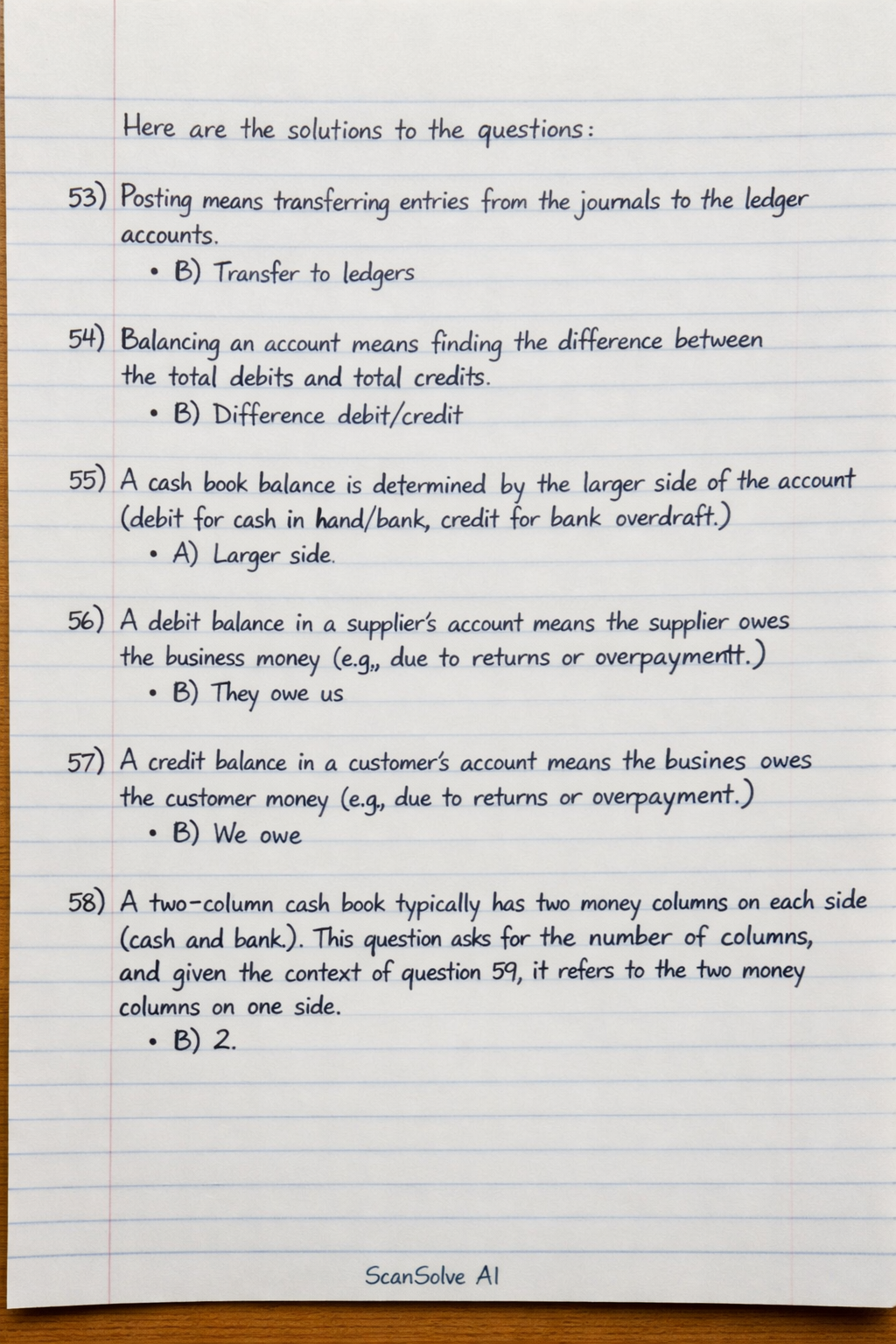
Here are the solutions to the questions:
53) Posting means transferring entries from the journals to the ledger accounts. * B) Transfer to ledgers
54) Balancing an account means finding the difference between the total debits and total credits. * B) Difference debit/credit
55) A cash book balance is determined by the larger side of the account (debit for cash in hand/bank, credit for bank overdraft). * A) Larger side
56) A debit balance in a supplier's account means the supplier owes the business money (e.g., due to returns or overpayment). * B) They owe us
57) A credit balance in a customer's account means the business owes the customer money (e.g., due to returns or overpayment). * B) We owe
58) A two-column cash book typically has two money columns on each side (cash and bank). This question asks for the number of columns, and given the context of question 59, it refers to the two money columns on one side. * B) 2
59) A two-column cash book has two money columns on each side, typically for cash and bank transactions. * B) Cash/bank
60) Discount allowed is recorded in the cash book (in the discount column on the debit side) when cash is received from a customer. * B) Cash book
61) Discount received is recorded in the cash book (in the discount column on the credit side) when cash is paid to a supplier. * B) Cash book
62) Bad debts are typically recorded in the General Journal when written off. * C) General journal
63) Depreciation is an adjusting entry recorded in the General Journal. * C) General journal
64) Accrued expenses are adjusting entries recorded in the General Journal. * C) General journal
65) Prepaid expenses are adjusting entries recorded in the General Journal. * C) General journal
66) A real account relates to assets. * C) Machinery
67) A nominal account relates to expenses, incomes, gains, or losses. * C) Wages
68) A personal account relates to individuals, firms, or institutions. * C) Creditor-ABC Ltd
69) Assets increase with a debit entry. * B) Increases
70) Liabilities increase with a credit entry. * B) Increases
71) Income increases with a credit entry when it is earned. * A) Earned
72) Expenses increase with a debit entry when they are incurred. Among the given options, "unpaid" implies an expense has been incurred but not yet paid, which still results in a debit. * A) Unpaid
73) Folio columns are found in journals (like the Cash Book and Sales Journal) to reference ledger pages, and in ledgers to reference journal pages. * B) Sales journal
74) Folio refers to the page number in a ledger where an entry from a journal is posted. * B) Ledger page posted
75) The total of the sales journal is posted to the Sales account in the General Ledger. * C) General-Sales
76) The total of the purchases journal is posted to the Purchases account in the General Ledger. * C) General-Purchases
77) Balancing customer accounts helps to determine the total amount owed by customers. * B) Amount owed
78) Balancing supplier accounts helps to determine the total amount the business owes to suppliers. * B) Amount we owe
79) A trial balance lists ledger balances and does not include source documents. * C) Source docs
80) A suspense account is opened when the trial balance does not agree, to temporarily hold the difference. * B) Does not agree
81) Budgeting is a planning activity, not a stage in the accounting cycle. * A) Budgeting
82) Transactions are classified into accounts in the ledger. * C) Ledger
83) Financial statements summarize the financial performance and position of a business. * B) Trial/Fin statements
84) Transactions are first recorded in the subsidiary books (journals). * C) Subsidiary
85) Subsidiary books, such as the cash book, are often prepared daily. * C) Subsidiary books
86) A trial balance is prepared at the end of an accounting period. * C) Trial balance
87) The accounting equation is Assets = Liabilities + Capital. * A) A=L+C
88) If assets increase with no change in liabilities, then capital must increase (e.g., owner invests cash). * B) Capital
89) Paying an expense reduces assets (cash) and reduces capital (due to the expense). * A) Assets
90) Receiving income increases assets (cash) and increases capital (due to the income). * A) Assets
91) Drawings reduce capital and assets. * C) Capital
Still stuck on this one?
Ask a follow-up, and the answer starts from this question.
More Accounting Questions
Handwritten Step-by-Step Solution
Get this as a handwritten image on WhatsApp — like a tutor wrote it for you.
Try on WhatsApp