
We read your photo as:
Calculate the money left over from a given income after a list of expenditures and advise on wise money usage.
Accounting
ScanSolve AI Answer
Step-by-step solution
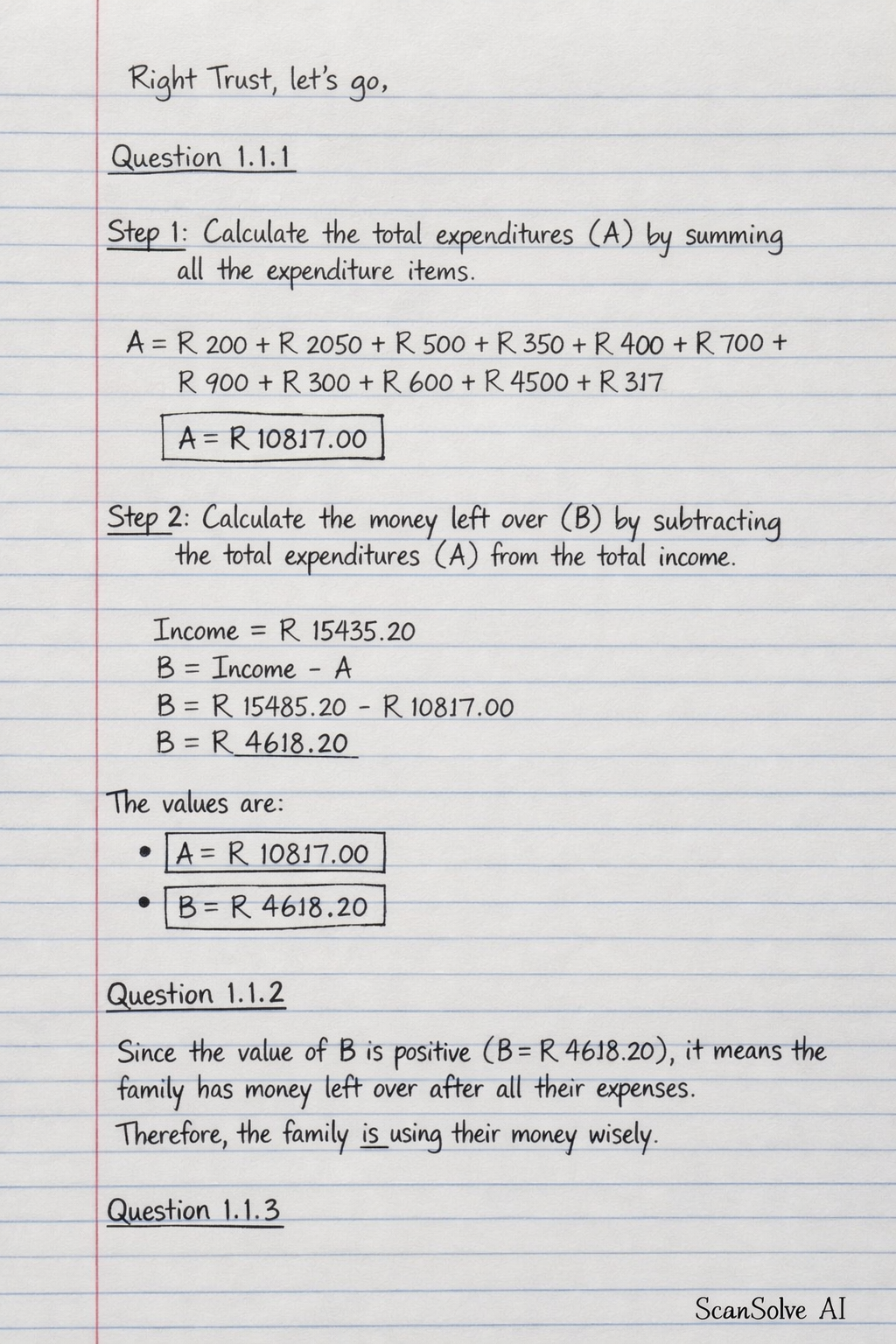
2 stepsQuestion 1.1.1
Calculate the total expenditures (A) by summing all the expenditure items.
Calculate the money left over (B) by subtracting the total expenditures (A) from the total income.
The values are:
Question 1.1.2
Since the value of B is positive (), it means the family has money left over after all their expenses. Therefore, the family is using their money wisely.
Question 1.1.3
If the family were not using their money wisely, two pieces of advice to improve their spending could be:
- Create a detailed budget and track all expenses to identify areas where spending can be reduced.
- Reduce discretionary spending on non-essential items like entertainment and clothing, or look for cheaper alternatives for groceries and toiletries.
Question 1.1.4
Occasional expenses are costs that do not occur regularly (e.g., monthly or weekly) but happen from time to time, often unexpectedly or annually. An example of an occasional expense is car maintenance or medical emergencies.
Was this helpful?
Still stuck on this one?
Ask a follow-up, and the answer starts from this question.
Got a different question?Ask your own question
More Accounting Questions
QCalculate Mr. Nkosi's remaining money, identify fixed and variable expenses, and suggest savings.QCalculate the item with the highest expenditure and the fraction spent on clothing, given the income…QAnalyze the provided monthly budget for the Welden family and calculate the total income, total…QDefine budget, list one fixed expense, calculate emergency fund (10% of R5000), define income and…QHow can one use money wisely, given that people often make unnecessary purchases?
Handwritten Step-by-Step Solution
Get this as a handwritten image on WhatsApp — like a tutor wrote it for you.
Try on WhatsApp