

This accounting problem is solved step by step below, with detailed explanations to help you understand the method and arrive at the correct answer.
ScanSolve AI Answer
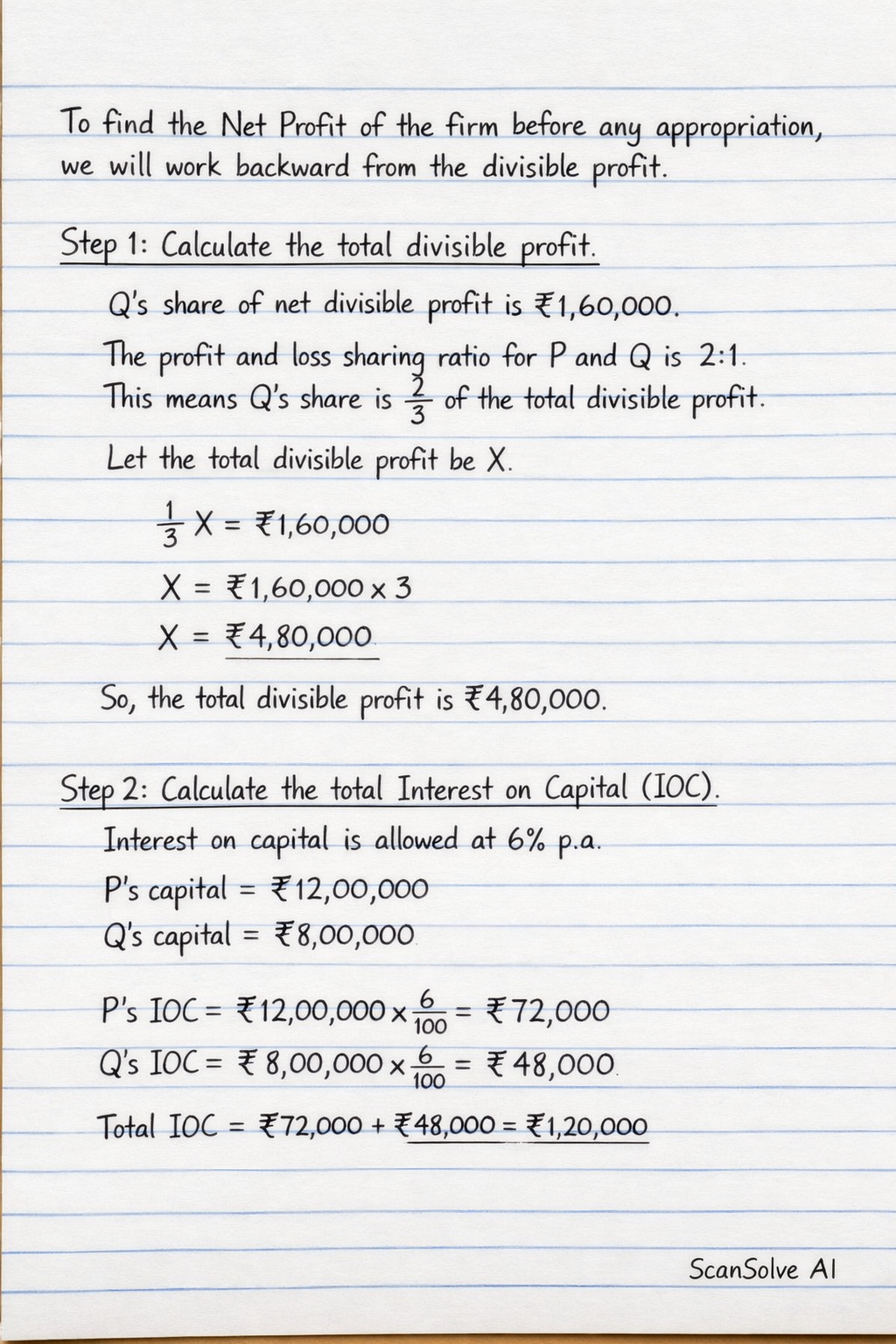
To find the Net Profit of the firm before any appropriation, we will work backward from the divisible profit. Step 1: Calculate the total divisible profit. Q's share of net divisible profit is ₹1,60,000. The profit and loss sharing ratio for P and Q is 2:1. This means Q's share is (1)/(3) of the total divisible profit. Let the total divisible profit be X. (1)/(3) X = ₹1,60,000 X = ₹1,60,000 × 3 = ₹4,80,000 So, the total divisible profit is ₹4,80,000. Step 2: Calculate the total Interest on Capital (IOC). Interest on capital is allowed at 6% p.a. P's capital = ₹12,00,000 Q's capital = ₹8,00,000 P's IOC = ₹12,00,000 × (6)/(100) = ₹72,000 Q's IOC = ₹8,00,000 × (6)/(100) = ₹48,000 Total IOC = ₹72,000 + ₹48,000 = ₹1,20,000 Step 3: Calculate the total Interest on Drawings (IOD). Interest on drawings is charged at 10% p.a. P's drawings = ₹2,40,000 Q's drawings = ₹1,60,000 Since no date of drawings is given, we assume interest is calculated for the full year on the amount drawn. P's IOD = ₹2,40,000 × (10)/(100) = ₹24,000 Q's IOD = ₹1,60,000 × (10)/(100) = ₹16,000 Total IOD = ₹24,000 + ₹16,000 = ₹40,000 Step 4: Calculate the Net Profit before appropriation. The Net Profit before appropriation is calculated using the following relationship: Net Profit before appropriation + Total IOD - Total IOC = Total Divisible Profit Rearranging the formula to find Net Profit before appropriation: Net Profit before appropriation = Total Divisible Profit + Total IOC - Total IOD Net Profit before appropriation = ₹4,80,000 + ₹1,20,000 - ₹40,000 Net Profit before appropriation = ₹6,00,000 - ₹40,000 Net Profit before appropriation = ₹5,60,000 The Net Profit of the firm before any appropriation is ₹5,60,000. This matches option (C). The final answer is C) ₹5,60,000. Send me the next one 📸