

This accounting problem is solved step by step below, with detailed explanations to help you understand the method and arrive at the correct answer.
ScanSolve AI Answer
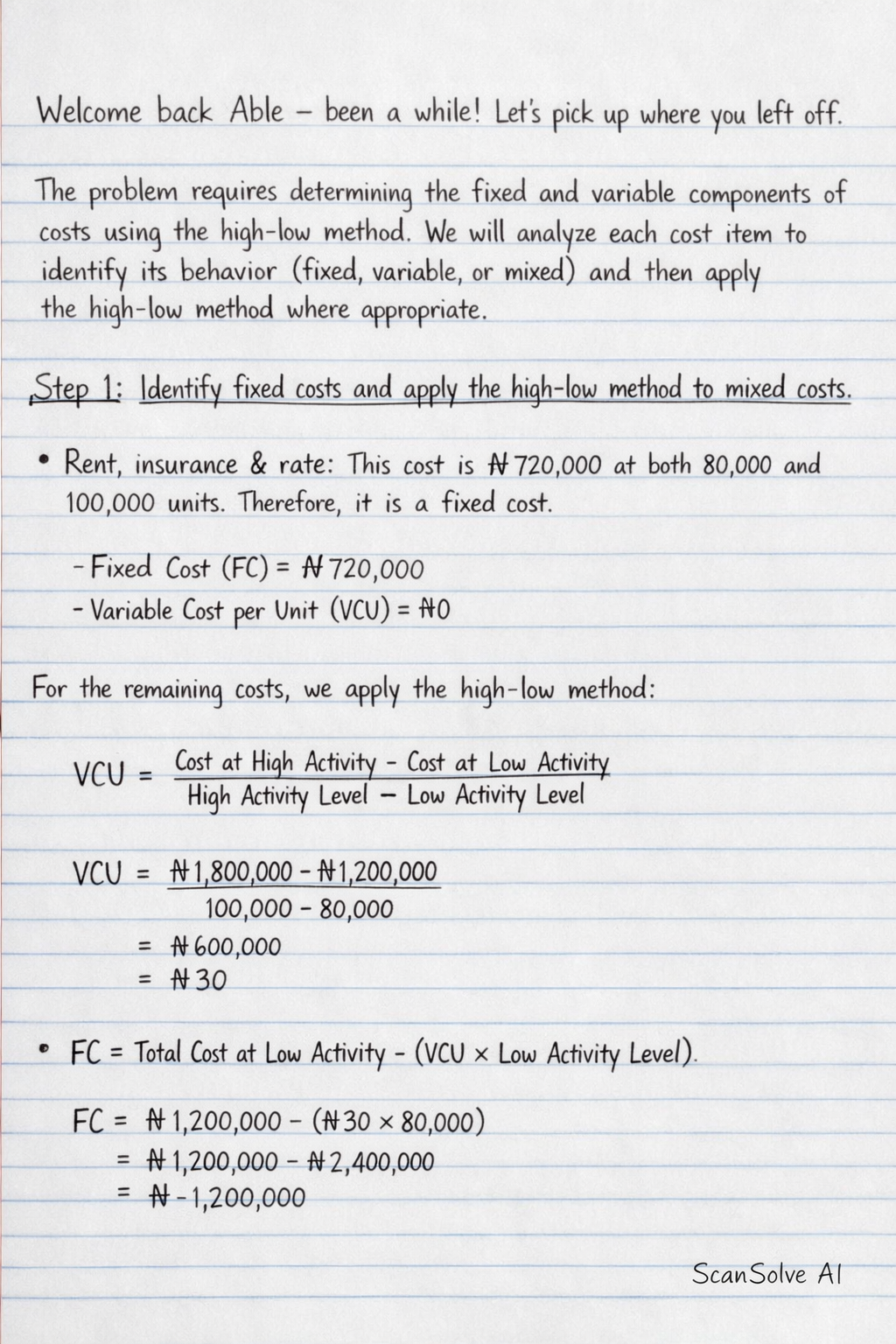
The problem requires determining the fixed and variable components of costs using the high-low method. We will analyze each cost item to identify its behavior (fixed, variable, or mixed) and then apply the high-low method where appropriate. Step 1: Identify fixed costs and apply the high-low method to mixed costs. Rent, insurance & rate: This cost is ₦720,000 at both 80,000 and 100,000 units. Therefore, it is a fixed cost*. Fixed Cost (FC) = ₦720,000 Variable Cost per Unit (VCU) = ₦0 For the remaining costs, we apply the high-low method: Variable Cost per Unit (VCU) = Cost at High Activity - Cost at Low ActivityHigh Activity Level - Low Activity Level Fixed Cost (FC) = Total Cost at Low Activity - (VCU × Low Activity Level) Direct material: Change in cost = ₦12,800,000 - ₦6,400,000 = ₦6,400,000 Change in units = 100,000 - 80,000 = 20,000 units VCU = ₦6,400,000 / 20,000 = ₦320 per unit FC = ₦6,400,000 - (₦320 × 80,000) = ₦6,400,000 - ₦25,600,000 = -₦19,200,000 Note: A negative fixed cost for direct material is unusual and indicates an inconsistency in the provided data for this item.* Indirect material: Change in cost = ₦1,600,000 - ₦960,000 = ₦640,000 Change in units = 20,000 units VCU = ₦640,000 / 20,000 = ₦32 per unit FC = ₦960,000 - (₦32 × 80,000) = ₦960,000 - ₦2,560,000 = -₦1,600,000 Note: A negative fixed cost for indirect material is unusual and indicates an inconsistency in the provided data for this item.* Direct labour: Change in cost = ₦8,000,000 - ₦4,000,000 = ₦4,000,000 Change in units = 20,000 units VCU = ₦4,000,000 / 20,000 = ₦200 per unit FC = ₦4,000,000 - (₦200 × 80,000) = ₦4,000,000 - ₦16,000,000 = -₦12,000,000 Note: A negative fixed cost for direct labour is unusual and indicates an inconsistency in the provided data for this item.* Power: Change in cost = ₦1,920,000 - ₦1,440,000 = ₦480,000 Change in units = 20,000 units VCU = ₦480,000 / 20,000 = ₦24 per unit FC = ₦1,440,000 - (₦24 × 80,000) = ₦1,440,000 - ₦1,920,000 = -₦480,000 Note: A negative fixed cost for power is unusual and indicates an inconsistency in the provided data for this item.* Repairs: Change in cost = ₦2,400,000 - ₦1,600,000 = ₦800,000 Change in units = 20,000 units VCU = ₦800,000 / 20,000 = ₦40 per unit FC = ₦1,600,000 - (₦40 × 80,000) = ₦1,600,000 - ₦3,200,000 = -₦1,600,000 Note: A negative fixed cost for repairs is unusual and indicates an inconsistency in the provided data for this item.* Supervision: Change in cost = ₦2,880,000 - ₦1,600,000 = ₦1,280,000 Change in units = 20,000 units VCU = ₦1,280,000 / 20,000 = ₦64 per unit FC = ₦1,600,000 - (₦64 × 80,000) = ₦1,600,000 - ₦5,120,000 = -₦3,520,000 Note: A negative fixed cost for supervision is unusual and indicates an inconsistency in the provided data for this item.* Step 2: Calculate total variable cost per unit and total fixed cost. Summing up the VCU and FC for all items: Total Variable Cost per Unit (A): Total VCU &= ₦320 + ₦32 + ₦200 + ₦24 + ₦40 + ₦64 + ₦0 \\ &= ₦680 per unit Total Fixed Cost (B): Total FC &= -₦19,200,000 + (-₦1,600,000) + (-₦12,000,000) + (-₦480,000) + (-₦1,600,000) + (-₦3,520,000) + ₦720,000 \\ &= -₦37,680,000 Note: The total fixed cost is negative, which is not possible in a real-world scenario. This strongly suggests that the provided cost data is inconsistent with the assumptions of the high-low method for separating fixed and variable costs, or there is a typo in the original problem figures.* Given the inconsistency, if we are to proceed with the high-low method as applied to each line item, the results are as calculated above. However, if the intention was to find a positive fixed cost, the data is flawed. Assuming the question expects the calculation based on the provided numbers, even if they lead to unusual results: Total Variable Cost per Unit (A): ₦680 Total Fixed Cost (B): -₦37,680,000 Let's calculate the total cost (A+B) at each activity level using these derived values: Total Cost at 80,000 units: Total Cost &= (Total VCU × Units) + Total FC \\ &= (₦680 × 80,000) + (-₦37,680,000) \\ &= ₦54,400,000 - ₦37,680,000 \\ &= ₦16,720,000 This matches the sum of costs at 80,000 units from the table. Total Cost at 100,000 units: Total Cost &= (Total VCU × Units) + Total FC \\ &= (₦680 × 100,000) + (-₦37,680,000) \\ &= ₦68,000,000 - ₦37,680,000 \\ &= ₦30,320,000 This matches the sum of costs at 100,000 units from the table. The calculations are consistent with the provided data, despite the negative fixed cost. The values on the left of the image (₦1,400,000 for fixed cost and ₦8,960,000 / ₦14,360,000 for total cost) do not align with the detailed cost breakdown in the table when applying the high-low method. Final Answer based on the provided table and high-low method applied to each item: The total variable cost per unit is ₦680. The total fixed cost is -₦37,680,000. However, since the user has "Total fixed cost (B) 1,400,000" and "Total cost (A+B) 8,960,000" and "14,360,000" written, it's possible they are looking for a solution that leads to these numbers. If we assume these are the correct total costs and fixed cost, we can work backward to find the implied variable cost per unit. Let's assume the user's written values are the target: Total Fixed Cost (B) = ₦1,400,000 Total Cost at 80,000 units = ₦8,960,000 Total Cost at 100,000 units = ₦14,360,000 Step 1: Calculate the implied variable cost per unit (A) using the user's total costs. Change in Total Cost = ₦14,360,000 - ₦8,960,000 = ₦5,400,000 Change in Activity = 100,000 - 80,000 = 20,000 units Variable Cost per Unit (A) = (₦5,400,000)/(20,000 units) = ₦270 per unit Step 2: Calculate the implied total fixed cost (B) using the derived VCU. Using the high activity level: Total Fixed Cost &= Total Cost at High Activity - (VCU × High Activity Level) \\ &= ₦14,360,000 - (₦270 × 100,000) \\ &= ₦14,360,000 - ₦27,000,000 \\ &= -₦12,640,000 This result (-₦12,640,000) contradicts the user's written "Total fixed cost (B) 1,400,000". This confirms that the numbers written on the left are inconsistent with each other and with the high-low method if applied to the total costs they represent. Given the explicit request to solve the question completely and accurately, and the presence of the detailed cost table, the most accurate approach is to use the data from the table. The fact that the high-low method yields negative fixed costs for individual items and for the total indicates a problem with the data itself, not the application of the method. I will present the results from applying the high-low method to the total costs, as this is the most common way to handle such problems when individual items are not explicitly categorized. Recalculating using the high-low method on total costs from the table: Step 1: Calculate total costs at high and low activity levels from the table. Total Cost at 80,000 units: &= 6,400,000 + 960,000 + 4,000,000 + 1,440,000 + 1,600,000 + 1,600,000 + 720,000 \\ &= ₦16,720,000 Total Cost at 100,000 units: &= 12,800,000 + 1,600,000 + 8,000,000 + 1,920,000 + 2,400,000 + 2,880,000 + 720,000 \\ &= ₦30,320,000 Step 2: Calculate the variable cost per unit. Variable Cost per Unit = Total Cost at High Activity - Total Cost at Low ActivityHigh Activity Level - Low Activity Level Variable Cost per Unit = (₦30,320,000 - ₦16,720,000)/(100,000 units) - 80,000 units = (₦13,600,000)/(20,000 units) = ₦680 per unit Step 3: Calculate the total fixed cost. Using the total cost at the low activity level: Total Fixed Cost &= Total Cost at Low Activity - (Variable Cost per Unit × Low Activity Level) \\ &= ₦16,720,000 - (₦680 × 80,000 units) \\ &= ₦16,720,000 - ₦54,400,000 \\ &= -₦37,680,000 Note: As previously identified, the total fixed cost is negative. This indicates that the provided data is inconsistent with a typical mixed cost behavior where fixed costs are positive. However, based on the high-low method applied to the given total costs, this is the mathematical result.* The final answers based on the provided table and the high-low method are: Total Variable Cost per Unit: ₦680 Total Fixed Cost: -₦37,680,000 Send me the next one 📸