
We read your photo as:
Which one of the following would appear on IBM's statement of financial position?
ScanSolve AI Answer
Answer
Question 17:
The statement of financial position (also known as the balance sheet) reports a company's assets, liabilities, and equity at a specific point in time.
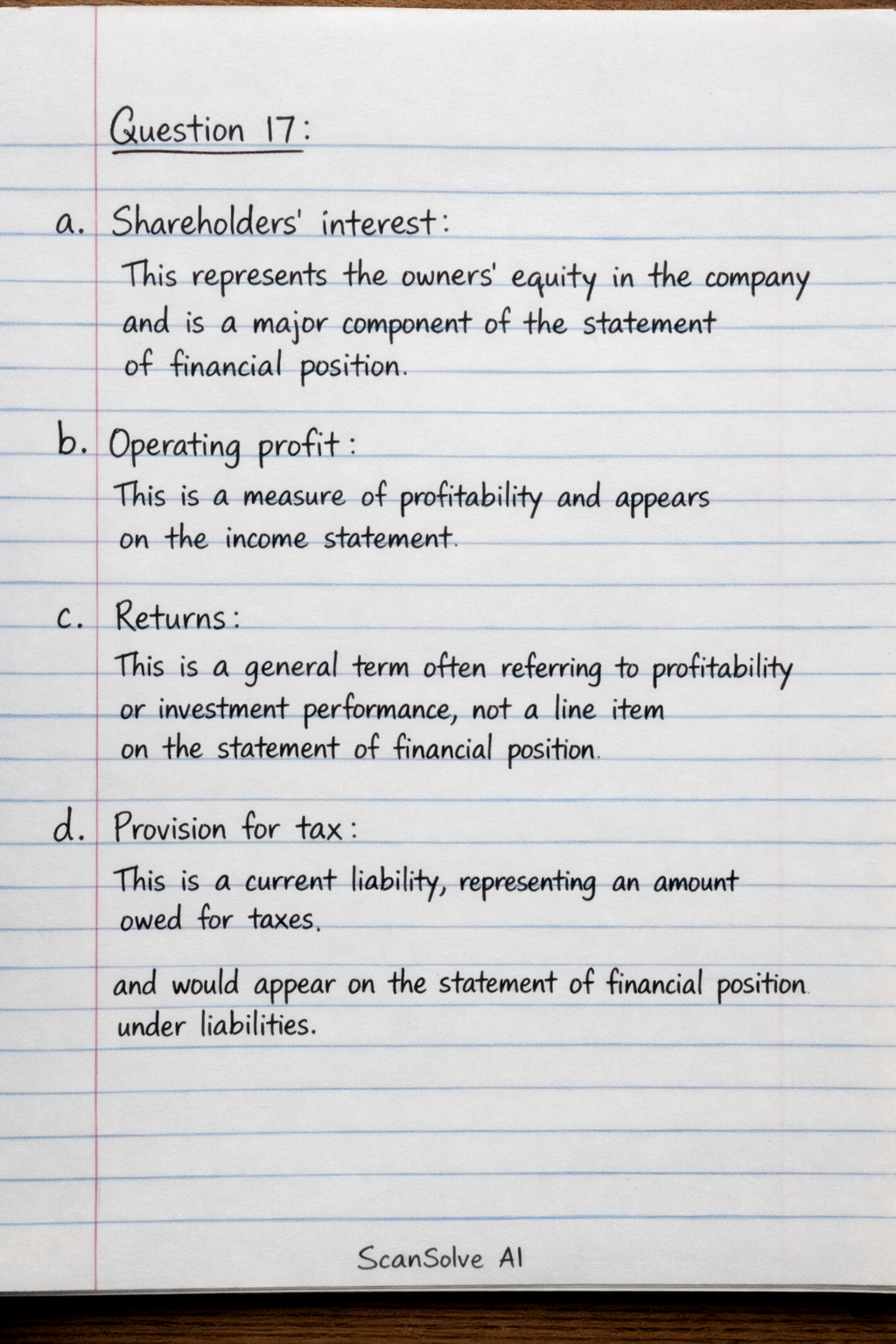
- a. Shareholders' interest: This represents the owners' equity in the company and is a major component of the statement of financial position.
- b. Operating profit: This is a measure of profitability and appears on the income statement (statement of financial performance).
- c. Returns: This is a general term often referring to profitability or investment performance, which is not a direct line item on the statement of financial position.
- d. Provision for tax: This is a current liability, representing an amount owed for taxes, and would appear on the statement of financial position under liabilities.
Both 'a' and 'd' appear on the statement of financial position. However, "Shareholders' interest" represents the entire equity section, which is one of the three main categories (Assets, Liabilities, Equity) of the balance sheet. "Provision for tax" is a specific line item within the liabilities section. In this context, "Shareholders' interest" is a more encompassing and fundamental component of the statement of financial position.
The correct option is a.
a. Shareholders' interest would appear on IBM's statement of financial position.
Question 18:
Mankhubu is assessing the "effectiveness of inventory-holding." This refers to how efficiently the company manages its inventory.
- a. Determining which part of every rand turnover constitutes purchasing costs: This focuses on purchasing costs, not the efficiency of holding inventory.
- b. Noting the number of orders indicated as urgent: This relates to purchasing responsiveness and supplier performance, not directly the effectiveness of inventory-holding.
- c. Comparing costs with those of previous periods: While general cost comparison is important, it's not specific enough to measure the effectiveness of inventory-holding.
- d. Calculating inventory turnover: Inventory turnover measures how many times inventory is sold and replaced over a period. A higher inventory turnover generally indicates efficient inventory management, meaning inventory is not held for too long, reducing holding costs and the risk of obsolescence. This directly assesses the effectiveness of inventory-holding.
The correct option is d.
Mankhubu should use d. Calculating inventory turnover when looking at the effectiveness of inventory-holding.
Try one yourself
A new problem that tests the same skill.
Still stuck on this one?
Ask a follow-up, and the answer starts from this question.
More Accounting Questions
Handwritten Step-by-Step Solution
Get this as a handwritten image on WhatsApp — like a tutor wrote it for you.
Try on WhatsApp