We read your photo as:

Prepare the Debtors Journal and Creditors Journal for the following transactions, assuming a 60% mark-up on cost.

Accounting

ScanSolve AI Answer

This answer stops before the end.

It was cut off when it was first written. Ask ScanSolve this question again for the full working.

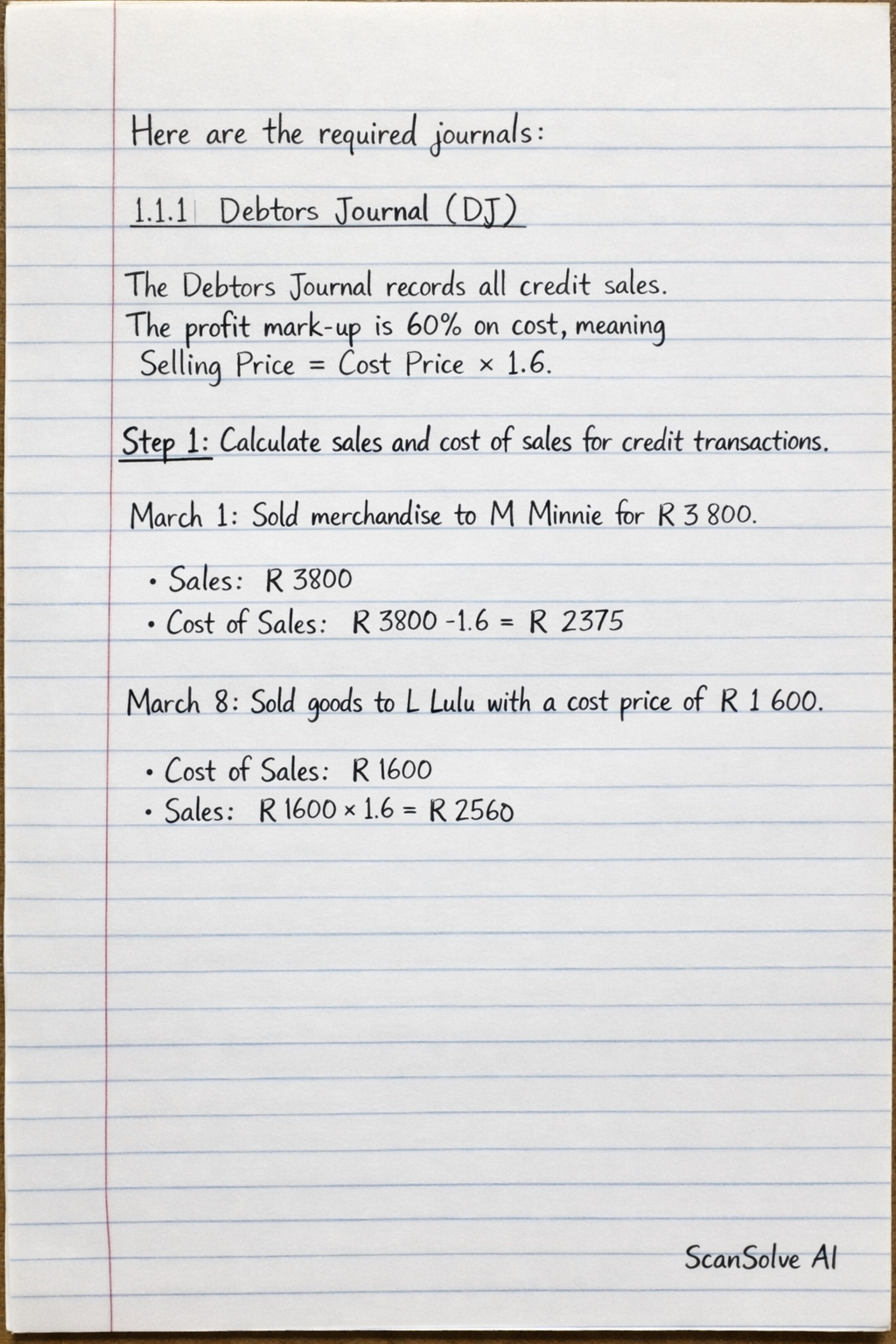
Here are the required journals:

1.1.1 Debtors Journal (DJ)

The Debtors Journal records all credit sales. The profit mark-up is 60% on cost, meaning Selling Price = Cost Price ×\times 1.6.

Step 1: Calculate sales and cost of sales for credit transactions.

  • March 1: Sold merchandise to M Minnie for R 3 800.
    • Sales: R 3800\text{R } 3800
    • Cost of Sales: R 38001.6=R 2375\frac{\text{R } 3800}{1.6} = \text{R } 2375
  • March 8: Sold goods to L Lulu with a cost price of R 1 600.
    • Cost of Sales: R 1600\text{R } 1600
    • Sales: R 1600×1.6=R 2560\text{R } 1600 \times 1.6 = \text{R } 2560

Step 2: Prepare the Debtors Journal.

DateDebtorInvoice No.FolioSales (Dr Debtors Control / Cr Sales)Cost of Sales (Dr Cost of Sales / Cr Trading Stock)Mar 1M Minnie51DL1R 3800R 2375Mar 8L Lulu52DL2R 2560R 1600TotalR 6360R 3975\begin{array}{|l|l|l|l|r|r|} \hline \textbf{Date} & \textbf{Debtor} & \textbf{Invoice No.} & \textbf{Folio} & \textbf{Sales (Dr Debtors Control / Cr Sales)} & \textbf{Cost of Sales (Dr Cost of Sales / Cr Trading Stock)} \\ \hline \text{Mar 1} & \text{M Minnie} & \text{51} & \text{DL1} & \text{R } 3800 & \text{R } 2375 \\ \text{Mar 8} & \text{L Lulu} & \text{52} & \text{DL2} & \text{R } 2560 & \text{R } 1600 \\ \hline & \textbf{Total} & & & \boxed{\textbf{R } \mathbf{6360}} & \boxed{\textbf{R } \mathbf{3975}} \\ \hline \end{array}

1.1.2 Creditors Journal (CJ)

The Creditors Journal records all credit purchases.

Step 1: Calculate amounts for each credit purchase.

  • March 3: Consumable stores from Barney Traders: R 450\text{R } 450
  • March 7: Goods from Teddy Suppliers: R 7500\text{R } 7500
  • March 14: From Queen Suppliers:
    • Laptops: 2×R 4350=R 87002 \times \text{R } 4350 = \text{R } 8700 (Equipment)
    • Merchandise: R 18000\text{R } 18000 (Trading Stock)
    • Stationery: R 855\text{R } 855
    • Total for Queen Suppliers: R 8700+R 18000+R 855=R 27555\text{R } 8700 + \text{R } 18000 + \text{R } 855 = \text{R } 27555
  • March 20: Goods from Ziggy Suppliers with 10% trade discount:
    • R 3400×(1−0.10)=R 3400×0.90=R 3060\text{R } 3400 \times (1 - 0.10) = \text{R } 3400 \times 0.90 = \text{R } 3060
  • March 25: Delivery van from Reasonable Cars:
    • Total cost: R 80000\text{R } 80000
    • Cash paid (25%): R 80000×0.25=R 20000\text{R } 80000 \times 0.25 = \text{R } 20000 (This is not a credit purchase)
    • Credit portion (balance): R 80000−R 20000=R 60000\text{R } 80000 - \text{R } 20000 = \text{R } 60000 (Vehicles)

Step 2: Prepare the Creditors Journal.

DateCreditorInvoice No.FolioCreditors Control (Cr)Trading Stock (Dr)Equipment (Dr)Stationery (Dr)Consumable Stores (Dr)Vehicles (Dr)Sundries (Account)Sundries (Amount)Mar 3Barney TradersX21CL1R 450R 450Mar 7Teddy SuppliersCL2R 7500R 7500Mar 14Queen SuppliersCL3R 27555R 18000R 8700R 855Mar 20Ziggy SuppliersCL4R 3060R 3060Mar 25Reasonable CarsCL5R 60000R 60000TotalR 98565R 28560R 8700R 855R 450R 60000R 0\begin{array}{|l|l|l|l|r|r|r|r|r|r|l|l|} \hline \textbf{Date} & \textbf{Creditor} & \textbf{Invoice No.} & \textbf{Folio} & \textbf{Creditors Control (Cr)} & \textbf{Trading Stock (Dr)} & \textbf{Equipment (Dr)} & \textbf{Stationery (Dr)} & \textbf{Consumable Stores (Dr)} & \textbf{Vehicles (Dr)} & \textbf{Sundries (Account)} & \textbf{Sundries (Amount)} \\ \hline \text{Mar 3} & \text{Barney Traders} & \text{X21} & \text{CL1} & \text{R } 450 & & & & \text{R } 450 & & & \\ \text{Mar 7} & \text{Teddy Suppliers} & & \text{CL2} & \text{R } 7500 & \text{R } 7500 & & & & & & \\ \text{Mar 14} & \text{Queen Suppliers} & & \text{CL3} & \text{R } 27555 & \text{R } 18000 & \text{R } 8700 & \text{R } 855 & & & & \\ \text{Mar 20} & \text{Ziggy Suppliers} & & \text{CL4} & \text{R } 3060 & \text{R } 3060 & & & & & & \\ \text{Mar 25} & \text{Reasonable Cars} & & \text{CL5} & \text{R } 60000 & & & & & \text{R } 60000 & & \\ \hline & \textbf{Total} & & & \boxed{\textbf{R } \mathbf{98565}} & \boxed{\textbf{R } \mathbf{28560}} & \boxed{\textbf{R } \mathbf{8700}} & \boxed{\textbf{R } \mathbf{855}} & \boxed{\textbf{R } \mathbf{450}} & \boxed{\textbf{R } \mathbf{60000}} & & \boxed{\textbf{R } \mathbf{0}} \\ \hline \end{array}

1.1.3 Creditors Allowances Journal (CAJ)

The Creditors Allowances Journal records all returns to suppliers.

Step 1: Calculate amounts for each return.

  • March 16: Damaged goods returned to Teddy Suppliers (cost price): R 400\text{R } 400 (Trading Stock)
  • March 27: One laptop returned to Queen Suppliers (from March 14 transaction): R 4350\text{R } 4350 (Equipment)

Step 2: Prepare the Creditors Allowances Journal.

\begin{array}{|l|l|l|l|r|r|r
Was this helpful?

Still stuck on this one?

Ask a follow-up, and the answer starts from this question.

Got a different question?Ask your own question
Handwritten step-by-step solution preview

Handwritten Step-by-Step Solution

Get this as a handwritten image on WhatsApp — like a tutor wrote it for you.

Try on WhatsApp