
We read your photo as:
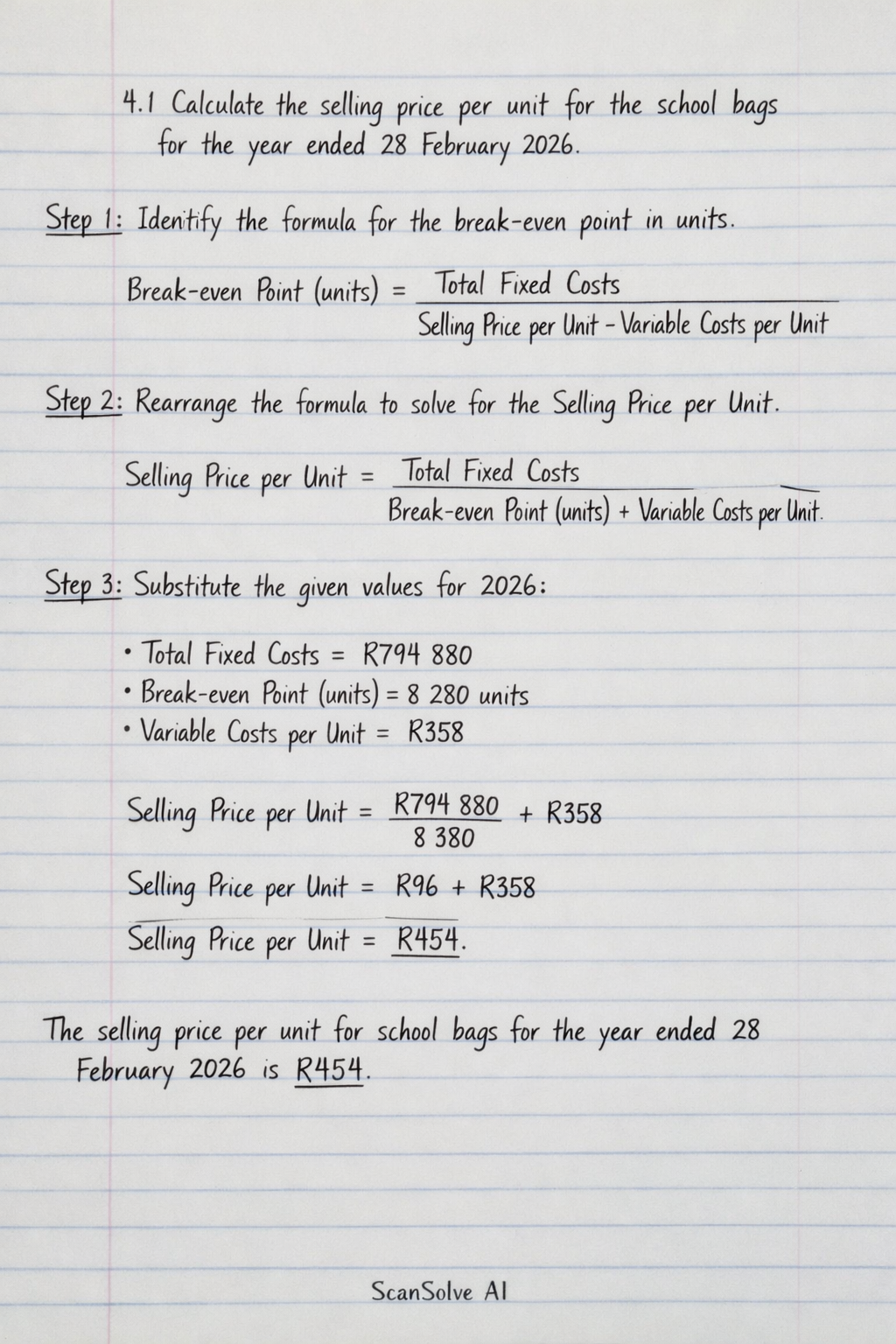
Calculate the selling price per unit for the school bags for the year ended 28 February 2026.
ScanSolve AI Answer
Step-by-step solution
6 stepslet's tackle these questions about school bags.
Part 4.1· 3 steps
Calculate the selling price per unit for the school bags for the year ended 28 February 2026.
Identify the formula for the break-even point in units.
Rearrange the formula to solve for the Selling Price per Unit.
Substitute the given values for 2026.
- Total Fixed Costs = R794 880
- Break-even Point (units) = 8 280 units
- Variable Costs per Unit = R358
The selling price per unit for school bags for the year ended 28 February 2026 is R454.
Part 4.2· 3 steps
Identify the variable cost that caused the biggest problem for the school bags in 2026 compared to 2025 figures. Give a valid solution for the problem identified.
Compare the individual variable costs per unit for 2026 and 2025.
- Direct material cost:
- 2026: R138
- 2025: R174
- Change: R138 - R174 = -R36 (Decrease)
- Direct labour cost:
- 2026: R197
- 2025: R150
- Change: R197 - R150 = +R47 (Increase)
- Selling and distribution cost:
- 2026: R23
- 2025: R42
- Change: R23 - R42 = -R19 (Decrease)
- Direct material cost:
Identify the variable cost that increased the most.
The Direct labour cost increased by R47 per unit, which is the largest increase among the variable costs.
Provide a valid solution for the identified problem.
A valid solution for the increased direct labour cost is to invest in training programs to improve labour efficiency and productivity, or to explore automation of certain production processes to reduce reliance on manual labour.
Still stuck on this one?
Ask a follow-up, and the answer starts from this question.
More Accounting Questions
Handwritten Step-by-Step Solution
Get this as a handwritten image on WhatsApp — like a tutor wrote it for you.
Try on WhatsApp