
We read your photo as:
What are the answers and explanations for the following accounting multiple-choice questions?
ScanSolve AI Answer
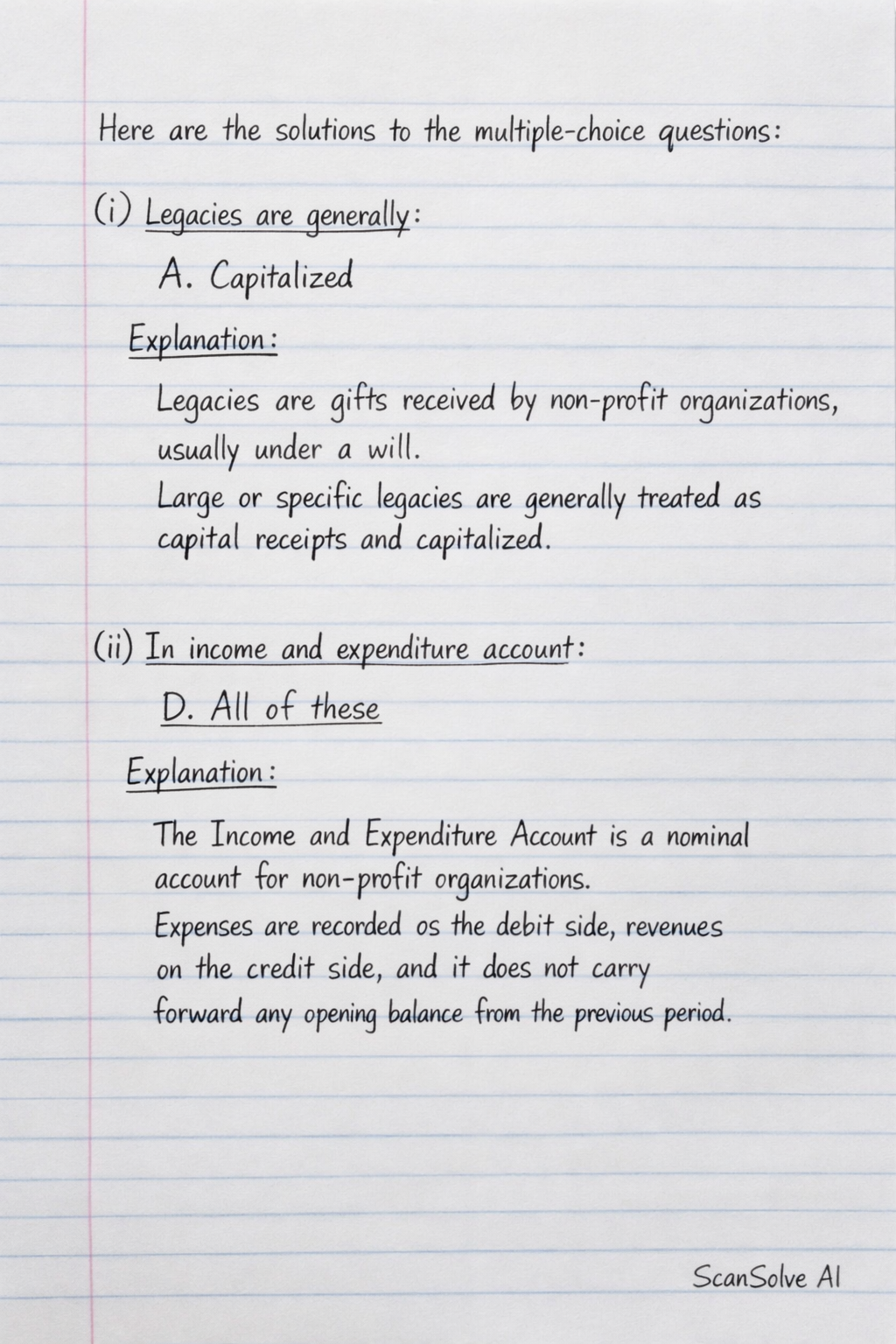
Here are the solutions to the multiple-choice questions:
(i) Legacies are generally:
- A. Capitalized
- Explanation: Legacies are gifts received by non-profit organizations, usually under a will. Large or specific legacies are generally treated as capital receipts and capitalized.
(ii) In income and expenditure account:
- D. All of these
- Explanation: The Income and Expenditure Account is a nominal account for non-profit organizations. Expenses are recorded on the debit side, revenues on the credit side, and it does not carry forward any opening balance from the previous period.
(iii) If the amount of prepaid rent is Rs. 150 and amount debited to income and expenditure account is Rs. 3,250 then rent paid during the year will be:
- A. Rs. 3,400
- Explanation: The amount debited to the Income and Expenditure Account represents the rent for the current year. Prepaid rent is the portion of rent paid during the year that relates to a future period.
(iv) Loss on the sale of machinery should be written off against:
- D. None of these
- Explanation: A loss on the sale of machinery is a capital loss and is typically debited to the Profit and Loss Account (or Income and Expenditure Account for non-profit organizations). None of the given options are the primary account for writing off such a loss.
(v) The period during which the asset will help in earning income of business is known as:
- D. Working life
- Explanation: The "working life" or "useful life" of an asset refers to the period over which it is expected to be available for use by the entity and contribute to earning income.
(vi) If original cost of an asset is Rs. 10,000, rate of depreciation 10% p.a. then the value of depreciation under diminishing balance method after third year will be:
- D. Rs. 810
- Explanation: Under the diminishing balance method, depreciation is calculated on the book value of the asset each year. The question asks for the depreciation for the third year.
- Original Cost = Rs. 10,000
- Depreciation Year 1 =
- Book Value after Year 1 =
- Depreciation Year 2 =
- Book Value after Year 2 =
- Depreciation Year 3 =
- Explanation: Under the diminishing balance method, depreciation is calculated on the book value of the asset each year. The question asks for the depreciation for the third year.
(vii) In consignment the risk attached to goods delivered is with:
- C. Consignor
- Explanation: In a consignment arrangement, the ownership of the goods remains with the consignor until they are sold to a third party. Therefore, the risk of loss or damage to the goods also remains with the consignor.
(viii) In books of consignee, the cash received from sundry debtors should be debited to:
- B. Cash account
- Explanation: When the consignee receives cash, the Cash Account (or Bank Account) is always debited to reflect the increase in cash.
(ix) Cash paid to creditors can be ascertained by preparing:
- B. Total creditor's account
- Explanation: To determine the cash paid to creditors during an accounting period, a Total Creditors Account is prepared, which reconciles opening and closing balances with credit purchases and cash payments.
(x) Net worth is equal to:
- A. Assets - liabilities
- Explanation: Net worth (also known as owner's equity or capital) is the residual value of assets after all liabilities have been deducted. This is derived from the accounting equation: Assets = Liabilities + Capital.
Still stuck on this one?
Ask a follow-up, and the answer starts from this question.
More Accounting Questions
Handwritten Step-by-Step Solution
Get this as a handwritten image on WhatsApp — like a tutor wrote it for you.
Try on WhatsApp