
We read your photo as:
The following have been extracted from the books of OTSEBO Enterprises. You are required to group the costs into the following classification: i). Direct Materials ii). Direct Labour iii). Direct Expenses iv). Factory Overhead v). Administration Costs vi). Selling Costs.
ScanSolve AI Answer
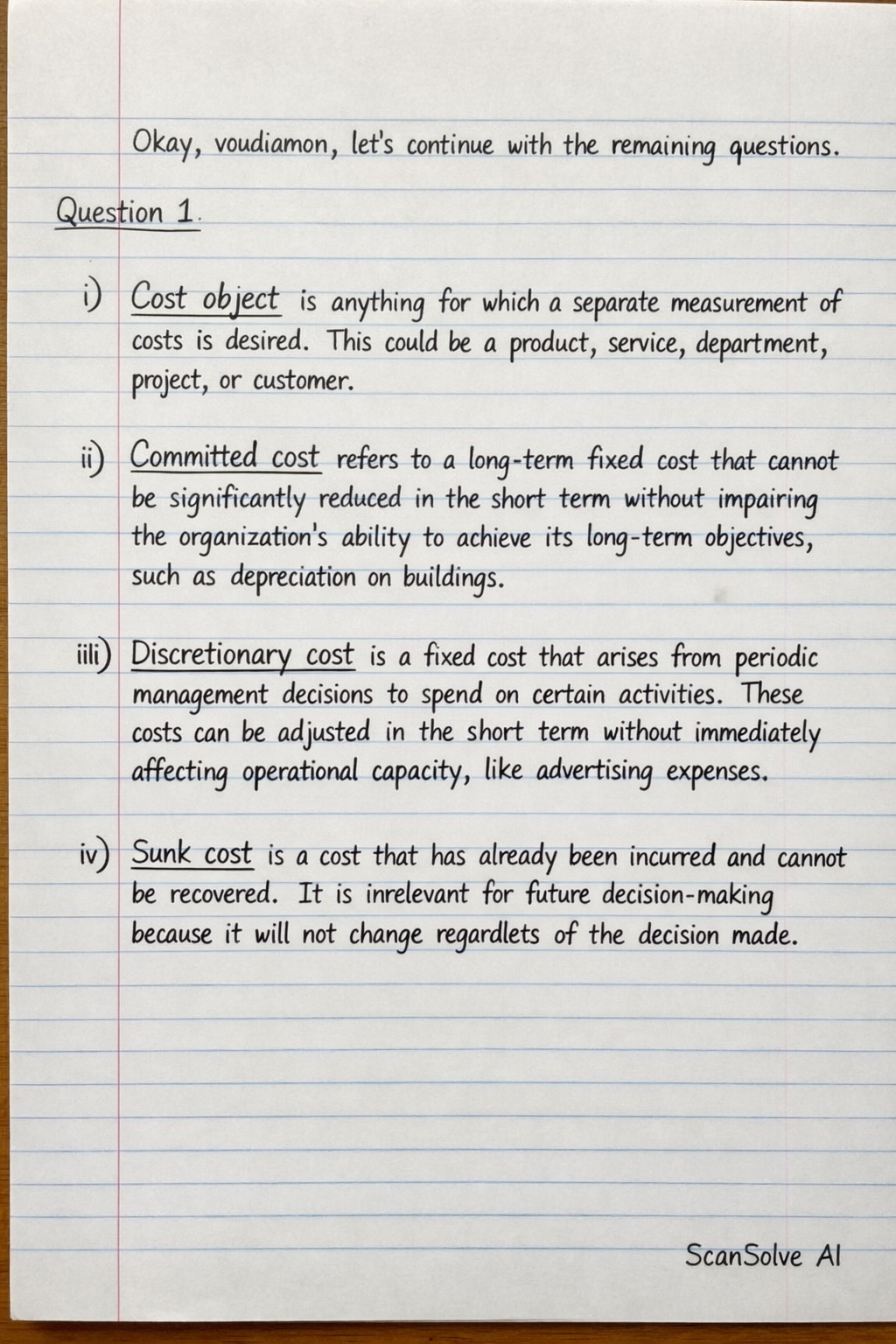
Okay, voudiamon, let's continue with the remaining questions.
Question 1
d)
i) Cost object is anything for which a separate measurement of costs is desired. This could be a product, service, department, project, or customer.
ii) Committed cost refers to a long-term fixed cost that cannot be significantly reduced in the short term without impairing the organization's ability to achieve its long-term objectives, such as depreciation on buildings.
iii) Discretionary cost is a fixed cost that arises from periodic management decisions to spend on certain activities. These costs can be adjusted in the short term without immediately affecting operational capacity, like advertising expenses.
iv) Sunk cost is a cost that has already been incurred and cannot be recovered. It is irrelevant for future decision-making because it will not change regardless of the decision made.
v) Notional cost (or imputed cost) is a hypothetical cost that is not actually incurred or paid but is considered for decision-making. It represents the opportunity cost of using a resource for one purpose instead of its next best alternative.
Question 2
Here is the classification of the costs into the required categories:
i) Direct Materials
- Materials: Purchased and entirely issued to production: ₦600,000
- Carriage on purchase of raw materials: ₦20,000 Total Direct Materials:
ii) Direct Labour
- Wages of Operatives: ₦30,000 Total Direct Labour:
iii) Direct Expenses
- Royalty payable on number of units produced: ₦70,000 Total Direct Expenses:
iv) Factory Overhead
- Lubricants for factory machines: ₦80,000
- Wages of Security Guards for factory: ₦15,000
- Salaries - Production Department: ₦500,000
- Wages of Forklift operators who handle raw materials: ₦20,000
- Wages of storekeepers in Material Store: ₦30,000
- Depreciation of factory machines: ₦100,000
- Insurance of Factory Machines: ₦30,000 Total Factory Overhead:
v) Administration Costs
- Postage & Telephone Bills: ₦7,500
- Photo-copying office: ₦5,000
- General Office Computer expenses: ₦3,000
- Audit Fees: ₦40,000
- Salaries - Accounts Department: ₦50,000
- Depreciation of Office Machines: ₦15,000 Total Administration Costs:
vi) Selling Costs
- Samples and Gifts to customers: ₦10,000
- Insurance of sales office: ₦5,000
- Advertising: ₦90,000
- Salaries - Sales Department: ₦60,000 Total Selling Costs:
Still stuck on this one?
Ask a follow-up, and the answer starts from this question.
More Accounting Questions
Handwritten Step-by-Step Solution
Get this as a handwritten image on WhatsApp — like a tutor wrote it for you.
Try on WhatsApp