
We read your photo as:
Calculate the Total and Sub Total values for the given table, given the count and unit cost for each item.
ScanSolve AI Answer
Answer
Step-by-step solution
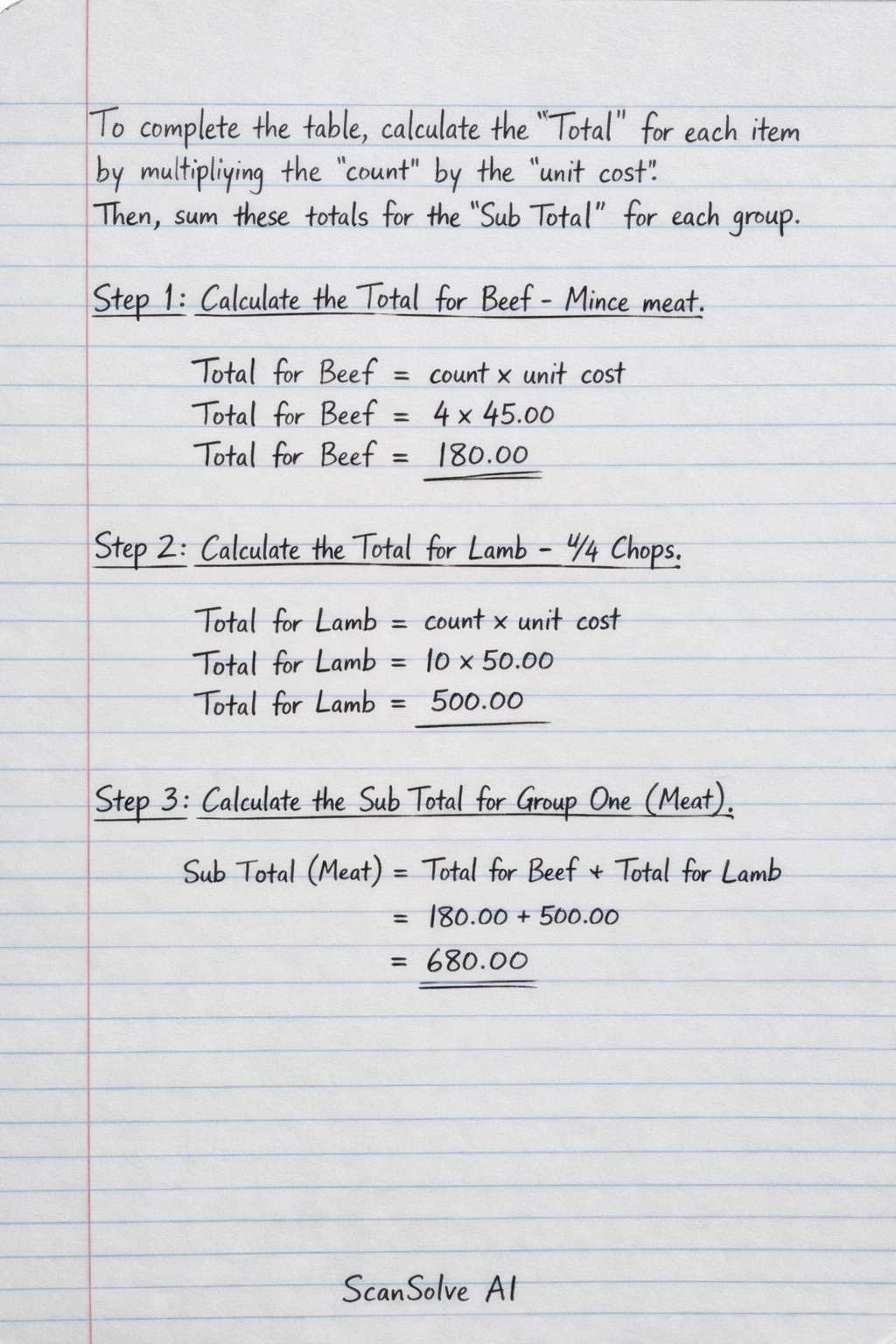
3 stepsTo complete the table, calculate the "Total" for each item by multiplying the "count" by the "unit cost". Then, sum these totals for the "Sub Total" for each group.
Calculate the Total for Beef - Mince meat.
Calculate the Total for Lamb - 4/4 Chops.
Calculate the Sub Total for Group One (Meat).
The values for "Rump Steak", "Lamb Leg", "chicken", "geese", and all items in "GROUP THREE- SMALLGOODS", "GROUP FOUR - BACON", and "GROUP FIVE - SEAFOOD" are not provided in the image. Therefore, their "Total" values and the "Sub Total" for Group Two, Group Three, Group Four, and Group Five cannot be calculated.
The completed parts of the table are:
ITEMS UNIT SIZE COUNT UNIT COST TOTAL GROUP ONE- MEAT Beef - Mince meat Kg 4 45.00 180.00 Rump Steak Kg Lamb - 4/4 Chops Kg 10 50.00 500.00 Lamb Leg Sub Total 680.00 GROUP TWO- POULTRY chicken Kg geese Kg Sub Total GROUP THREE- SMALLGOODS Sub Total GROUP FOUR - BACON Sub Total GROUP FIVE- SEAFOOD Sub Total The final answers for the calculable parts are:
Beef - Mince meat Total:
Lamb - 4/4 Chops Total:
Sub Total (Meat):
Try one yourself
A new problem that tests the same skill.
Still stuck on this one?
Ask a follow-up, and the answer starts from this question.
More Accounting Questions
Handwritten Step-by-Step Solution
Get this as a handwritten image on WhatsApp — like a tutor wrote it for you.
Try on WhatsApp