
We read your photo as:
Explain audit-related services and the benefits of audit planning.
ScanSolve AI Answer
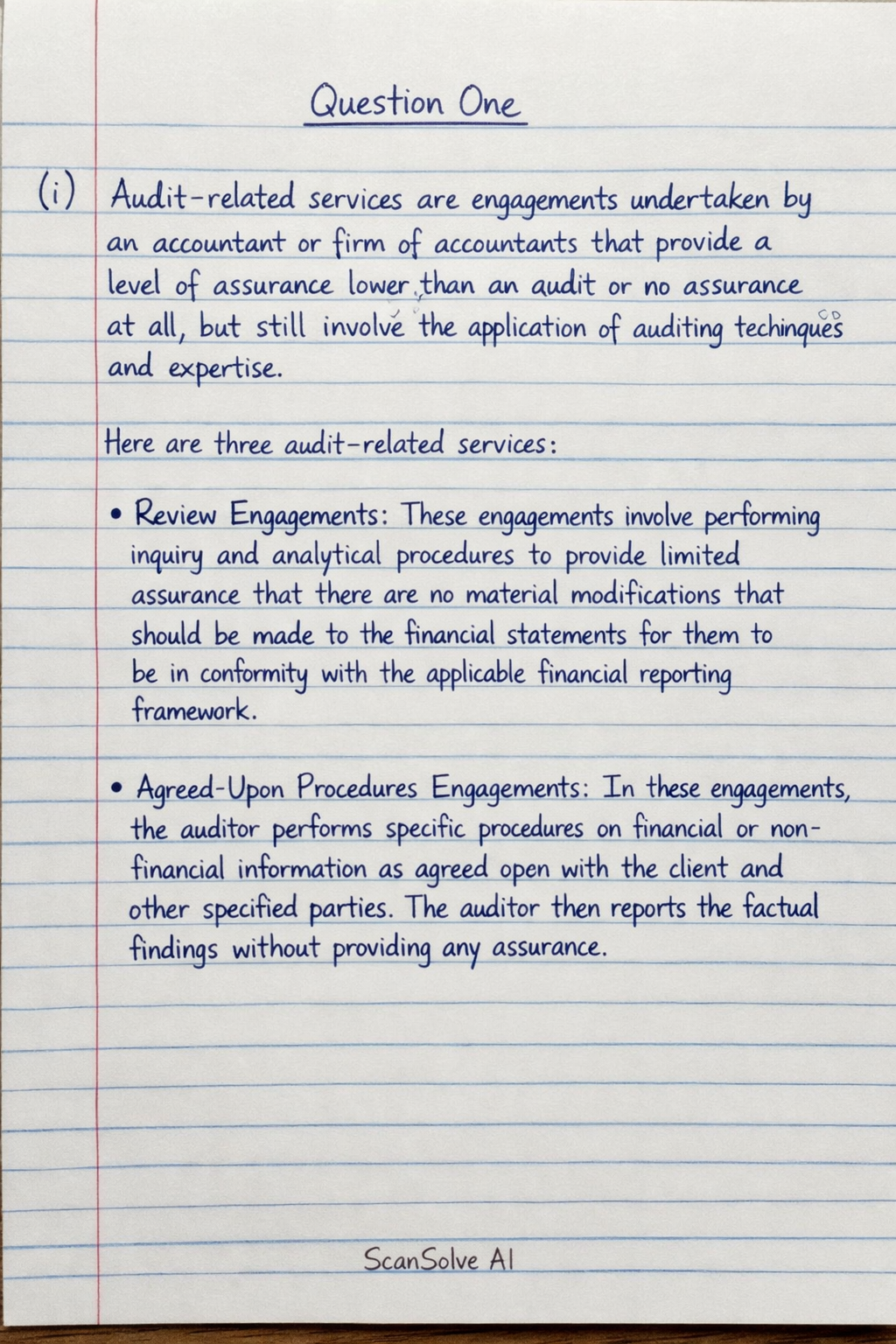
Question One
i) Audit-related services are engagements undertaken by an accountant or firm of accountants that provide a level of assurance lower than an audit or no assurance at all, but still involve the application of auditing techniques and expertise.
Here are three audit-related services:
- Review Engagements: These engagements involve performing inquiry and analytical procedures to provide limited assurance that there are no material modifications that should be made to the financial statements for them to be in conformity with the applicable financial reporting framework.
- Agreed-Upon Procedures Engagements: In these engagements, the auditor performs specific procedures on financial or non-financial information as agreed upon with the client and other specified parties. The auditor then reports the factual findings without providing any assurance.
- Compilation Engagements: This service involves assisting management in the preparation and presentation of financial statements without providing any assurance on those statements. The accountant essentially compiles the financial information into a structured format.
ii) The objective of the auditor, per ISA 300 Planning an audit of financial statements, is to plan the audit work so that the audit will be performed in an effective manner.
Here are five benefits of adequate planning to audit:
- It helps the auditor to devote appropriate attention to important areas of the audit.
- It helps the auditor identify and resolve potential problems on a timely basis.
- It assists in the proper organization and management of the audit engagement, ensuring it is performed effectively and efficiently.
- It facilitates the selection of engagement team members with appropriate capabilities and competence to respond to anticipated risks.
- It assists, where applicable, in the coordination of work done by auditors of components and experts.
iii) ISA 300 (Planning an Audit of Financial Statements) outlines requirements for the auditor to ensure effective audit planning.
Here are three requirements of ISA 300 from the auditor:
- The auditor must establish an overall audit strategy that sets the scope, timing, and direction of the audit, and that guides the development of the audit plan.
- The auditor must develop an audit plan that includes a description of the nature, timing, and extent of planned risk assessment procedures, planned further audit procedures at the assertion level, and other planned audit procedures.
- The auditor must update and change the overall audit strategy and the audit plan as necessary during the course of the audit engagement.
Still stuck on this one?
Ask a follow-up, and the answer starts from this question.
More Accounting Questions
Handwritten Step-by-Step Solution
Get this as a handwritten image on WhatsApp — like a tutor wrote it for you.
Try on WhatsApp