
We read your photo as:
Uses of farm record, Types of farm record, Cash book, Advantage of maintaining of cash book, Depreciation, Appreciation, Blankshit, Income Statement, Farm Budgeting & Types, What is Income Statement
ScanSolve AI Answer
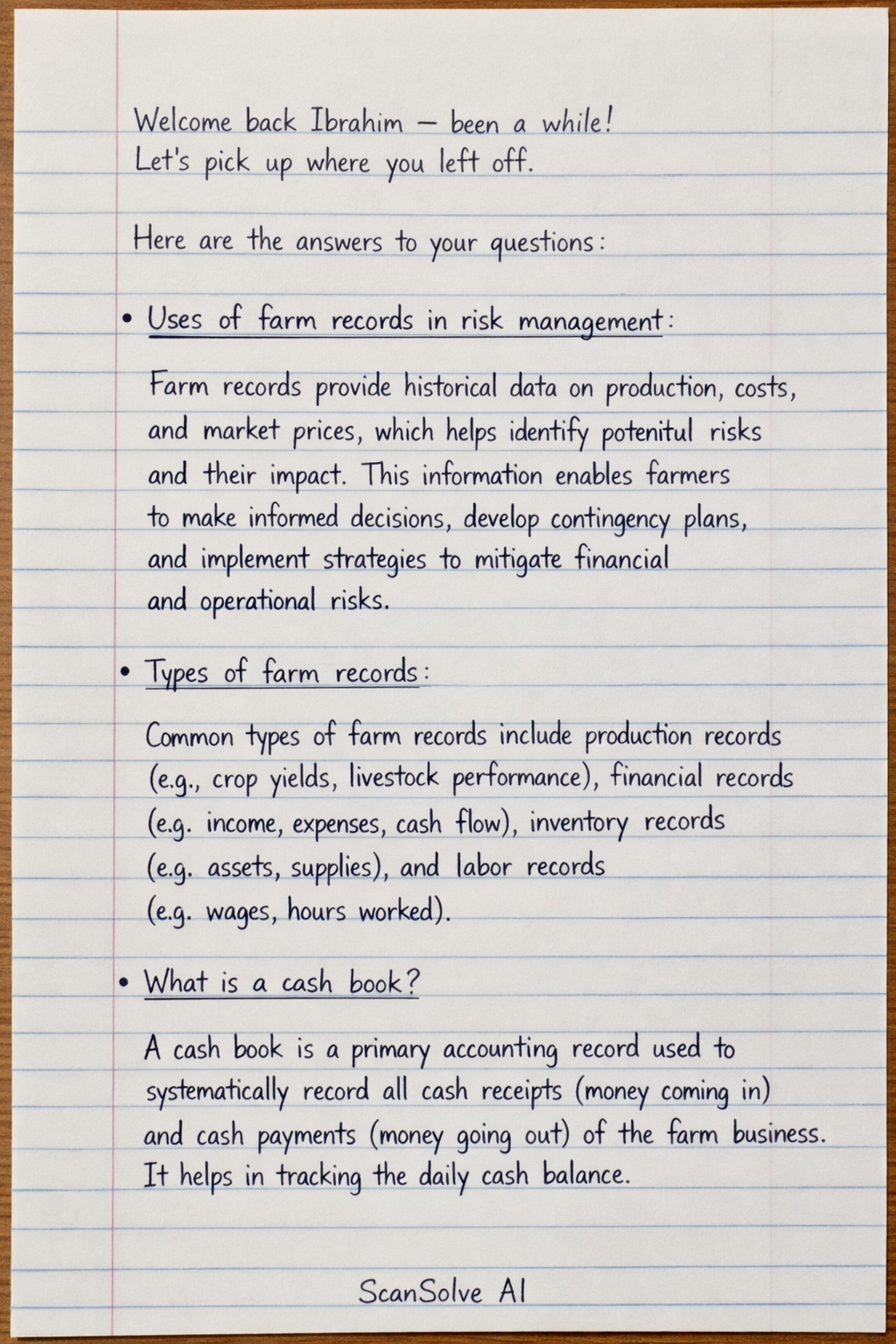
Here are the answers to your questions:
-
Uses of farm records in risk management: Farm records provide historical data on production, costs, and market prices, which helps identify potential risks and their impact. This information enables farmers to make informed decisions, develop contingency plans, and implement strategies to mitigate financial and operational risks.
-
Types of farm records: Common types of farm records include production records (e.g., crop yields, livestock performance), financial records (e.g., income, expenses, cash flow), inventory records (e.g., assets, supplies), and labor records (e.g., wages, hours worked).
-
What is a cash book? A cash book is a primary accounting record used to systematically record all cash receipts (money coming in) and cash payments (money going out) of the farm business. It helps in tracking the daily cash balance.
-
Advantages of maintaining a cash book: Maintaining a cash book helps in monitoring daily cash balances, preventing errors and fraud, and providing essential data for budgeting and financial analysis. It also simplifies the preparation of other financial statements.
-
Depreciation: Depreciation is the systematic reduction in the value of a tangible asset over its useful life due to wear and tear, obsolescence, or usage. It is an accounting method used to allocate the cost of an asset over the period it benefits the business.
-
Appreciation: Appreciation is an increase in the value of an asset over time. This can occur due to various factors such as increased demand, inflation, or improvements made to the asset.
-
Balance sheet: A balance sheet is a financial statement that provides a snapshot of a farm's financial position at a specific point in time. It lists the farm's assets, liabilities, and owner's equity, adhering to the accounting equation: Assets = Liabilities + Owner's Equity.
-
Income statement: An income statement, also known as a profit and loss statement, summarizes a farm's revenues, expenses, and net profit or loss over a specific accounting period. It shows the financial performance of the farm during that period.
-
Farm budgeting and types: Farm budgeting is the process of planning and forecasting the financial activities of a farm for a future period, outlining expected income and expenses. Types include enterprise budgets (for specific crops or livestock), cash flow budgets (tracking cash inflows and outflows), and whole-farm budgets (for the entire operation).
-
Differentiate between fixed assets and current assets: Fixed assets are long-term tangible assets used in farm operations for more than one year, such as land, buildings, and machinery. Current assets are short-term assets that can be converted into cash within one year, such as inventory (crops, livestock for sale) and cash on hand.
-
What is farm inventory? Farm inventory refers to the raw materials, work-in-progress, and finished goods held by a farm that are intended for sale or for use in the production process. Examples include harvested crops, livestock, feed, and supplies.
Still stuck on this one?
Ask a follow-up, and the answer starts from this question.
More Accounting Questions
Handwritten Step-by-Step Solution
Get this as a handwritten image on WhatsApp — like a tutor wrote it for you.
Try on WhatsApp