
We read your photo as:
Using the accounting equation. Complete the table below.
ScanSolve AI Answer
Here are the answers to your questions:
5. (a) Mention four advantages of using a computer.
i. Speed: Computers can process information and perform calculations much faster than humans.
ii. Accuracy: They provide highly accurate results, reducing errors in data processing.
iii. Storage Capacity: Computers can store vast amounts of data and information.
iv. Automation: They can perform repetitive tasks automatically, saving time and effort.
v. Communication: Facilitate global communication through networks and the internet.
5. (b) List four basic parts of a computer.
i. Central Processing Unit (CPU)
ii. Memory (RAM)
iii. Storage Device (e.g., Hard Drive, SSD)
iv. Input Devices (e.g., Keyboard, Mouse)
v. Output Devices (e.g., Monitor, Printer)
5. (c) Give the three types of computers.
i. Analog Computers
ii. Digital Computers
iii. Hybrid Computers
6. (a) (i) Define Asset.
An asset is an economic resource owned by a business or individual that is expected to provide future economic benefits. Examples include cash, property, and equipment.
6. (a) (ii) What is a Liability?
A liability is a financial obligation or debt owed by a business or individual to another entity, which must be settled in the future. Examples include loans payable and accounts payable.
6. (a) (iii) List the two types of Assets.
i. Current Assets (e.g., cash, inventory, accounts receivable)
ii. Non-current Assets or Fixed Assets (e.g., land, buildings, machinery)
6. (a) (iv) List the two types of Liabilities.
i. Current Liabilities (e.g., accounts payable, short-term loans)
ii. Non-current Liabilities or Long-term Liabilities (e.g., long-term loans, bonds payable)
6. (b) (i) State the accounting equation.
The accounting equation is:
6. (b) (ii) Using the accounting equation, complete the table below.
The accounting equation is . We can rearrange this to find missing values:
Row 2:
Row 3:
Row 4:
Row 5:
Here is the completed table:
| Assets (Le) | Capital (Le) | Liabilities (Le) | |
|---|---|---|---|
| 1 | |||
| 2 | 6,500 | 4,000 | 2,500 |
| 3 | 35,500 | 25,000 | 10,500 |
| 4 | 18,000 | 11,000 | 7,000 |
| 5 | 40,000 | 19,500 | 20,500 |
Still stuck on this one?
Ask a follow-up, and the answer starts from this question.
More Accounting Questions
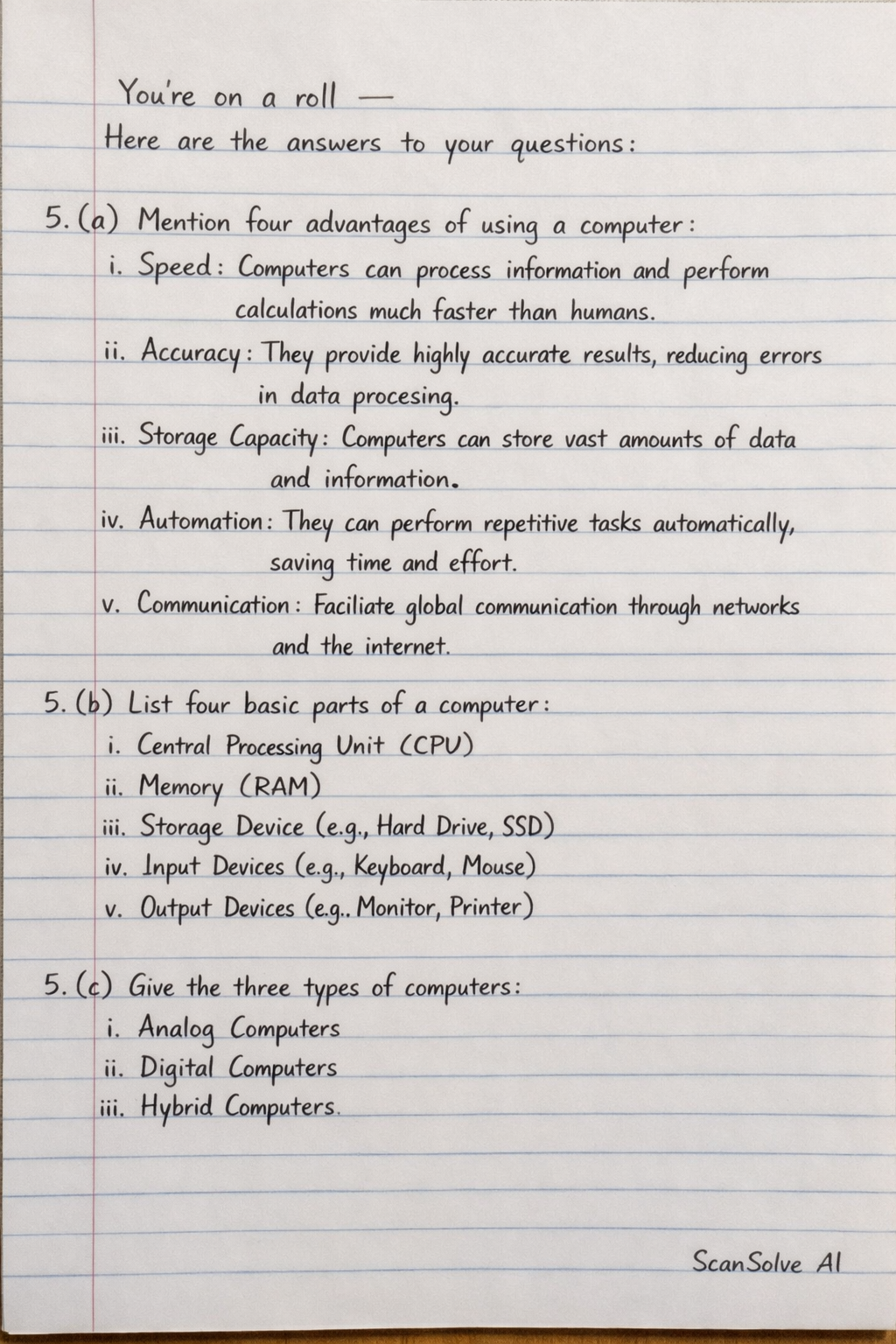
Handwritten Step-by-Step Solution
Get this as a handwritten image on WhatsApp — like a tutor wrote it for you.
Try on WhatsApp