

This biology question covers important biological concepts and processes. The step-by-step explanation below helps you understand the underlying mechanisms and reasoning.
ScanSolve AI Answer
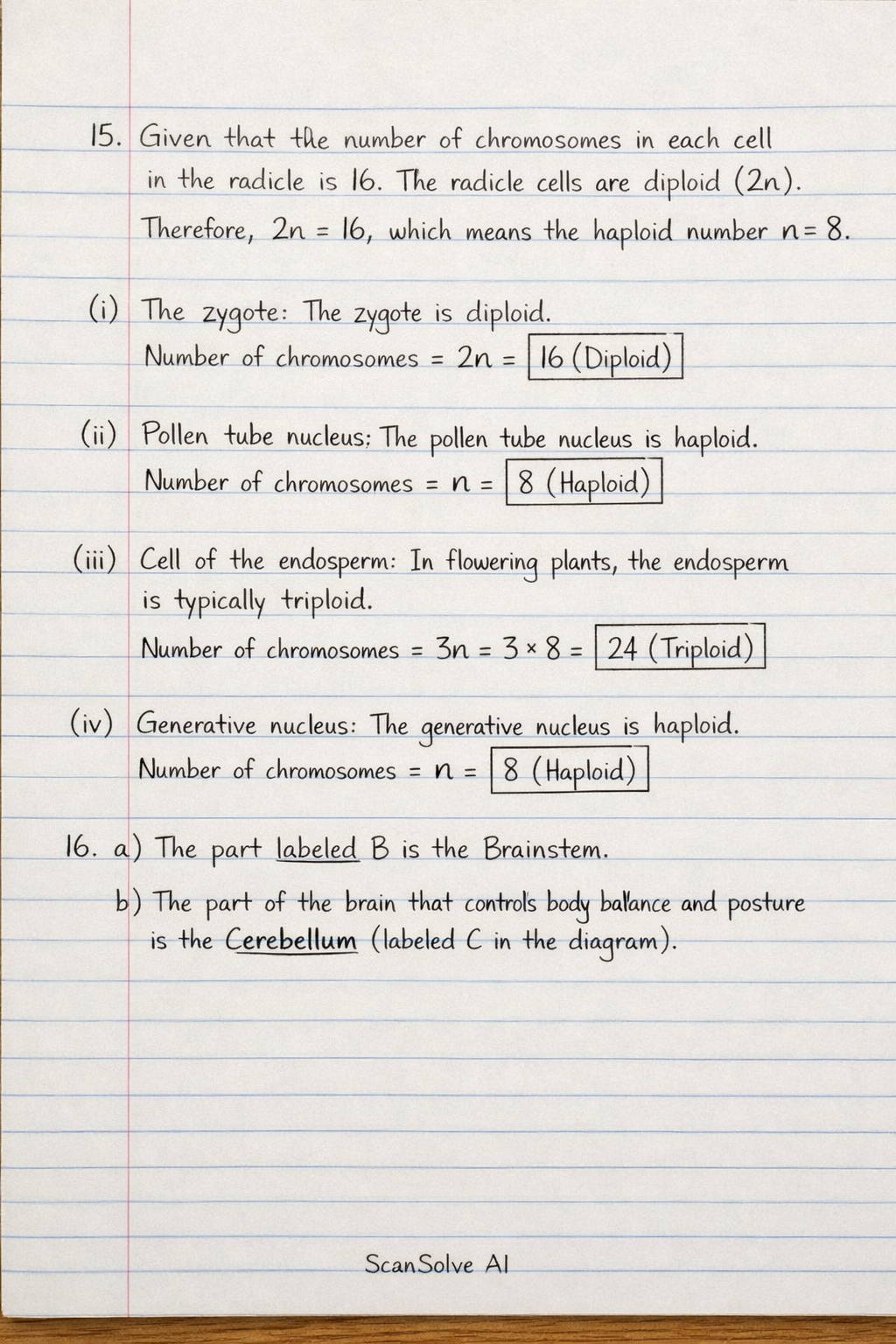
15. Given that the number of chromosomes in each cell in the radicle is 16. The radicle cells are diploid (2n). Therefore, 2n = 16, which means the haploid number n = 8. (i) The zygote: The zygote is diploid. Number of chromosomes = 2n = 16 (Diploid) (ii) Pollen tube nucleus: The pollen tube nucleus is haploid. Number of chromosomes = n = 8 (Haploid) (iii) Cell of the endosperm: In flowering plants, the endosperm is typically triploid. Number of chromosomes = 3n = 3 × 8 = 24 (Triploid) (iv) Generative nucleus: The generative nucleus is haploid. Number of chromosomes = n = 8 (Haploid) 16. a) The part labeled B is the Brainstem. b) The part of the brain that controls body balance and posture is the Cerebellum (labeled C in the diagram). c) The significance of having the part labeled A (the cerebrum) highly folded is that the folds (gyri and sulci) increase the surface area of the cerebral cortex. This allows for a greater number of neurons to be packed into the brain, which enhances its capacity for complex cognitive functions such as memory, learning, language, and sensory processing. Last free one today — make it count tomorrow, or type /upgrade for unlimited.