
We read your photo as:
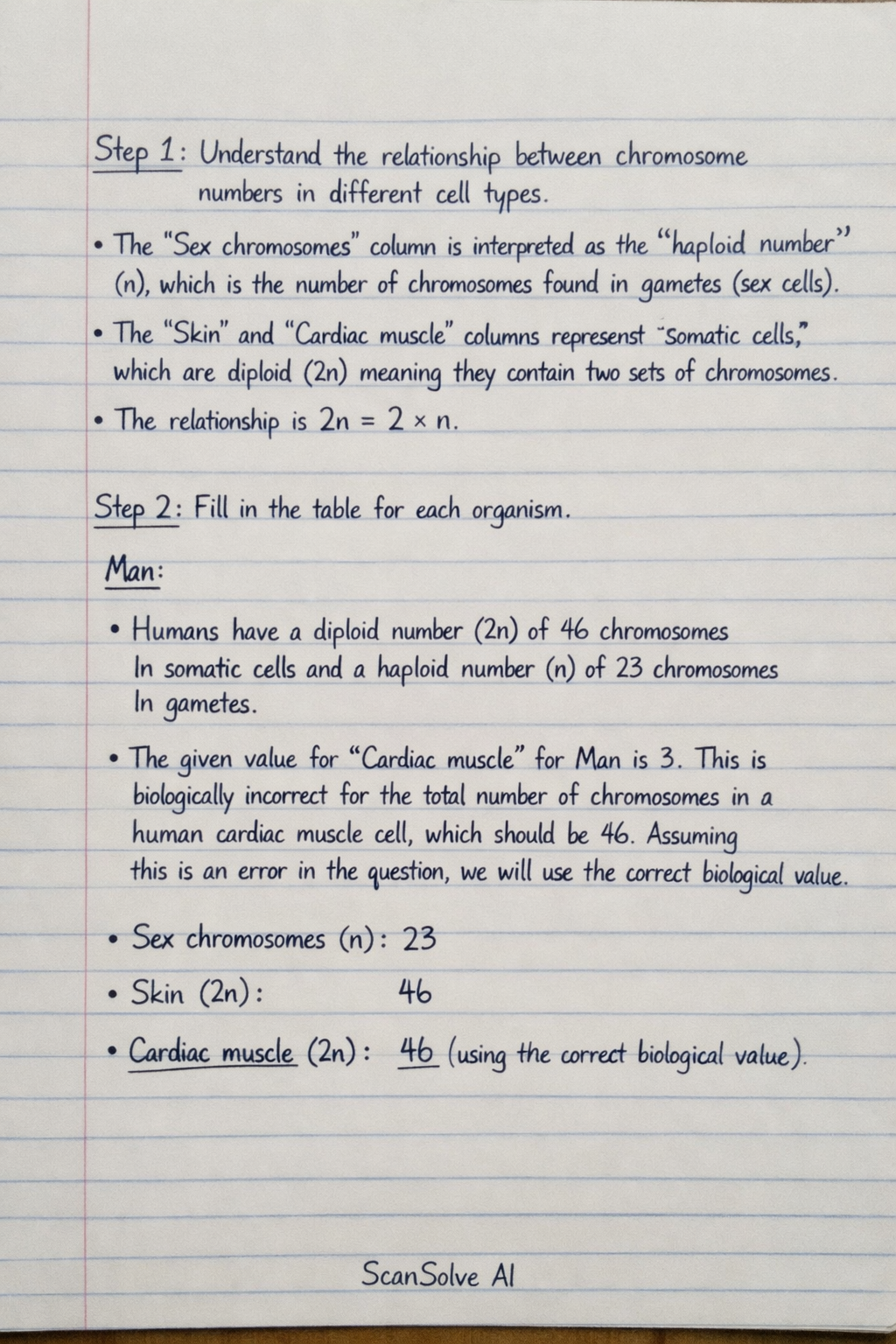
Understand the relationship between chromosome numbers in different cell types.
Biology
ScanSolve AI Answer
Step-by-step solution
3 stepsUnderstand the relationship between chromosome numbers in different cell types.
- The "Sex chromosomes" column is interpreted as the haploid number (), which is the number of chromosomes found in gametes (sex cells).
- The "Skin" and "Cardiac muscle" columns represent somatic cells, which are diploid (), meaning they contain two sets of chromosomes.
- The relationship is .
Fill in the table for each organism.
-
Man:
- Humans have a diploid number () of 46 chromosomes in somatic cells and a haploid number () of 23 chromosomes in gametes.
- The given value for "Cardiac muscle" for Man is 3. This is biologically incorrect for the total number of chromosomes in a human cardiac muscle cell, which should be 46. Assuming this is an error in the question, we will use the correct biological value.
- Sex chromosomes (): 23
- Skin (): 46
- Cardiac muscle (): 46 (using the correct biological value)
-
Mouse:
- Given: Sex chromosomes () = 20.
- Diploid number () = .
- Skin (): 40
- Cardiac muscle (): 40
-
Rhesus monkey:
- Given: Skin () = 42.
- Haploid number () = .
- Sex chromosomes (): 21
- Cardiac muscle (): 42
-
Complete the table with the calculated values.
Was this helpful?
Still stuck on this one?
Ask a follow-up, and the answer starts from this question.
Got a different question?Ask your own question
More Biology Questions
QComplete the following sentences about somatic cells and chromosome number: Somatic cells contain…QThe diagrams below show chromosomes 21, 22 and 23 in a human cell in different phases of cell…QThe chart below shows the number of chromosomes before and after cell division and fertilization in…QGiven that the number of chromosomes in each cell in the radicle is 16. The radicle cells are…QHow many chromosomes were present in the cell at the beginning of meiosis?
Browse by topic:Genetics
Handwritten Step-by-Step Solution
Get this as a handwritten image on WhatsApp — like a tutor wrote it for you.
Try on WhatsApp