
We read your photo as:
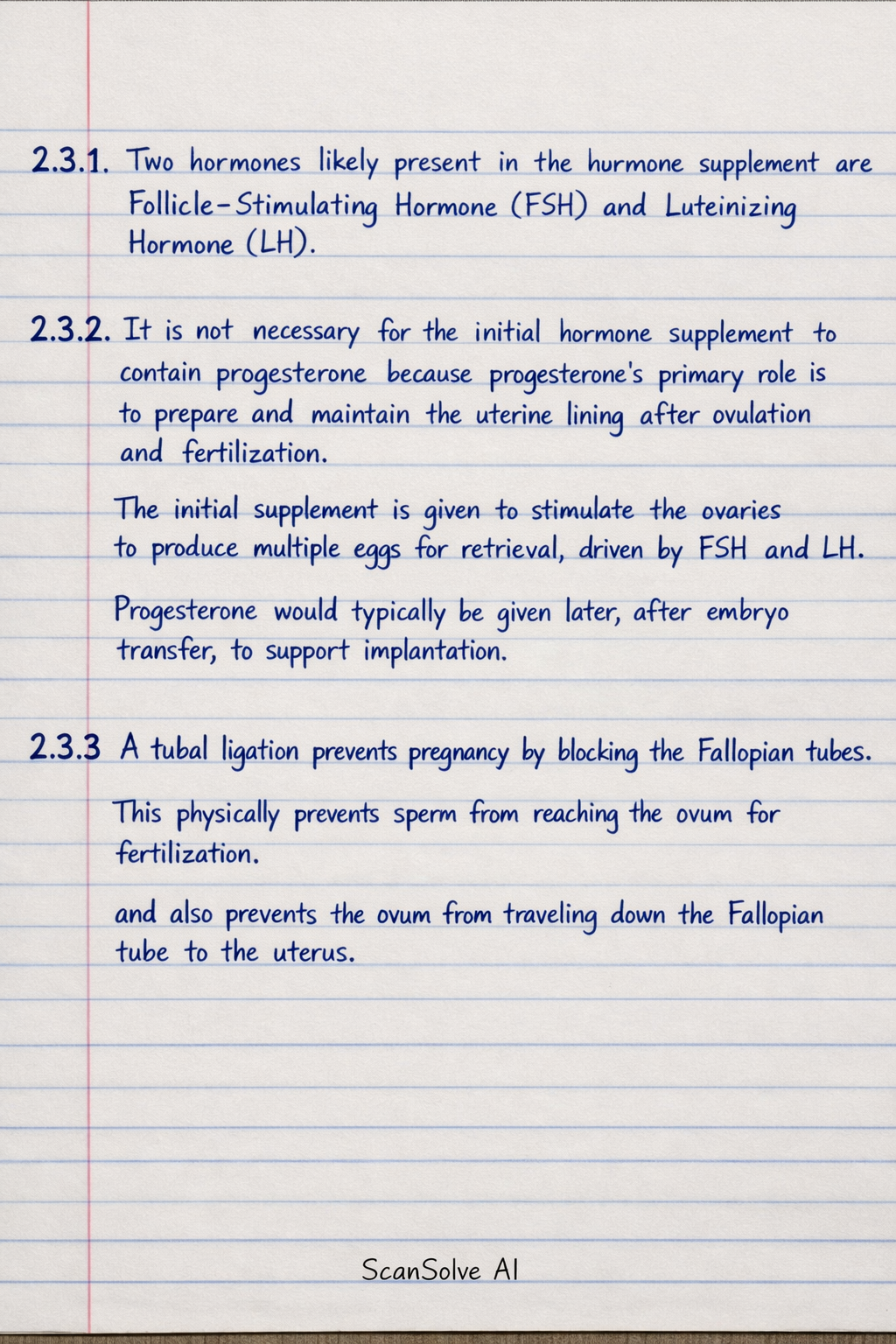
2.3.1 Two hormones likely present in the hormone supplement are Follicle-Stimulating Hormone (FSH) and Luteinizing Hormone (LH).
ScanSolve AI Answer
2.3.1 Two hormones likely present in the hormone supplement are Follicle-Stimulating Hormone (FSH) and Luteinizing Hormone (LH).
2.3.2 It is not necessary for the initial hormone supplement to contain progesterone because progesterone's primary role is to prepare and maintain the uterine lining after ovulation and fertilization. The initial supplement is given to stimulate the ovaries to produce multiple eggs for retrieval, a process primarily driven by FSH and LH. Progesterone would typically be administered later, after embryo transfer, to support implantation.
2.3.3 A tubal ligation prevents pregnancy by blocking the Fallopian tubes. This physically prevents sperm from reaching the ovum for fertilization and also prevents the ovum from traveling down the Fallopian tube to the uterus.
2.3.4
After fertilization in the test tube, the resulting zygote undergoes rapid mitotic cell divisions called cleavage. This forms a solid ball of cells known as a morula. The morula then develops into a hollow structure called a blastocyst, which consists of an inner cell mass and an outer layer (trophoblast). This blastocyst is then transferred into the uterus, where it implants into the thickened, vascularized endometrium (uterine lining).
2.3.5
During pregnancy, high levels of progesterone are produced by the corpus luteum and later by the placenta. These high levels of progesterone exert a negative feedback effect on the hypothalamus and the anterior pituitary gland. This inhibits the secretion of Gonadotropin-Releasing Hormone (GnRH) from the hypothalamus and, consequently, the release of Follicle-Stimulating Hormone (FSH) and Luteinizing Hormone (LH) from the anterior pituitary. The suppression of FSH prevents the development of new ovarian follicles and thus inhibits further ovulation during pregnancy.
2.3.6 When Mpume falls pregnant:
a) Corpus luteum: The corpus luteum will persist (not degenerate) due to the production of human chorionic gonadotropin (hCG) by the developing embryo. It will continue to produce progesterone and estrogen to maintain the uterine lining until the placenta takes over hormone production.
b) Endometrium: The endometrium will be maintained and continue to thicken and become more vascularized and glandular. It will not shed (menstruation will be prevented) to provide a suitable environment for the developing embryo.
Still stuck on this one?
Ask a follow-up, and the answer starts from this question.
More Biology Questions
Handwritten Step-by-Step Solution
Get this as a handwritten image on WhatsApp — like a tutor wrote it for you.
Try on WhatsApp