
We read your photo as:
Answer ALL 3 questions SECTION A Define the following terms: i) Assimilation. ii) Peristalsis. Describe how proteins are digested as they move through the", "subject": "Biology"}
ScanSolve AI Answer
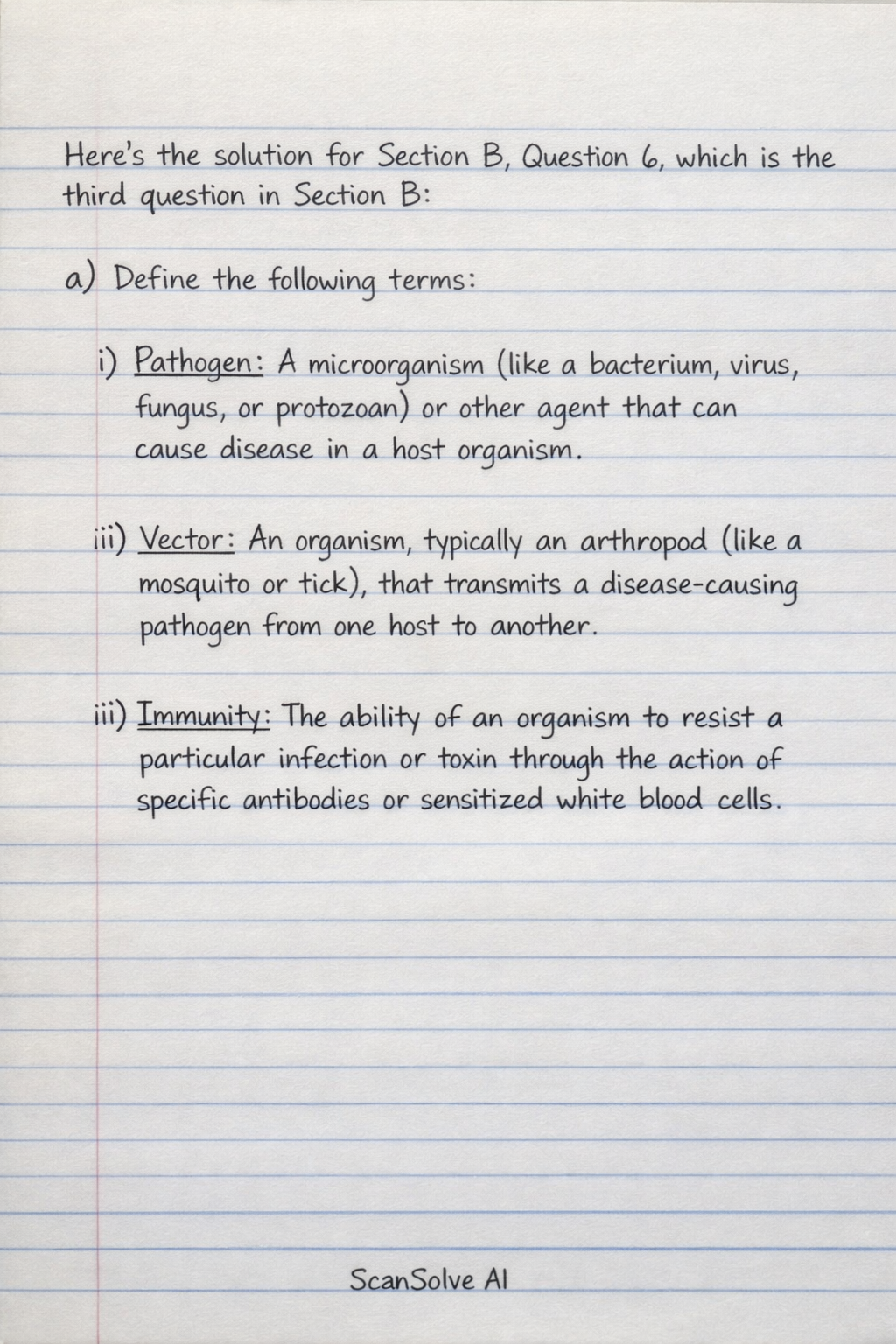
Here's the solution for Section B, Question 6, which is the third question in Section B:
a) Define the following terms:
i) Pathogen: A microorganism (like a bacterium, virus, fungus, or protozoan) or other agent that can cause disease in a host organism.
ii) Vector: An organism, typically an arthropod (like a mosquito or tick), that transmits a disease-causing pathogen from one host to another.
iii) Immunity: The ability of an organism to resist a particular infection or toxin through the action of specific antibodies or sensitized white blood cells.
b) Using malaria as an example, describe:
i) The causative organism and how it is transmitted.
The causative organism of malaria is a parasitic protozoan belonging to the genus Plasmodium. In humans, the most common species are Plasmodium falciparum, Plasmodium vivax, Plasmodium ovale, and Plasmodium malariae. Malaria is transmitted to humans through the bite of an infected female Anopheles mosquito, which acts as the vector. When the mosquito bites, it injects Plasmodium sporozoites into the human bloodstream.
ii) The main symptoms of the disease in humans.
The main symptoms of malaria typically include recurrent episodes of high fever, chills, profuse sweating, headaches, muscle aches, and fatigue. Other common symptoms can include nausea, vomiting, diarrhea, and abdominal pain. In severe cases, malaria can lead to anemia, jaundice, seizures, coma, and death.
c) State FIVE measures that can be taken to control the spread of malaria in a community.
- Use of insecticide-treated bed nets (ITNs): These nets provide a physical barrier and chemical protection against mosquito bites during sleep.
- Indoor residual spraying (IRS): Applying long-lasting insecticides to the inner walls of homes to kill mosquitoes that rest there.
- Larval source management: Eliminating or treating mosquito breeding sites, such as stagnant water bodies, with larvicides or by draining them.
- Prompt diagnostic testing and effective treatment: Early diagnosis using rapid diagnostic tests (RDTs) or microscopy, followed by immediate treatment with appropriate antimalarial drugs, reduces the parasite reservoir and prevents further transmission.
- Chemoprevention: Administering antimalarial drugs to vulnerable populations (e.g., pregnant women, infants, and young children) to prevent infection or disease.
Still stuck on this one?
Ask a follow-up, and the answer starts from this question.
More Biology Questions
Handwritten Step-by-Step Solution
Get this as a handwritten image on WhatsApp — like a tutor wrote it for you.
Try on WhatsApp