
We read your photo as:
The table provides the rate of extinction for two periods:
Biology
ScanSolve AI Answer
Answer
A
Here are the solutions to the questions:
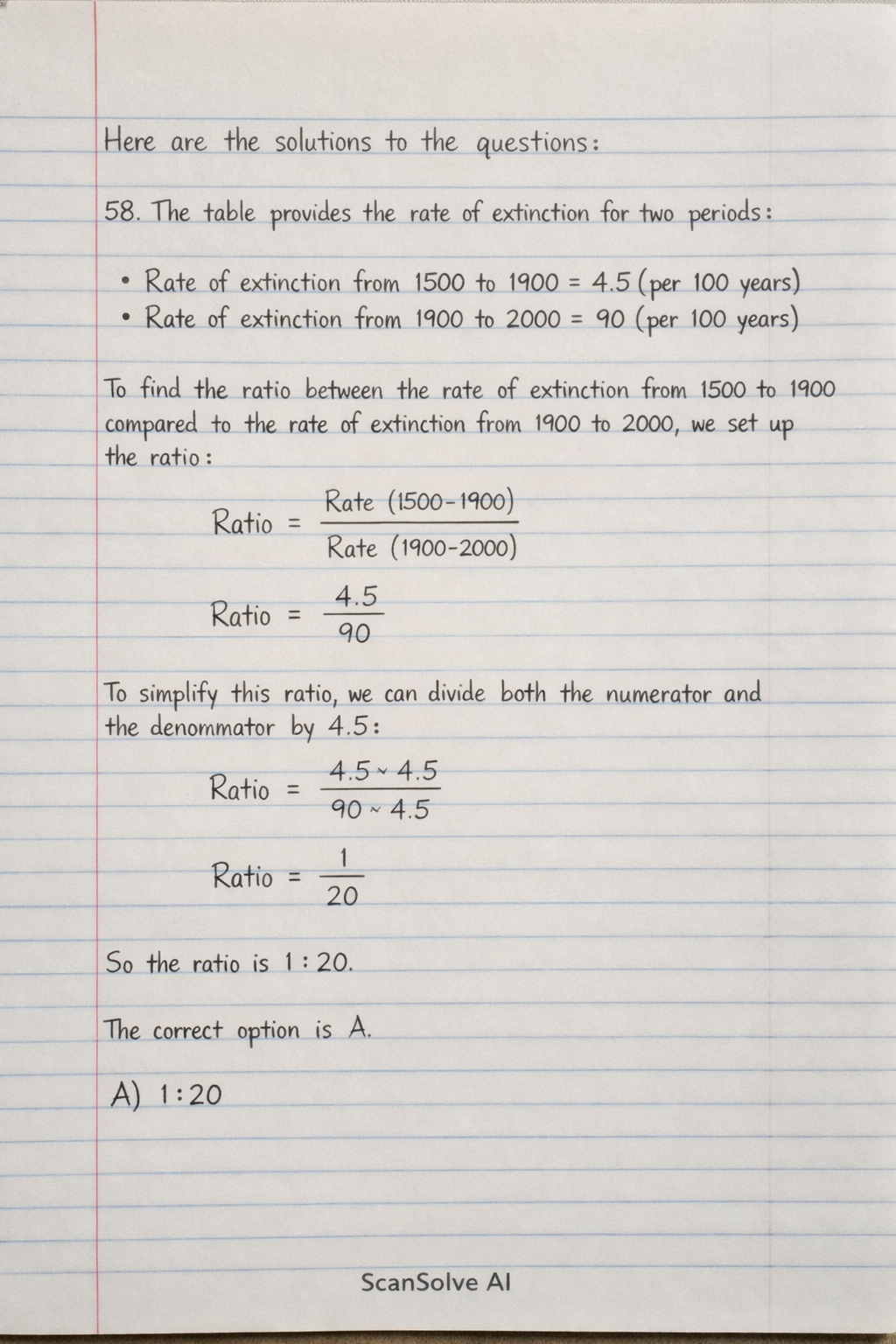
- The table provides the rate of extinction for two periods:
- Rate of extinction from 1500 to 1900 = 4.5 (per 100 years)
- Rate of extinction from 1900 to 2000 = 90 (per 100 years)
To find the ratio between the rate of extinction from 1500 to 1900 compared to the rate of extinction from 1900 to 2000, we set up the ratio:
To simplify this ratio, we can divide both the numerator and the denominator by 4.5:
So the ratio is .
The correct option is A.
A) 1:20
- In an investigation, the independent variable is the factor that is intentionally changed or manipulated by the experimenter to observe its effect on another variable. The investigation described aims "to determine the resistance of E. coli to two antibiotics, A and B". The scientists are comparing the effects of different antibiotics. Therefore, the type of antibiotic (A or B) is the variable being changed by the scientists.
The correct option is C.
C) type of antibiotic
- The graph shows the average percentage resistance of E. coli to two types of antibiotics (A and B) over time.
- A higher percentage resistance means the antibiotic is less effective against the E. coli.
- A lower percentage resistance means the antibiotic is more effective against the E. coli.
From the graph:
- The line for Antibiotic A consistently shows a higher percentage resistance than Antibiotic B throughout the six months. For example, at 6 months, resistance to A is about 85%, while resistance to B is about 45%.
- Since E. coli shows less resistance to Antibiotic B, it means Antibiotic B is more effective at inhibiting E. coli growth compared to Antibiotic A.
The correct option is B.
B) antibiotic B is more effective than antibiotic A.
Was this helpful?
Try one yourself
A new problem that tests the same skill.
Still stuck on this one?
Ask a follow-up, and the answer starts from this question.
Got a different question?Ask your own question
More Biology Questions
QComplete Table 1 by calculating the Rate, 1/t ( exts⁻¹) for each experiment.Q1 the rate of reaction 2 the half lifeQComplete the table for calculating the period of a pendulum, given measurements of two time…QBriefly explain why the count rate reduces with time. Calculate the background count. Without…QGive me the period table
Handwritten Step-by-Step Solution
Get this as a handwritten image on WhatsApp — like a tutor wrote it for you.
Try on WhatsApp