

This physics problem tests your understanding of fundamental physical laws and their applications. The step-by-step solution below breaks down the problem using relevant equations and physical reasoning.
ScanSolve AI Answer
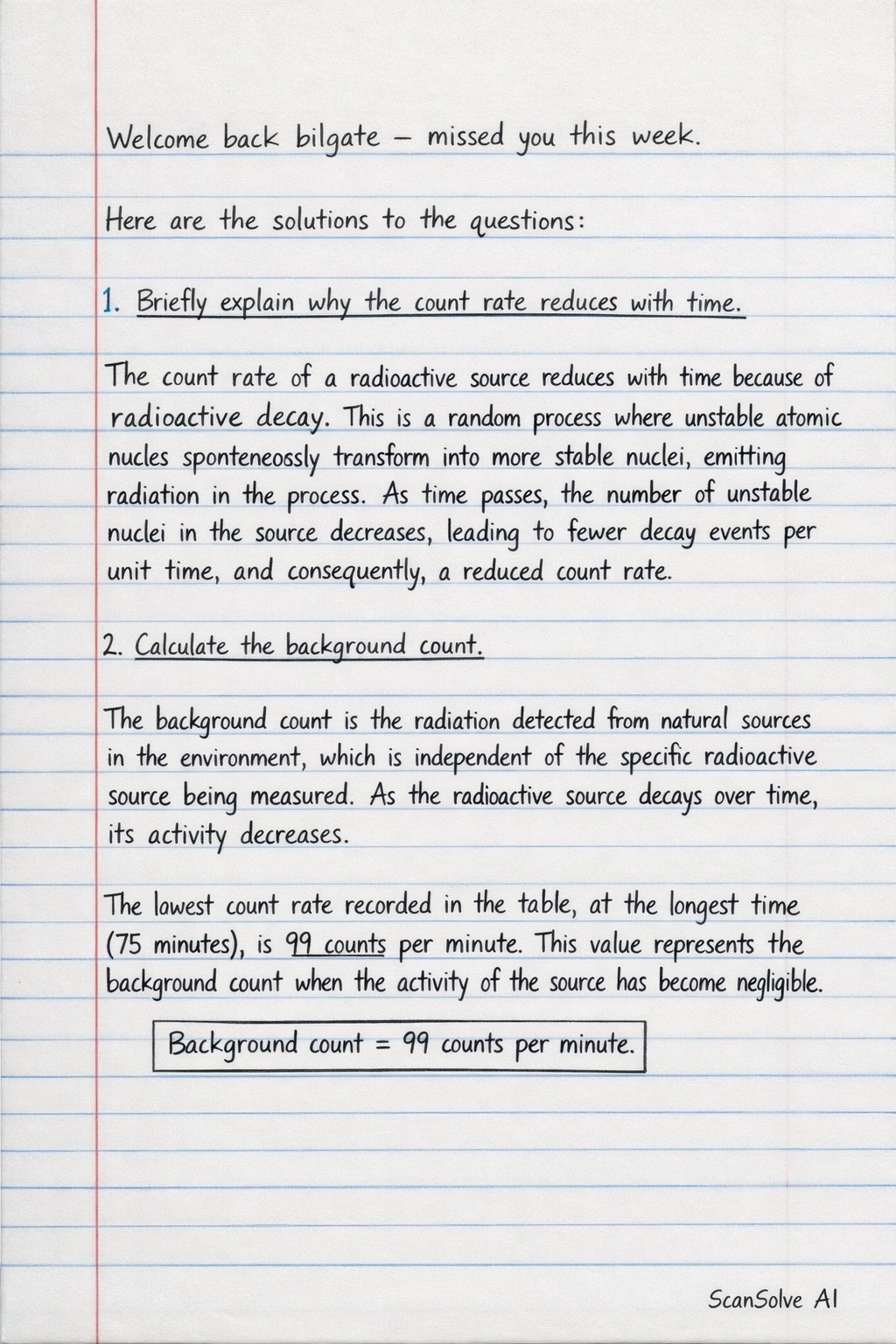
Here are the solutions to the questions: 1. Briefly explain why the count rate reduces with time. The count rate of a radioactive source reduces with time because of radioactive decay. This is a random process where unstable atomic nuclei spontaneously transform into more stable nuclei, emitting radiation in the process. As time passes, the number of unstable nuclei in the source decreases, leading to fewer decay events per unit time, and consequently, a reduced count rate. 2. Calculate the background count. The background count is the radiation detected from natural sources in the environment, which is independent of the specific radioactive source being measured. As the radioactive source decays over time, its activity decreases. The lowest count rate recorded in the table, at the longest time (75 minutes), is 99 counts per minute. This value represents the background count when the activity of the source has become negligible. Background count = 99 counts per minute 3. Without drawing a graph suggest an approximate half-life of the source. Step 1: Calculate the corrected count rates by subtracting the background count (99 cpm) from the observed count rates. | Time (minutes) | Observed Count Rate (cpm) | Corrected Count Rate (cpm) | | :------------- | :------------------------ | :------------------------- | | 0 | 240 | 240 - 99 = 141 | | 15 | 187.5 | 187.5 - 99 = 88.5 | | 30 | 150 | 150 - 99 = 51 | | 40 | 120 | 120 - 99 = 21 | | 55 | 102 | 102 - 99 = 3 | | 75 | 99 | 99 - 99 = 0 | Step 2: Identify the initial corrected count rate. The initial corrected count rate (at 0 minutes) is 141 cpm. Step 3: Determine half of the initial corrected count rate. Half of the initial corrected count rate = 141 cpm2 = 70.5 cpm. Step 4: Estimate the time when the corrected count rate is approximately 70.5 cpm from the table. From the table, at 15 minutes, the corrected count rate is 88.5 cpm. At 30 minutes, the corrected count rate is 51 cpm. The value 70.5 cpm falls between these two time points. Since 70.5 is roughly midway between 88.5 and 51, the half-life is approximately midway between 15 minutes and 30 minutes. Approximate half-life = 15 min + 30 min2 = 45 min2 = 22.5 minutes Send me the next one 📸