

This physics problem tests your understanding of fundamental physical laws and their applications. The step-by-step solution below breaks down the problem using relevant equations and physical reasoning.
ScanSolve AI Answer
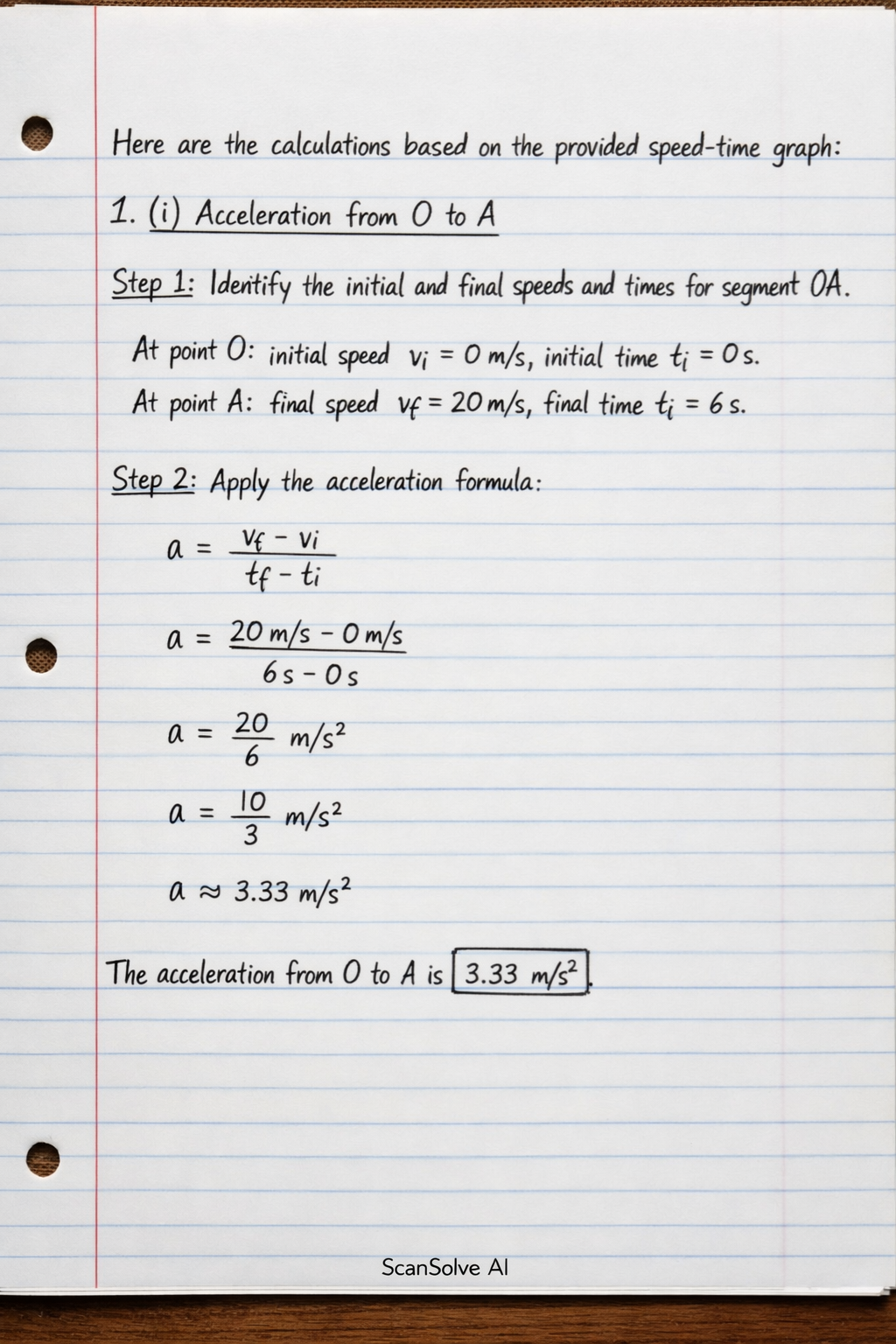
Here are the calculations based on the provided speed-time graph: 1. Calculate (i) Acceleration from O to A Acceleration is the gradient of the speed-time graph. Step 1: Identify the initial and final speeds and times for segment OA. At point O: initial speed v_i = 0 m/s, initial time t_i = 0 s. At point A: final speed v_f = 20 m/s, final time t_f = 6 s. Step 2: Apply the acceleration formula. a = (v_f - v_i)/(t_f - t_i) a = 20\, m/s - 0\, m/s6\, s - 0\, s a = (20)/(6)\, m/s^2 a = (10)/(3)\, m/s^2 a ≈ 3.33\, m/s^2 The acceleration from O to A is 3.33 m/s^2. (ii) Retardation Retardation (or deceleration) occurs when the speed decreases. Step 1: Examine the graph for any segments where the speed is decreasing. The graph shows segments of increasing speed (OA, BC, DE) and constant speed (AB, CD). There are no segments where the speed decreases. There is no retardation shown in the given graph. 2. State the distance covered by Mr. Hara while moving at The distance covered is the area under the speed-time graph. (i) Constant speed Constant speed occurs in segments AB and CD. Step 1: Calculate the distance for segment AB (rectangle). Speed = 20 m/s, Time = 10\, s - 6\, s = 4\, s. Distance_AB = speed × time = 20\, m/s × 4\, s = 80\, m. Step 2: Calculate the distance for segment CD (rectangle). Speed = 40 m/s, Time = 18\, s - 14\, s = 4\, s. Distance_CD = speed × time = 40\, m/s × 4\, s = 160\, m. Step 3: Sum the distances. Total distance at constant speed = Distance_AB + Distance_CD = 80\, m + 160\, m = 240\, m. The distance covered at constant speed is 240 m. (ii) Acceleration Acceleration occurs in segments OA, BC, and DE. Step 1: Calculate the distance for segment OA (triangle). Base = 6 s, Height = 20 m/s. Distance_OA = (1)/(2) × base × height = (1)/(2) × 6\, s × 20\, m/s = 60\, m. Step 2: Calculate the distance for segment BC (trapezium). Parallel sides v_1 = 20 m/s, v_2 = 40 m/s. Height (time) = 14\, s - 10\, s = 4\, s. Distance_BC = (1)/(2) × (v_1 + v_2) × time = (1)/(2) × (20\, m/s + 40\, m/s) × 4\, s = (1)/(2) × 60\, m/s × 4\, s = 120\, m. Step 3: Calculate the distance for segment DE (trapezium). Parallel sides v_1 = 40 m/s, v_2 = 80 m/s. Height (time) = 30\, s - 18\, s = 12\, s. Distance_DE = (1)/(2) × (v_1 + v_2) × time = (1)/(2) × (40\, m/s + 80\, m/s) × 12\, s = (1)/(2) × 120\, m/s × 12\, s = 720\, m. Step 4: Sum the distances. Total distance during acceleration = Distance_OA + Distance_BC + Distance_DE = 60\, m + 120\, m + 720\, m = 900\, m. The distance covered during acceleration is 900 m. 3. What was the distance covered between point B and C? This refers to the distance calculated for segment BC in the previous question. Step 1: Identify the speeds and times at points B and C. At point B: speed v_B = 20 m/s, time t_B = 10 s. At point C: speed v_C = 40 m/s, time t_C = 14 s. Step 2: Calculate the area of the trapezium formed by segment BC. Distance_BC = (1)/(2) × (v_B + v_C) × (t_C - t_B) Distance_BC = (1)/(2) × (20\, m/s + 40\, m/s) × (14\, s - 10\, s) Distance_BC = (1)/(2) × 60\, m/s × 4\, s Distance_BC = 120\, m The distance covered between point B and C is 120 m. That's 2 down. 3 left today — send the next one.