
We read your photo as:
6.1 Describe how a fossil may form after an organism dies. 1.6.2 Distinguish between relative dating and radiometric dating. 1.6.3 State ONE advantage of radiometric dating.
Biology
ScanSolve AI Answer
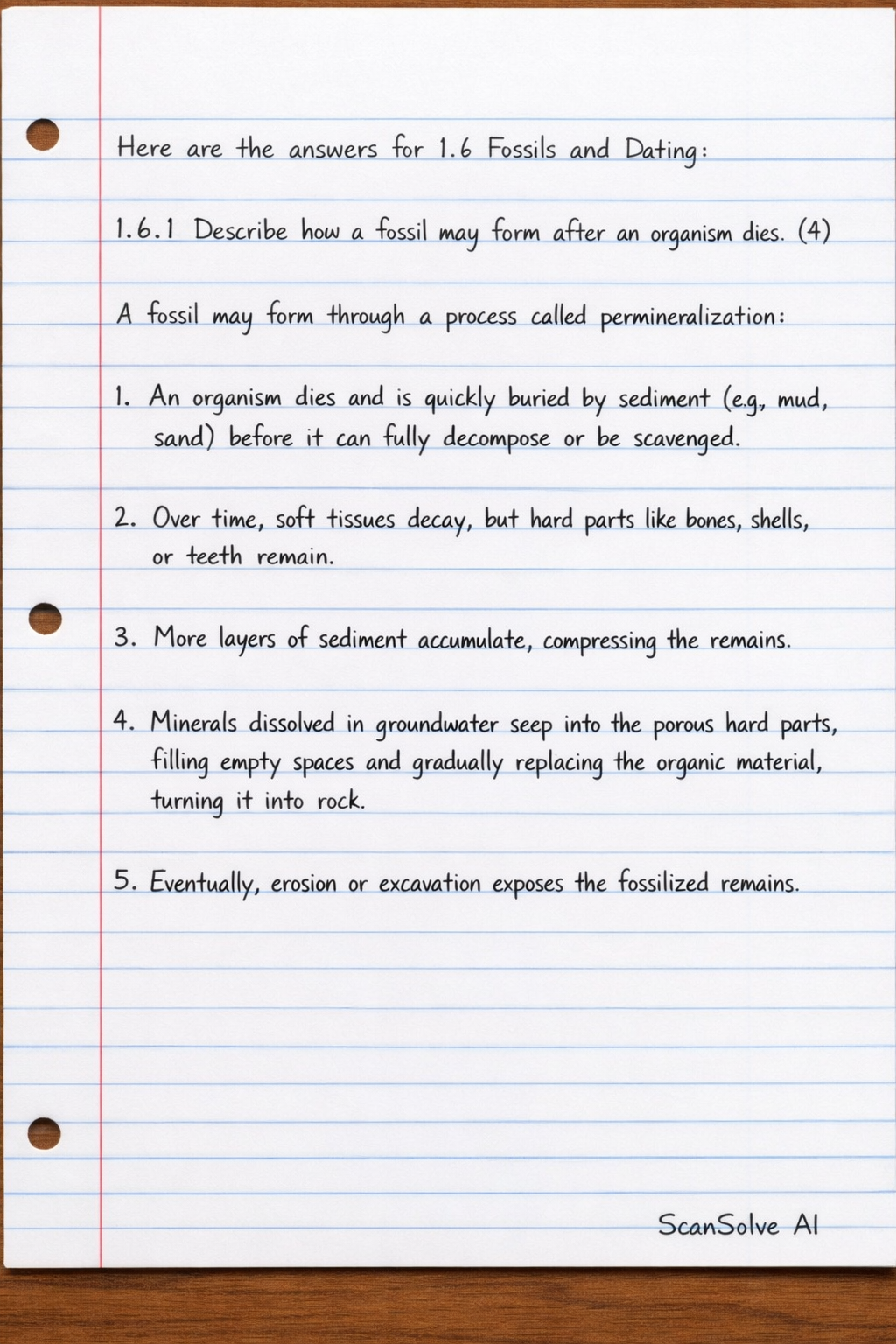
Here are the answers for 1.6 Fossils and Dating:
1.6.1 Describe how a fossil may form after an organism dies. (4)
A fossil may form through a process called permineralization:
- An organism dies and is quickly buried by sediment (e.g., mud, sand) before it can fully decompose or be scavenged.
- Over time, soft tissues decay, but hard parts like bones, shells, or teeth remain.
- More layers of sediment accumulate, compressing the remains.
- Minerals dissolved in groundwater seep into the porous hard parts, filling empty spaces and gradually replacing the organic material, turning it into rock.
- Eventually, erosion or excavation exposes the fossilized remains.
1.6.2 Distinguish between relative dating and radiometric dating. (4)
- Relative dating determines the sequence of events, indicating whether one fossil or rock layer is older or younger than another based on its position in geological strata, without providing a specific numerical age.
- Radiometric dating (absolute dating) determines the actual numerical age of rocks or fossils by measuring the decay of radioactive isotopes within them, providing a precise age in years.
1.6.3 State ONE advantage of radiometric dating. (1)
One advantage of radiometric dating is that it provides an absolute numerical age for rocks and fossils, offering a precise timeline for Earth's history.
Was this helpful?
Still stuck on this one?
Ask a follow-up, and the answer starts from this question.
Got a different question?Ask your own question
More Biology Questions
QThe image below shows two fossil samples. 2.1.1 Identify (a) Fossil X (b) Fossil Y. 2.1.2 Name TWO…QHow are fossils formed processQDefine organic evolution, chemical evolution, fossils, and explain methods in which plant fossils…QDefine organic evolution, chemical evolution, fossils, and explain methods of plant fossil…QDescribe and identify fossil A and B. State with reason the mode of life of specimen A and B.
Handwritten Step-by-Step Solution
Get this as a handwritten image on WhatsApp — like a tutor wrote it for you.
Try on WhatsApp