
We read your photo as:
A) (i) Two examples of stem tubers cultivated in Ghana are:
ScanSolve AI Answer
Step-by-step solution
4 stepsHere are the solutions to the questions:
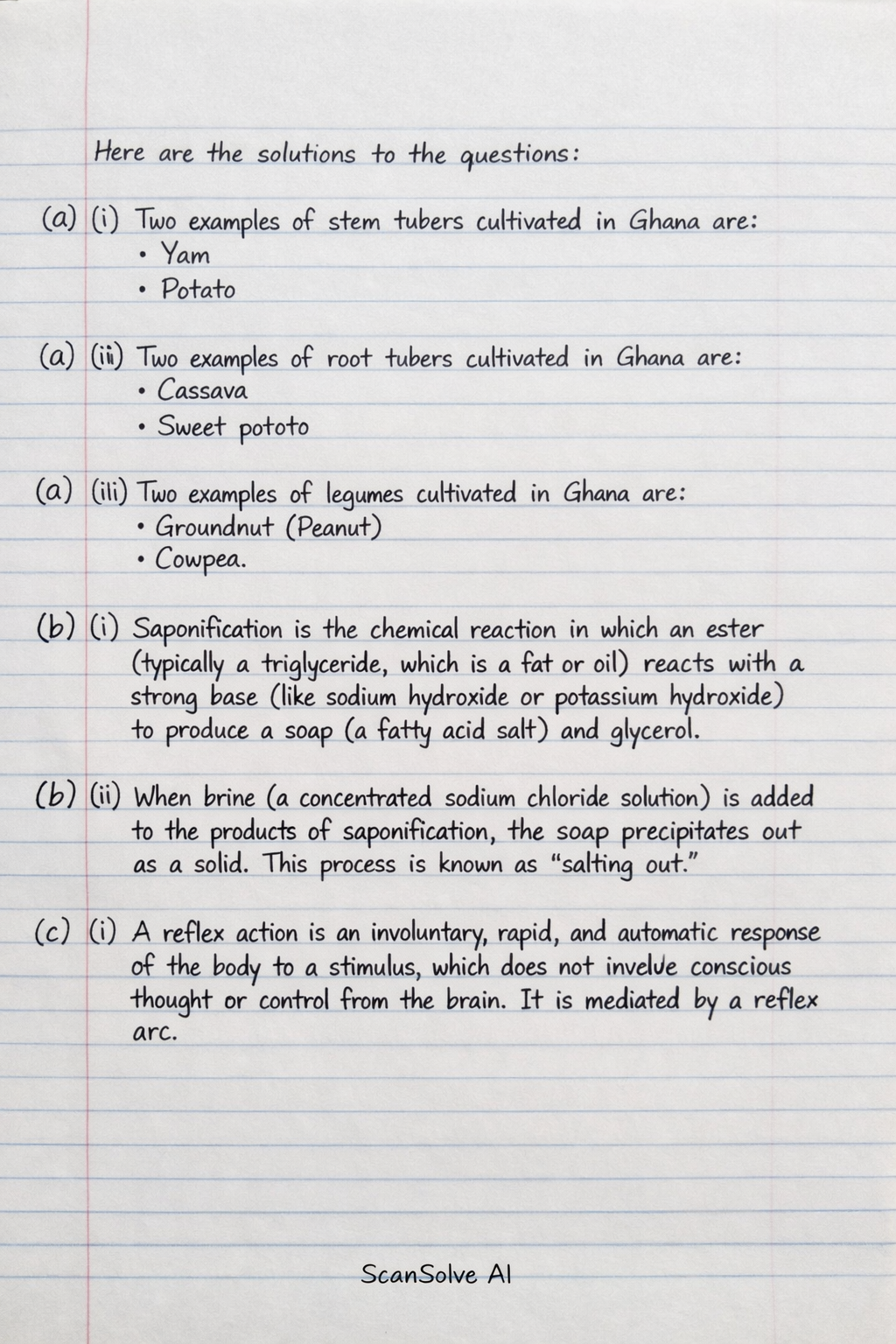
a) (i) Two examples of stem tubers cultivated in Ghana are:
- Yam
- Potato
a) (ii) Two examples of root tubers cultivated in Ghana are:
- Cassava
- Sweet potato
a) (iii) Two examples of legumes cultivated in Ghana are:
- Groundnut (Peanut)
- Cowpea
b) (i) Saponification is the chemical reaction in which an ester (typically a triglyceride, which is a fat or oil) reacts with a strong base (like sodium hydroxide or potassium hydroxide) to produce a soap (a fatty acid salt) and glycerol.
b) (ii) When brine (a concentrated sodium chloride solution) is added to the products of saponification, the soap precipitates out as a solid. This process is known as "salting out."
c) (i) A reflex action is an involuntary, rapid, and automatic response of the body to a stimulus, which does not involve conscious thought or control from the brain. It is mediated by a reflex arc.
c) (ii) Three examples of reflex actions in the human body are:
- Knee-jerk reflex (patellar reflex)
- Blinking when an object approaches the eye
- Withdrawal of a hand from a hot object
d) (i) The law of conservation of energy states that energy cannot be created or destroyed, but it can be transformed from one form to another. The total energy in an isolated system remains constant.
d) (ii) To calculate the velocity of the block, we use the principle of conservation of mechanical energy. The potential energy at height is converted into kinetic energy just before it touches the ground.
State the formula for potential and kinetic energy.
Potential energy (PE)
Kinetic energy (KE)Apply the law of conservation of energy.
Initial PE at height = Final KE just before touching the ground
Substitute the given values into the equation.
Given: , , .
Since mass appears on both sides, it cancels out:Solve for .
The velocity of the block just before it touches the ground is (or ).
Still stuck on this one?
Ask a follow-up, and the answer starts from this question.
More Biology Questions
Handwritten Step-by-Step Solution
Get this as a handwritten image on WhatsApp — like a tutor wrote it for you.
Try on WhatsApp