
We read your photo as:
A) Make a fully labeled diagram of a named non-septate fungus. b) Differentiate between an Obligate and facultative parasite.
ScanSolve AI Answer
Here's the solution for Question 1:
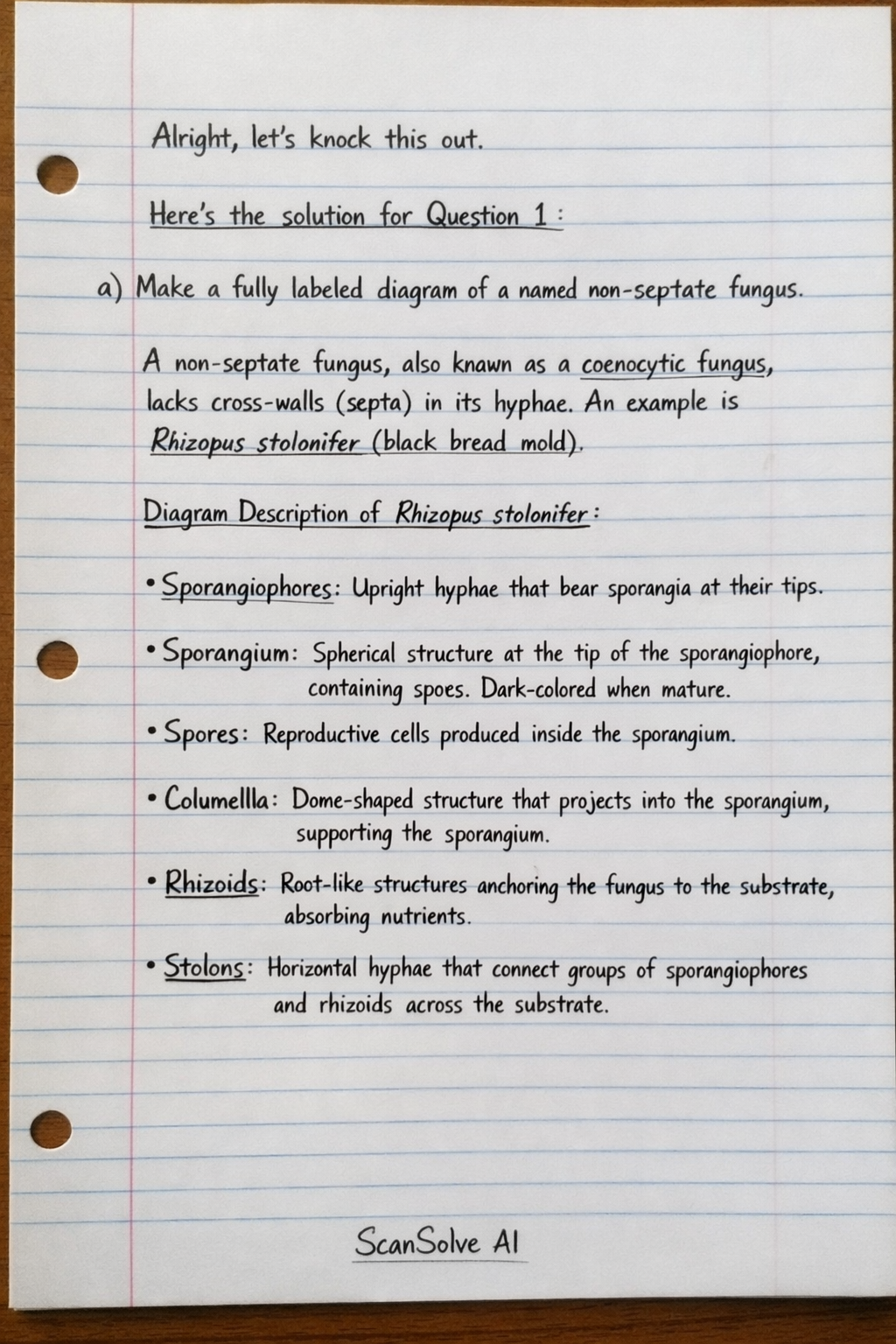
a) Make a fully labeled diagram of a named non-septate fungus.
A non-septate fungus, also known as a coenocytic fungus, lacks cross-walls (septa) in its hyphae. An example is Rhizopus stolonifer (black bread mold).
Diagram Description of Rhizopus stolonifer:
Imagine a structure with three main parts:
- Sporangiophores: Upright hyphae that bear sporangia at their tips.
- Sporangium: A spherical structure at the tip of the sporangiophore, containing spores. It is typically dark-colored when mature.
- Spores: Reproductive cells produced inside the sporangium.
- Columella: A dome-shaped structure that projects into the sporangium from the sporangiophore, supporting the sporangium.
- Rhizoids: Root-like structures that anchor the fungus to the substrate and absorb nutrients. They extend downwards from the point where sporangiophores arise.
- Stolons: Horizontal hyphae that connect groups of sporangiophores and rhizoids, spreading across the substrate.
b) Differentiate between an Obligate and facultative parasite.
- An obligate parasite is an organism that cannot complete its life cycle without exploiting a suitable host. It is entirely dependent on the host for survival and reproduction. Examples include viruses and some bacteria like Mycobacterium leprae.
- A facultative parasite is an organism that can live independently as a saprophyte (feeding on dead organic matter) but can also act as a parasite if given the opportunity. It does not strictly require a host to complete its life cycle. Examples include some fungi like Armillaria species.
c) What are Mycorrhizae? Give at least three (3) benefits of Mycorrhizae in its environment.
Mycorrhizae are symbiotic associations between a fungus and the roots of a vascular plant. The term "mycorrhiza" literally means "fungus root."
Benefits of Mycorrhizae:
- Enhanced Nutrient Uptake: The fungal hyphae extend far into the soil, increasing the surface area for absorption of water and essential nutrients, especially phosphorus, nitrogen, and micronutrients, which are often immobile or scarce in the soil.
- Improved Water Absorption: The extensive network of fungal hyphae helps the plant access water from a larger volume of soil, improving drought resistance.
- Protection Against Pathogens: Mycorrhizal fungi can form a physical barrier around the roots and produce antimicrobial compounds, protecting the plant from root pathogens and diseases.
- Increased Stress Tolerance: Mycorrhizal plants often show increased tolerance to various environmental stresses, such as heavy metal toxicity, salinity, and extreme temperatures.
- Soil Structure Improvement: The fungal hyphae bind soil particles together, improving soil aggregation and stability, which can reduce erosion.
Still stuck on this one?
Ask a follow-up, and the answer starts from this question.
More Biology Questions
Handwritten Step-by-Step Solution
Get this as a handwritten image on WhatsApp — like a tutor wrote it for you.
Try on WhatsApp