
We read your photo as:
A potometer is set up to measure the rate of transpiration. The apparatus and results are shown above. (a) Name the apparatus. (b) Identify the dependent and independent variables. (c) State two preca
ScanSolve AI Answer
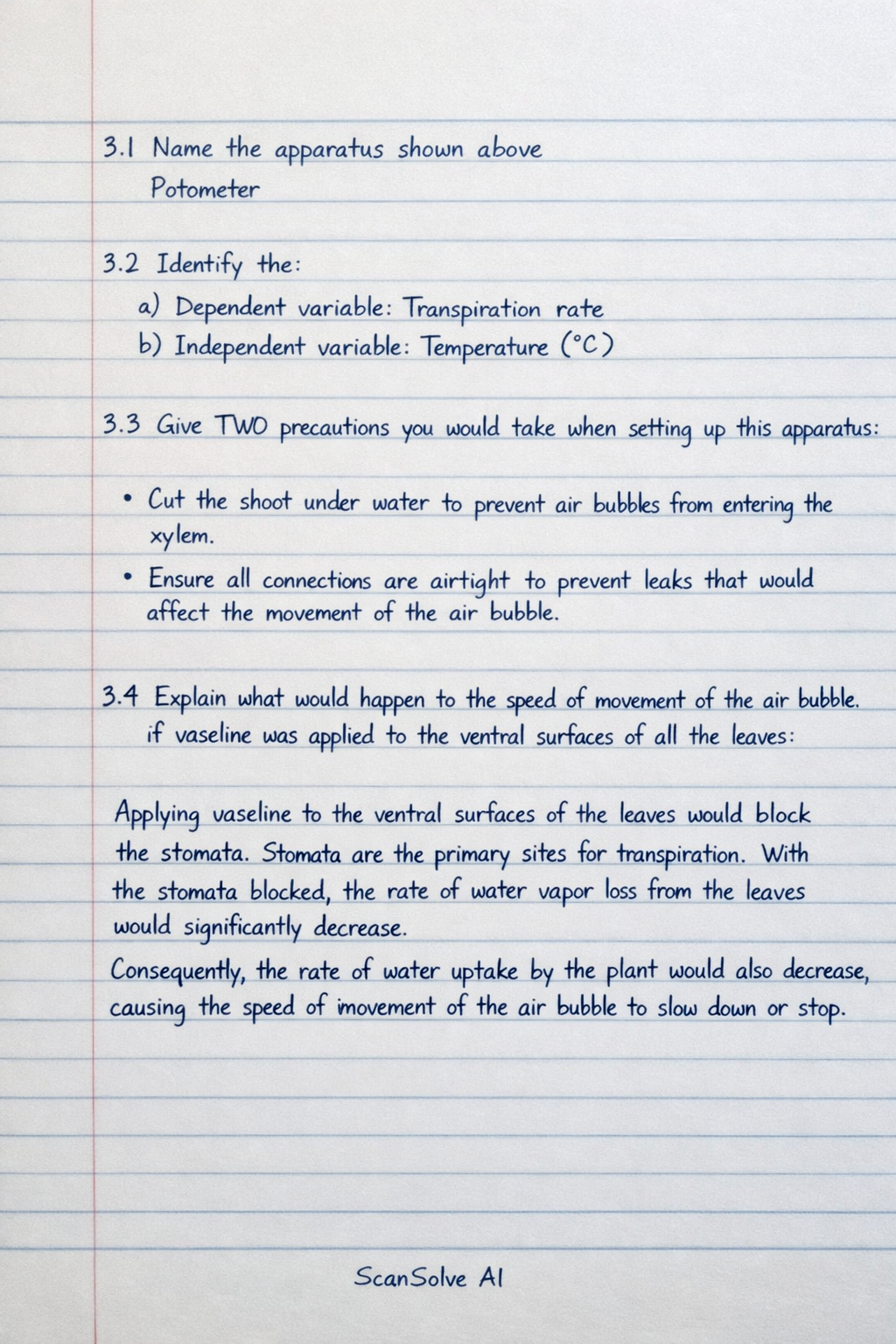
3.1 Name the apparatus shown above
Potometer
3.2 Identify the:
a) Dependent variable: Transpiration rate
b) Independent variable: Temperature (°C)
3.3 Give TWO precautions you would take when setting up this apparatus.
- Cut the shoot under water to prevent air bubbles from entering the xylem.
- Ensure all connections are airtight to prevent leaks that would affect the movement of the air bubble.
3.4 Explain what would happen to the speed of movement of the air bubble if vaseline was applied to the ventral surfaces of all the leaves.
Applying vaseline to the ventral surfaces of the leaves would block the stomata. Stomata are the primary sites for transpiration. With the stomata blocked, the rate of water vapor loss from the leaves would significantly decrease. Consequently, the rate of water uptake by the plant would also decrease, causing the speed of movement of the air bubble to slow down or stop.
3.5 Draw a line graph using the results in the table
To draw the line graph:
- Plot Temperature (°C) on the x-axis (horizontal axis) and Transpiration rate (mol/m²sec) on the y-axis (vertical axis).
- Choose an appropriate scale for both axes to accommodate the range of data (Temperature: 22-30°C, Transpiration rate: 1.5-5 mol/m²sec).
- Plot the following points: (22, 1.5), (25, 3.5), (27, 5), (28, 4.5), (30, 4).
- Connect the plotted points with a smooth curve or straight lines.
- Label both axes clearly with their respective units and provide a suitable title for the graph, such as "Effect of Temperature on Transpiration Rate".
Still stuck on this one?
Ask a follow-up, and the answer starts from this question.
More Biology Questions
Handwritten Step-by-Step Solution
Get this as a handwritten image on WhatsApp — like a tutor wrote it for you.
Try on WhatsApp