
We read your photo as:
Describe the apparatus used to measure the rate of water uptake in plants and explain how to conduct the experiment, including precautions, expected results, and how to present the data.
Biology
ScanSolve AI Answer
Step-by-step solution
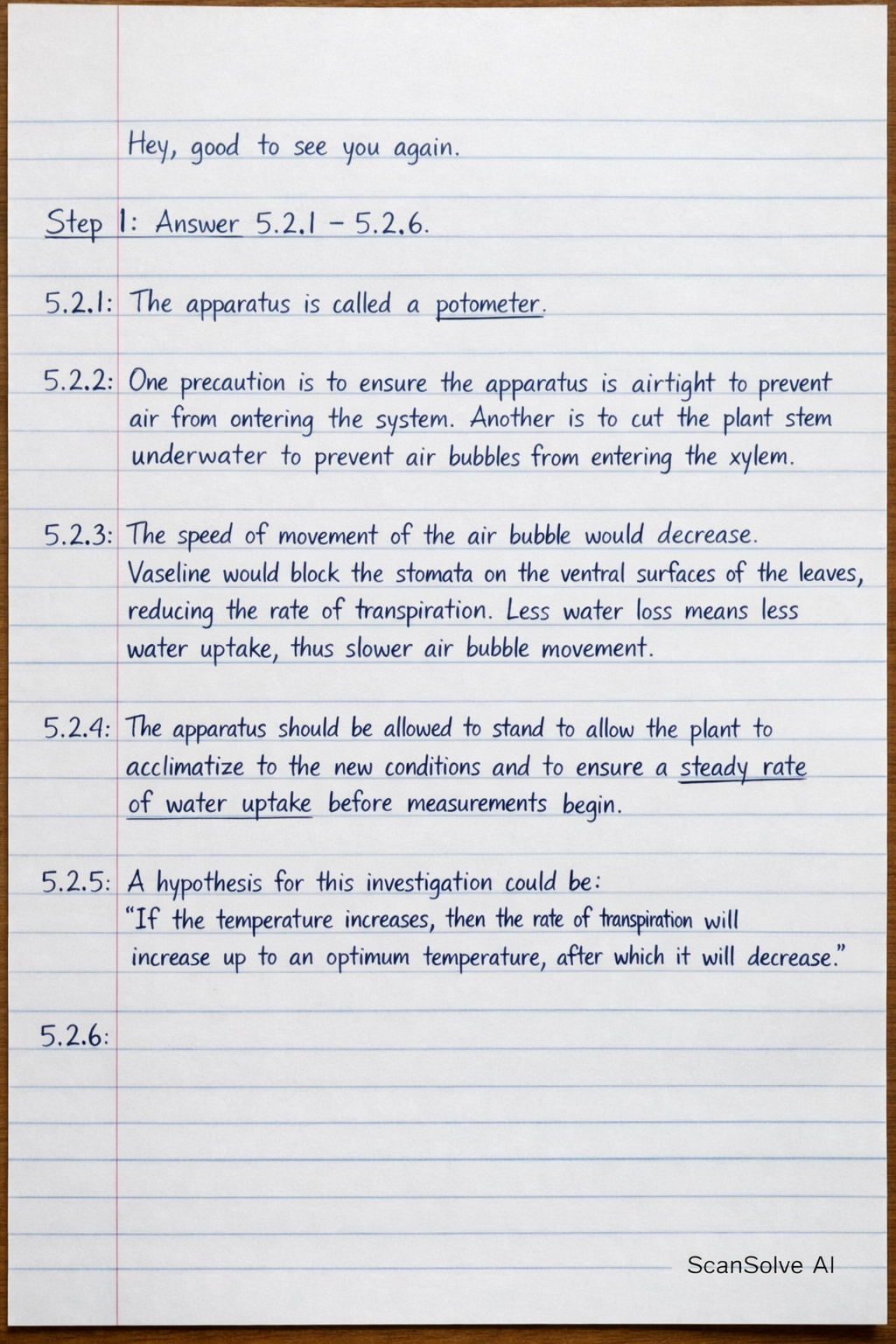
2 stepsStep 1: Answer 5.2.1, 5.2.2, 5.2.3, 5.2.4, 5.2.5, and 5.2.6.
- 5.2.1: The apparatus is called a potometer.
- 5.2.2: One precaution is to ensure the apparatus is airtight to prevent air from entering the system, which would affect the accuracy of the readings. Another is to cut the plant stem underwater to prevent air bubbles from entering the xylem.
- 5.2.3: The speed of movement of the air bubble would decrease. Vaseline would block the stomata on the ventral surfaces of the leaves, reducing the rate of transpiration (water loss) from the plant. Less water loss means less water uptake, thus slower air bubble movement.
- 5.2.4: The apparatus should be allowed to stand to allow the plant to acclimatize to the new conditions and to ensure a steady rate of water uptake before measurements begin.
- 5.2.5: A hypothesis for this investigation could be: "If the temperature increases, then the rate of transpiration will increase up to an optimum temperature, after which it will decrease."
- 5.2.6:
Part a
Dependent variable: Transpiration rate (m mol/m² sec)
Part b· 2 steps
Independent variable: Temperature (°C)
Address 5.2.7.
- 5.2.7: To draw a line graph:
- Plot Temperature (°C) on the x-axis and Transpiration rate (m mol/m² sec) on the y-axis.
- Plot the points: $(22, 1.5)$, $(25, 3.5)$, $(27, 5)$, $(28, 4.5)$, and $(30, 4)$.
- Connect the plotted points with a line. (I cannot draw the graph for you, but these instructions describe how to create it.)
- 5.2.7: To draw a line graph:
Answer 5.2.8.
- 5.2.8: Based on the results, as the temperature increases from to , the transpiration rate increases. However, beyond (at and ), the transpiration rate starts to decrease. This indicates that there is an optimum temperature for transpiration, which appears to be around in this experiment.
Was this helpful?
Still stuck on this one?
Ask a follow-up, and the answer starts from this question.
Got a different question?Ask your own question
More Biology Questions
QExplain the process of water uptake by plants, identifying the structures and forces involved, and…QA potometer is set up to measure the rate of transpiration. The apparatus and results are shown…QOutline the theoretical concepts and practical skills needed for a Plant Water Relations practical…QThis image describes Experiment 17.1, which aims to investigate the rate of water loss from plant…QOutline the experimental procedure to investigate osmosis in plant tissue using potato cylinders, as…
Handwritten Step-by-Step Solution
Get this as a handwritten image on WhatsApp — like a tutor wrote it for you.
Try on WhatsApp