

This biology question covers important biological concepts and processes. The step-by-step explanation below helps you understand the underlying mechanisms and reasoning.
ScanSolve AI Answer
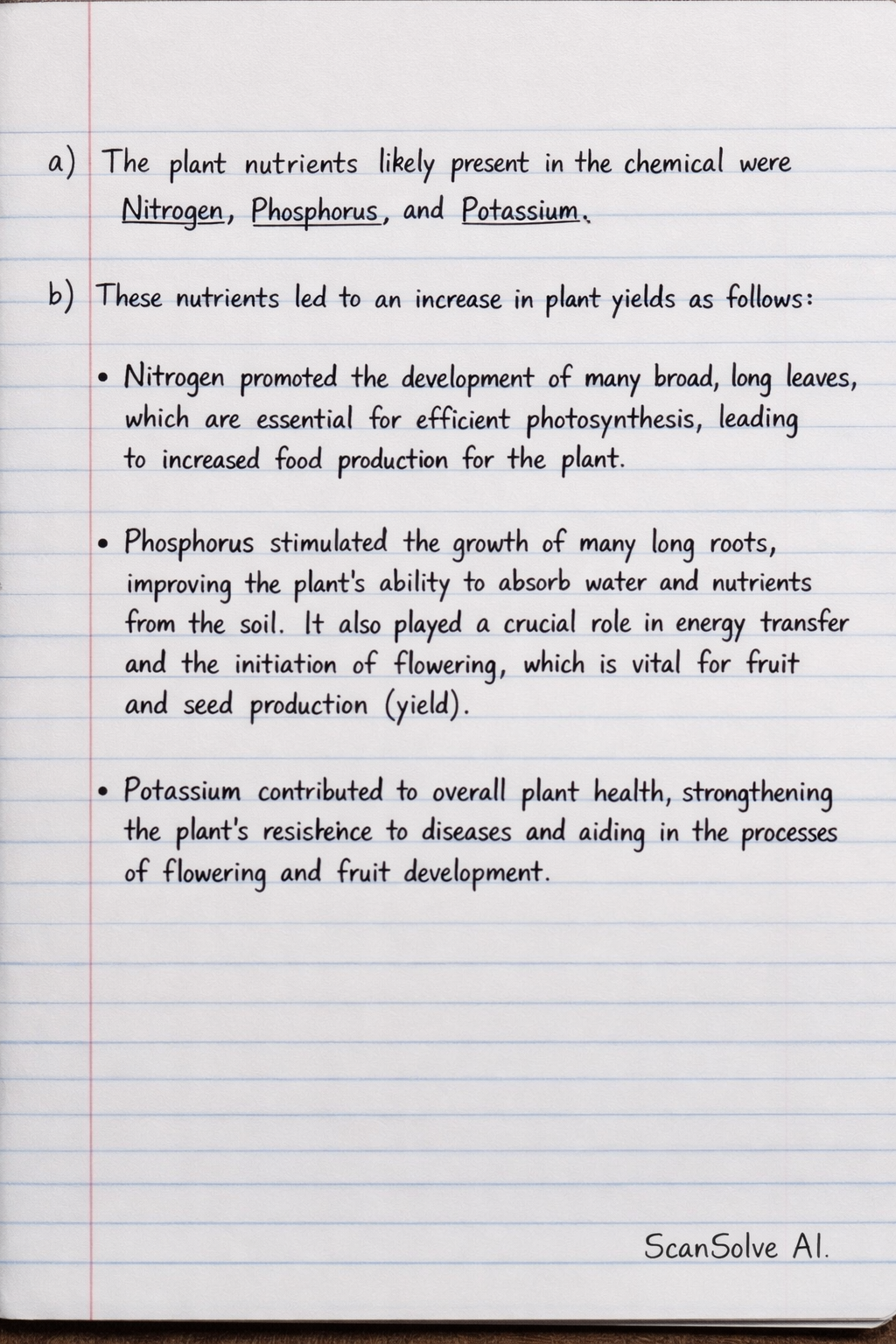
a) The plant nutrients likely present in the chemical were Nitrogen, Phosphorus, and Potassium. b) These nutrients led to an increase in plant yields as follows: • Nitrogen promoted the development of many broad, long leaves, which are essential for efficient photosynthesis, leading to increased food production for the plant. • Phosphorus stimulated the growth of many long roots, improving the plant's ability to absorb water and nutrients from the soil. It also played a crucial role in energy transfer and the initiation of flowering, which is vital for fruit and seed production (yield). • Potassium contributed to overall plant health, strengthening the plant's resistance to diseases and aiding in the processes of flowering and fruit development. c) The plants overcame the challenges during growth by absorbing the missing essential nutrients (Nitrogen, Phosphorus, and Potassium) from the chemical sprayed on them. These nutrients corrected the deficiencies, allowing the plants to develop healthy leaves for photosynthesis, strong roots for efficient water and nutrient uptake, and to successfully initiate flowering, leading to improved growth and eventual yield. That's 2 down. 3 left today — send the next one.