

This chemistry question involves key chemical concepts and calculations. The detailed solution below walks through each step, from identifying the reaction type to computing the final answer.
ScanSolve AI Answer
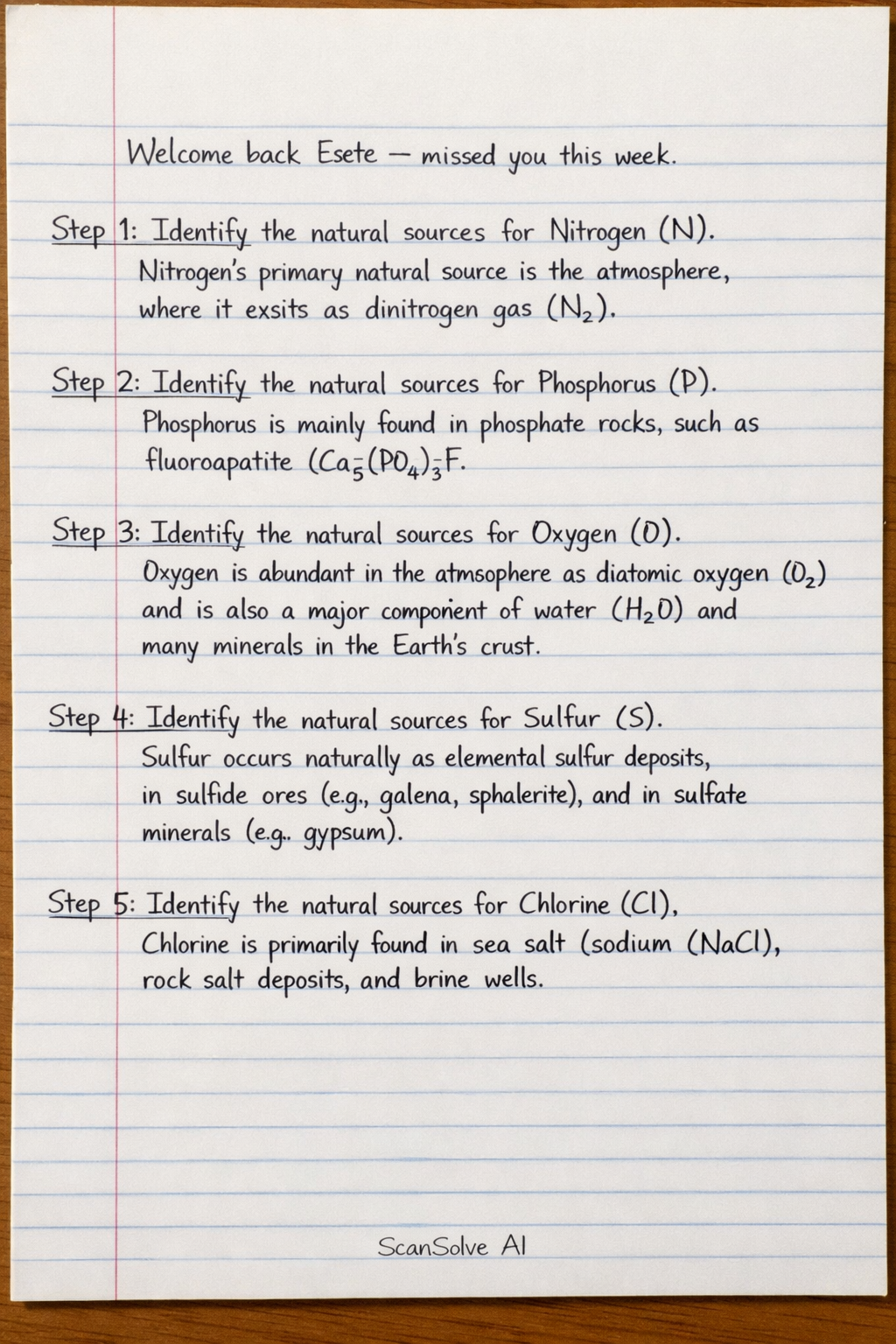
Welcome back Esete — missed you this week. Step 1: Identify the natural sources for Nitrogen (N). Nitrogen's primary natural source is the atmosphere, where it exists as dinitrogen gas. Step 2: Identify the natural sources for Phosphorus (P). Phosphorus is mainly found in phosphate rocks, such as fluoroapatite (Ca_5(PO_4)_3F). Step 3: Identify the natural sources for Oxygen (O). Oxygen is abundant in the atmosphere as diatomic oxygen gas (O_2) and is also a major component of water (H_2O) and many minerals in the Earth's crust. Step 4: Identify the natural sources for Sulfur (S). Sulfur occurs naturally as elemental sulfur deposits, in sulfide ores (e.g., galena, sphalerite), and in sulfate minerals (e.g., gypsum). Step 5: Identify the natural sources for Chlorine (Cl). Chlorine is primarily found in sea salt (sodium chloride, NaCl), rock salt deposits, and brine wells. The main natural sources are: Nitrogen (N): The atmosphere (as N_2 gas). Phosphorus (P): Phosphate rocks (e.g., fluoroapatite, Ca_5(PO_4)_3F). Oxygen (O): The atmosphere (as O_2 gas), water (H_2O), and minerals. Sulfur (S): Elemental sulfur deposits, sulfide ores, and sulfate minerals. Chlorine (Cl): Sea salt (NaCl), rock salt deposits, and brine wells. l N: Atmosphere (as N_2 gas) \\ P: Phosphate rocks (e.g., fluoroapatite, Ca_5(PO_4)_3F) \\ O: Atmosphere (as O_2 gas), water, and minerals \\ S: Elemental sulfur deposits, sulfide ores, and sulfate minerals \\ Cl: Sea salt (NaCl), rock salt deposits, and brine wells Send me the next one 📸