
We read your photo as:
Provide the principal industrial source of nitrogen and another element in Group VII. Describe the structure and bonding of CO2 and SiO2.
ScanSolve AI Answer
Answers
2 partsStep-by-step solution
5 stepsHere are the solutions to your questions:
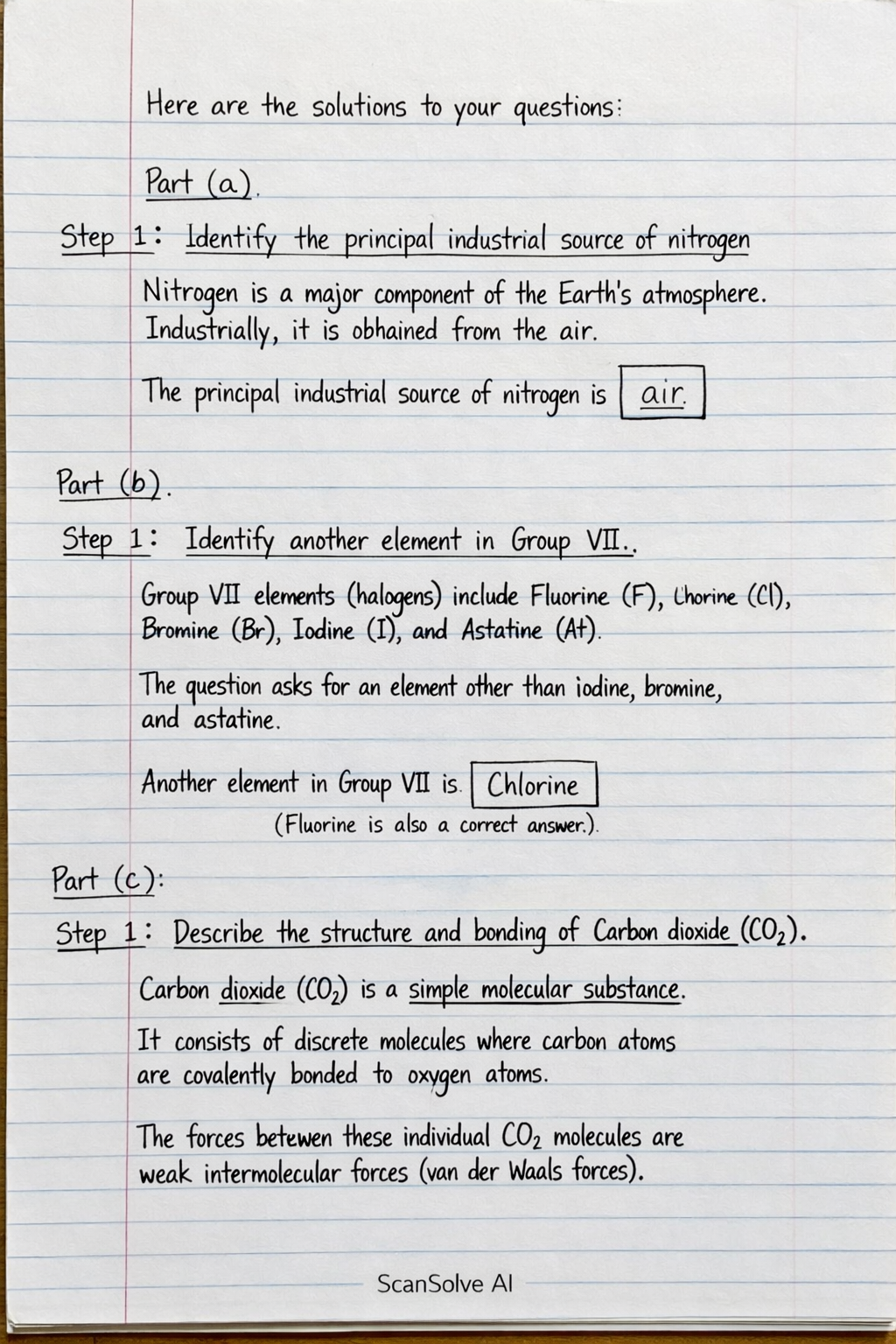
Part a· 1 step
Identify the principal industrial source of nitrogen.
Nitrogen is a major component of the Earth's atmosphere. Industrially, it is obtained from the air.
The principal industrial source of nitrogen is .
Part b
Identify another element in Group VII.
Group VII elements (halogens) include Fluorine (F), Chlorine (Cl), Bromine (Br), Iodine (I), and Astatine (At). The question asks for an element other than iodine, bromine, and astatine.
Another element in Group VII is . (Fluorine is also a correct answer).
Part c· 3 steps
Describe the structure and bonding of Carbon dioxide ().
Carbon dioxide () is a simple molecular substance. It consists of discrete molecules where carbon atoms are covalently bonded to oxygen atoms. The forces between these individual molecules are weak intermolecular forces (van der Waals forces).
Describe the structure and bonding of Silicon dioxide ().
Silicon dioxide () has a giant covalent structure (also known as a macromolecular structure). In this structure, each silicon atom is covalently bonded to four oxygen atoms, and each oxygen atom is covalently bonded to two silicon atoms, forming a continuous, extensive network of strong covalent bonds.
Explain the difference in physical properties based on structure.
Due to the weak intermolecular forces between molecules, very little energy is required to overcome them, which is why carbon dioxide has a low melting point and exists as a gas at room temperature. In contrast, the giant covalent structure of requires a large amount of energy to break the numerous strong covalent bonds throughout the entire network, resulting in a very high melting point and its existence as a solid.
Try one yourself
A new problem that tests the same skill.
Still stuck on this one?
Ask a follow-up, and the answer starts from this question.
More Chemistry Questions
Handwritten Step-by-Step Solution
Get this as a handwritten image on WhatsApp — like a tutor wrote it for you.
Try on WhatsApp